Atmore physician enters no-contest plea, will take anger management classes
An Atmore physician entered a no-contest plea to three battery counts and will complete anger management classes under a pre-trial diversion program.
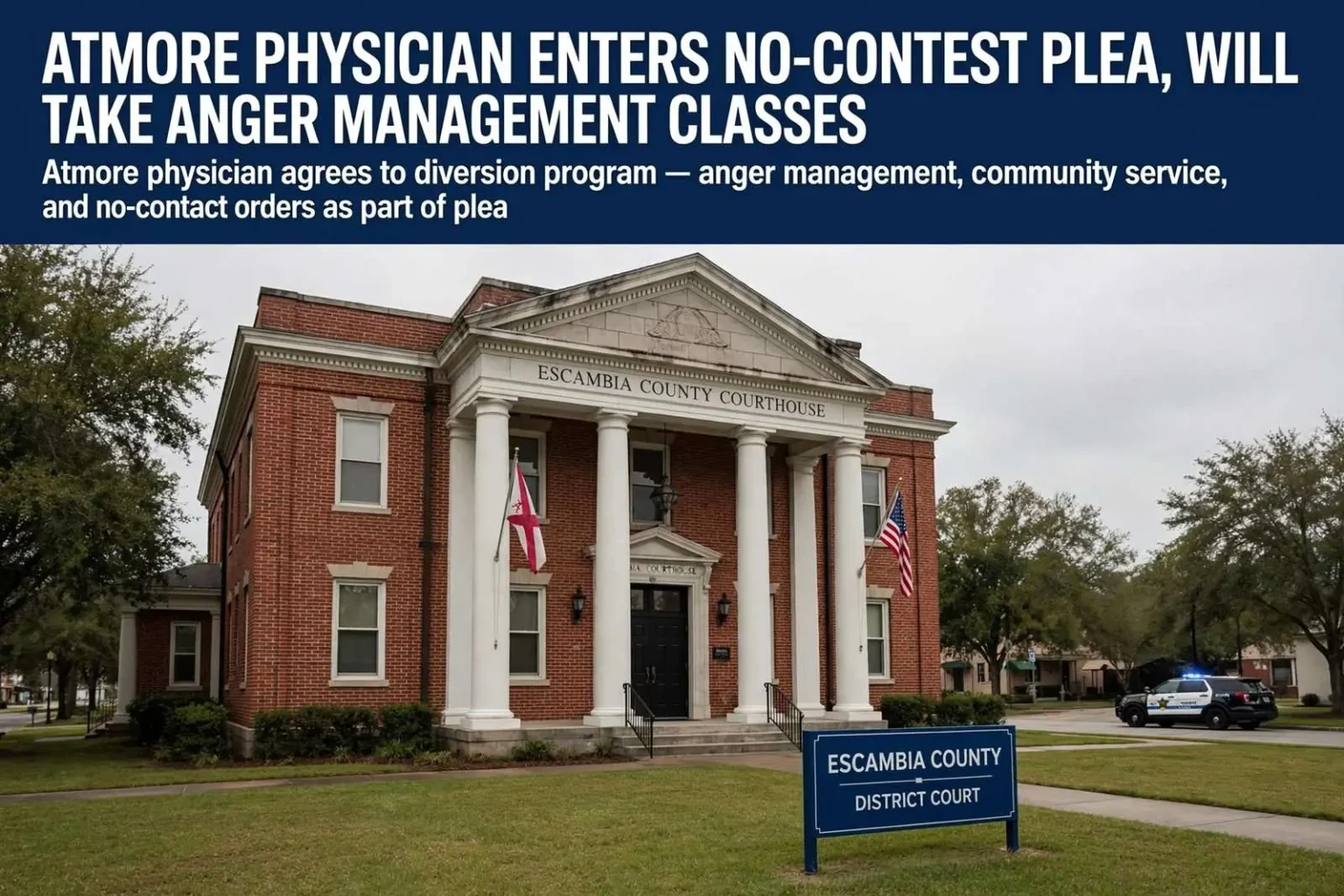
ATMORE, Ala. — An Atmore physician entered a no-contest plea Tuesday to three counts of battery stemming from an incident earlier this year, according to court proceedings, and will resolve the case through a pre-trial diversion program rather than proceed to trial.
Dr. William Shane Harigel entered the plea under an arrangement that places the charges on hold while he completes a supervised set of court-ordered conditions. Under the terms outlined in court, he must complete anger management classes, abstain from alcohol and drugs, and perform 25 hours of community service. He also has the option to pay a fee to buy out of the community service requirement.
In addition to the classes and service hours, Harigel will be subject to random urine tests for the duration of the program and is ordered to have no violent contact with the witness or victim in the case. Random screening is a standard feature of diversion agreements in the region, giving supervising officers a way to verify compliance with the abstinence condition without waiting for a formal violation report.
The battery charges followed an altercation earlier this year. According to an arrest report, the case involved a dispute with two of Harigel’s children, and he was instructed to have no contact with them as part of his court conditions. That no-contact directive runs alongside the order protecting the witness or victim, meaning the terms of the diversion agreement restrict his interaction with more than one party connected to the case.
What a No-Contest Plea Means in Alabama Courts
A no-contest plea, known formally in Alabama as a plea of nolo contendere, is neither an admission nor a denial of guilt. By entering it, a defendant accepts that the court may treat the charge as resolved without the state having to prove its case at trial, while the plea itself generally cannot be used as an admission of guilt in a separate civil proceeding. For defendants facing civil exposure — a consideration that can loom large in cases involving altercations — that distinction is often a central reason the plea is chosen.
Battery in Alabama’s misdemeanor framework is a Class A misdemeanor, the most serious misdemeanor classification on the books, carrying a potential penalty of up to a year in jail and fines if a conviction were entered. A single battery count can arise from unwanted physical contact that causes injury; prosecutors filed three counts in this case, reflecting the three separate charges to which the plea was entered.
Because the case is being handled through diversion rather than a conviction, the immediate practical consequences for Harigel differ from those that would follow a guilty plea. No sentence of jail time is imposed up front, and the charges remain pending in the court system until the program’s requirements are met or the agreement ends for some other reason.
How Pre-Trial Diversion Works in Alabama
Pre-trial diversion programs exist across Alabama’s court systems as an alternative to conventional prosecution, generally aimed at defendants charged with non-violent or lower-level offenses who have no extensive criminal history. The structure is broadly similar from one circuit to the next: the defendant agrees to a list of conditions, pays program-related costs, and remains under supervision for a defined period while the charges are held in abeyance.
Compliance is verified at regular intervals, typically through check-ins with a diversion officer, proof of enrollment and completion for required classes, documentation of community service hours, and the results of any ordered testing. If a participant completes every condition on schedule, the charges are usually dismissed at the end of the program. If a participant fails to comply — missing classes, testing positive for a prohibited substance, or violating a contact order — the state can move to terminate the diversion agreement and resume prosecution of the original charges.
The conditions imposed in this case track the standard menu of diversion requirements. Anger management courses address the conduct that gave rise to the charges, random urine tests back up the abstinence condition, and the community service component puts the participant to work on behalf of the community affected by the offense.
The Community Service Buy-Out Option
Court documents in the case note that Harigel has the option to pay a fee to buy out of the 25-hour community service requirement. Buy-out provisions appear in a number of Alabama diversion and probation agreements and are generally designed for participants whose work schedules, travel, or health limitations make completing hours in person difficult. The fees collected under such arrangements are typically directed to the program or to public-purpose funds designated by the court.
Twenty-five hours is a comparatively modest service requirement; diversion agreements in misdemeanor cases commonly impose service obligations that run substantially longer, particularly where the underlying offense involved injury to a person. The buy-out option does not shorten the other conditions — the anger management classes, the abstinence requirement, and the random testing all remain in place regardless of how the service hours are satisfied.
Anger Management and What the Classes Involve
Anger management classes ordered through Alabama courts are typically completed through certified providers in person or online, with participants receiving a certificate upon completion that is filed with the court or the supervising agency. The coursework generally covers recognizing triggers, de-escalation techniques, communication strategies, and accountability for behavior, with programs often running several weeks in structured sessions.
Courts impose the requirement most often in cases where the alleged conduct involved a personal dispute or a loss of temper, since the classes are designed to reduce the likelihood of a repeat incident. Completion is verified rather than assumed: a participant who fails to enroll, stops attending, or does not produce the completion certificate can be found out of compliance with the diversion agreement.
Atmore and the Escambia County Court System
Atmore sits in the northern reaches of Escambia County, near the Alabama-Florida line, and its municipal and district court matters are handled through the county’s court system, which is based at the Escambia County courthouse in Brewton. The county’s dockets cover everything from traffic offenses to felony preliminary hearings, and diversion programs there follow the framework used statewide under Alabama law, which authorizes pre-trial diversion for eligible defendants in both district and circuit court.
For a small city like Atmore, cases involving local professionals tend to draw community attention out of proportion to their legal profile, particularly when the charges involve a family dispute. Court records in the case identify the matter as stemming from a single incident earlier this year rather than a pattern of allegations, and the diversion outcome reflects that posture.
Why No-Contact Orders Matter in Family-Related Cases
The dual no-contact provisions in Harigel’s conditions — one covering the witness or victim and one covering his two children — mirror the way Alabama courts structure protective terms in cases where the parties involved are related. No-contact orders in diversion agreements are enforceable by arrest: a participant who reaches out to a protected party, whether directly or through a third party, risks termination of the program and reinstatement of the original charges.
In cases involving children, such orders are often paired with supervision by the family court or, in some matters, by the Department of Human Resources, though the terms in this case were described in court as conditions of the diversion program itself. The orders remain in effect for the life of the program unless the court modifies them.
What Comes Next
With the plea entered and the diversion terms set, the case now moves into its supervision phase. Harigel is expected to begin the anger management classes, complete the community service hours or pay the buy-out fee, and submit to random urine testing as directed by the supervising officers. The court will receive periodic updates on his compliance.
Diversion agreements of this kind run for a supervised period set by the court, with the length tailored to the offense and the conditions imposed. Programs built around classes and service hours are generally structured to give participants enough time to finish the requirements without returning to the docket every few weeks, and supervising officers report progress to the judge handling the case. In matters where the underlying dispute involved family members, courts also tend to monitor the no-contact conditions closely, since a violation of those terms ends the program faster than almost any other kind of non-compliance. The result is a case that stays active — and the defendant under court supervision — for the life of the agreement.
If he completes the program successfully, the three battery counts are expected to be dismissed under the terms of the diversion agreement, closing the case without a conviction. If he does not, the state retains the ability to prosecute the original charges, and the no-contest plea can be treated as an admission for purposes of moving the case forward. Either way, the no-contact conditions remain binding until the court says otherwise, and any violation of them can independently trigger a return to prosecution.