Atmore Police Say Corrections Officer Charged With Child Abuse
Atmore police say an Alabama corrections officer was arrested in April and charged with willful abuse of a child after officers found injuries.
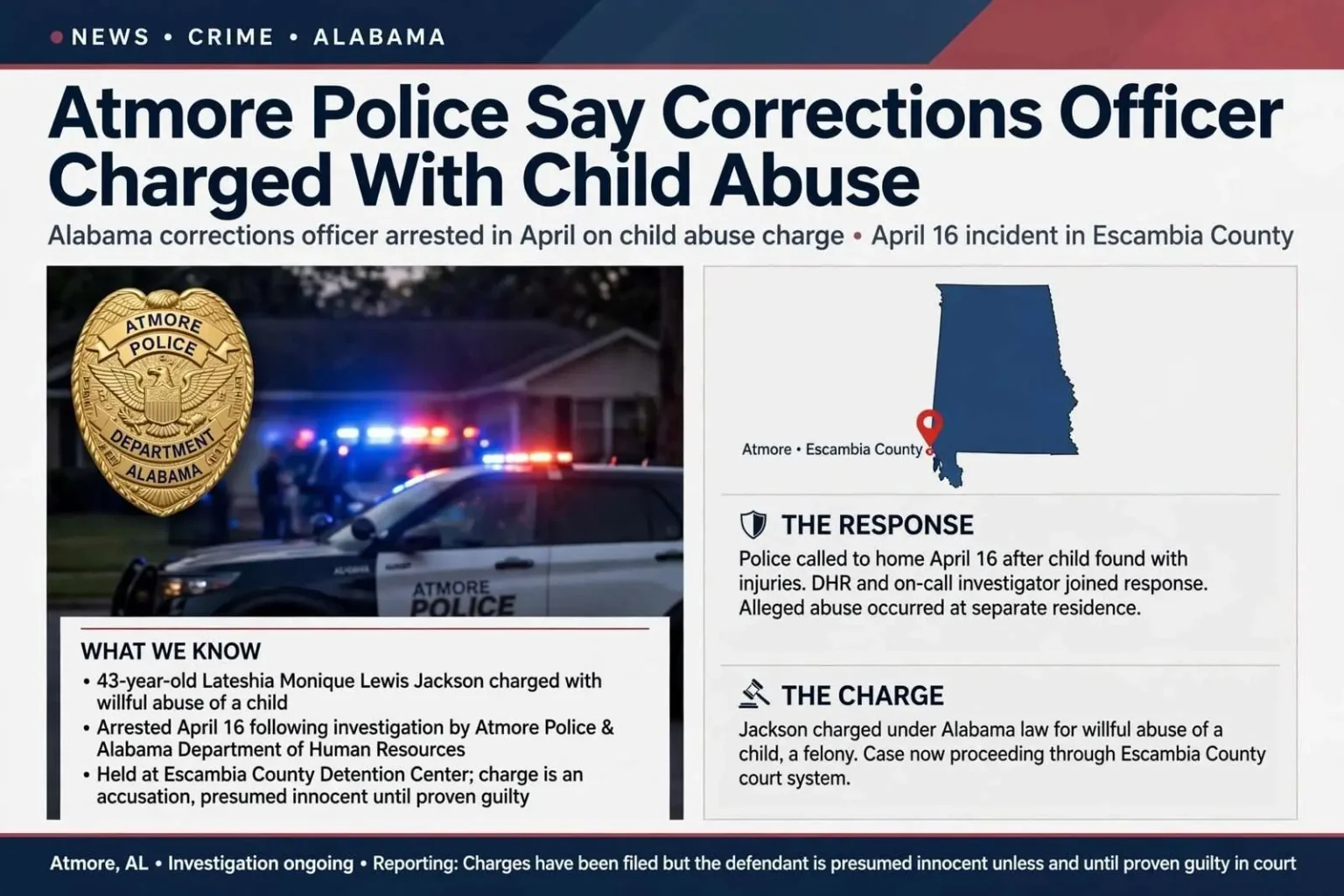
An Alabama corrections officer was arrested in April on a child abuse charge, according to a release from the Atmore Police Department.
Police said officers were called to a home on April 16 for a report of child abuse. Officers found a child with injuries and notified the Alabama Department of Human Resources along with an on-call investigator.
According to the department, the investigator concluded that Lateshia Monique Lewis Jackson, 43, had caused the child’s injuries. Jackson, whose relationship to the child was described as stepparent, was arrested and charged with willful abuse of a child and taken to the Escambia County Detention Center.
Police said the alleged abuse did not occur at the residence officers were originally called to, but at a different home. The charge is an accusation, and Jackson is presumed innocent unless and until proven guilty in court.
How the Response Unfolded
The sequence described by Atmore police follows the standard protocol Alabama agencies use when a child is found injured under suspicious circumstances. Responding officers secured the scene and attended to the child’s immediate safety, then brought in the Alabama Department of Human Resources, the state agency charged with protecting children from abuse and neglect. An on-call investigator joined the response, a step that places a trained specialist in the case from the earliest hours rather than leaving the inquiry to patrol officers alone.
That structure exists for a reason. Child abuse investigations demand specialized interviewing techniques, medical assessment of injuries and careful documentation that ordinary patrol work is not designed to provide. By notifying DHR at the scene and activating an investigator the same day, Atmore officers put the case on a track designed to hold up through prosecution while protecting the child from further contact with a suspected abuser.
The detail that the alleged abuse occurred at a different residence than the one officers were called to illustrates how these cases often develop. Initial reports can come from a location — a school, a relative’s home, a hospital — far from where the injury happened, and establishing where an injury actually occurred matters legally for jurisdiction, for search authority and for the physical evidence investigators collect.
The Charge and What It Carries
Jackson was charged with willful abuse of a child, an offense under Alabama law that covers the intentional mistreatment or cruel punishment of a child under the age of 18. The statute is a felony in Alabama’s criminal code, and convictions carry significant prison terms, which is why cases of this kind are handled with intensive investigation before charges are filed.
The role of the investigator in concluding that Jackson caused the child’s injuries reflects how charging decisions are built in these cases. Investigators synthesize medical findings, statements, scene evidence and the child’s condition before presenting a case, and the arrest follows a judgment that the evidence supports the charge. That judgment now faces the test it is designed for: the adversarial process of the courts, where the accused has the right to counsel, to challenge the evidence and to require the state to prove every element of the offense beyond a reasonable doubt.
Jackson’s employment as a corrections officer adds a professional dimension to the case but no legal one — the charge concerns events in a private home, not her duties. Her employer status typically becomes relevant only in administrative terms, as state correctional agencies maintain their own conduct standards and review processes for employees facing criminal charges. The Atmore release did not identify the facility where she worked.
The Agencies Involved
The Alabama Department of Human Resources operates the state’s child protective system, with county offices staffed by social workers who assess abuse reports, arrange for children’s safety and coordinate with law enforcement on criminal cases. In Escambia County, DHR’s involvement in a case like this one continues after the arrest: the agency determines what arrangements protect the child during the legal process, whether placement with relatives, foster placement or supervised conditions at home.
Atmore itself sits in the northern reaches of Escambia County, near the Florida line, a city of roughly 10,000 residents best known regionally as home to major correctional facilities and as a stop along the historic Louisville and Nashville railroad corridor. The Atmore Police Department handles municipal law enforcement, working alongside the Escambia County Sheriff’s Office, which covers the surrounding county.
The Escambia County Detention Center, where Jackson was taken following her arrest, serves as the county jail, housing pretrial detainees and sentenced inmates under the authority of the county sheriff. Booking at the facility creates the formal arrest record — the charges, the bond determination and the personal information that become the public record of the case as it moves toward district and circuit court.
Child Abuse Cases in the Alabama Courts
Willful abuse of a child cases move through Alabama’s court system beginning in district court, where bond is set and preliminary hearings determine whether sufficient evidence exists to send the case to a grand jury. Prosecutors in the Escambia County District Attorney’s office handle the state’s case, relying heavily on medical evidence and investigative records assembled in the first days after an arrest.
The involvement of both DHR and law enforcement creates a dual track that is standard in Alabama child welfare practice. The criminal case addresses punishment and public accountability; the dependency side, handled in juvenile court, addresses the child’s living situation and long-term welfare. The two proceedings run in parallel, and information from the criminal investigation informs the decisions juvenile judges make about custody and family reunification.
Advocates for child welfare in Alabama note that the system’s early hours are its most critical. The protocol Atmore police followed — immediate notification of DHR, activation of an on-call investigator, and swift arrest once evidence pointed to a perpetrator — is designed to compress the time between a report and protection. Delays in that window are where children remain at risk, which is why departments across the state train their officers on the coordination steps as a matter of routine.
What Comes Next in the Case
From here, the case proceeds through the standard stages of an Alabama criminal prosecution. Jackson will be arraigned on the charge, at which point she will enter a plea and the court will address bond conditions. Discovery will follow, with prosecutors providing the defense access to the investigative file, medical records and statements gathered by the Atmore Police Department and the on-call investigator.
The presumption of innocence that anchors the process is not a formality — it is the operating rule of every stage that follows. The state bears the burden of proof throughout, and an arrest, a charge or an accusation reported by police carries no legal conclusion about guilt. Only a conviction, by plea or by a unanimous jury verdict after trial, establishes criminal responsibility, and defendants in cases of this kind challenge the evidence at every step.
Timeline in cases like this one varies with the court docket, the complexity of the medical evidence and whether the case resolves by plea or proceeds to trial. Child abuse prosecutions in Alabama frequently take many months from arrest to resolution, with the dependency proceedings concerning the child’s welfare often concluding on a separate track.
Recognizing and Reporting Abuse
Cases that begin with a call to police, as this one did on April 16, highlight the role ordinary residents play in child protection. Alabama law requires certain professionals — teachers, doctors, nurses, social workers, day care employees and others — to report suspected abuse or neglect, but any resident can make a report, and reports can be made to local police, to the county DHR office or through the state’s centralized reporting system.
Authorities stress that callers do not need certainty to report; the threshold is reasonable suspicion, and the assessment of whether abuse occurred belongs to investigators, not to callers. Reports can be made anonymously, and the law provides immunity for good-faith reports. The alternative — a child left in a dangerous situation because a neighbor hesitated — is the outcome the reporting system is built to prevent.
In the Atmore case, the response that began with a report to police ended with an arrest within days, following the pattern child protection advocates describe as the system working as designed. The child’s injuries prompted a same-day response, the state’s child welfare agency was engaged immediately, and a specialized investigator built the case that led to the charge against Jackson.
The Escambia County court record will now determine the legal outcome. Until a court decides otherwise, the charge against Lateshia Monique Lewis Jackson remains exactly what the police department described it as in its release: an accusation, with the presumption of innocence attached until the state proves its case or the process concludes some other way.