
Atmosphreak’s Soul Kitchen Set Featured on ‘Just Live Music’
The Just Live Music web series films Mobile band Atmosphreak's uninterrupted set at Soul Kitchen — one band, one take, no commercial breaks.
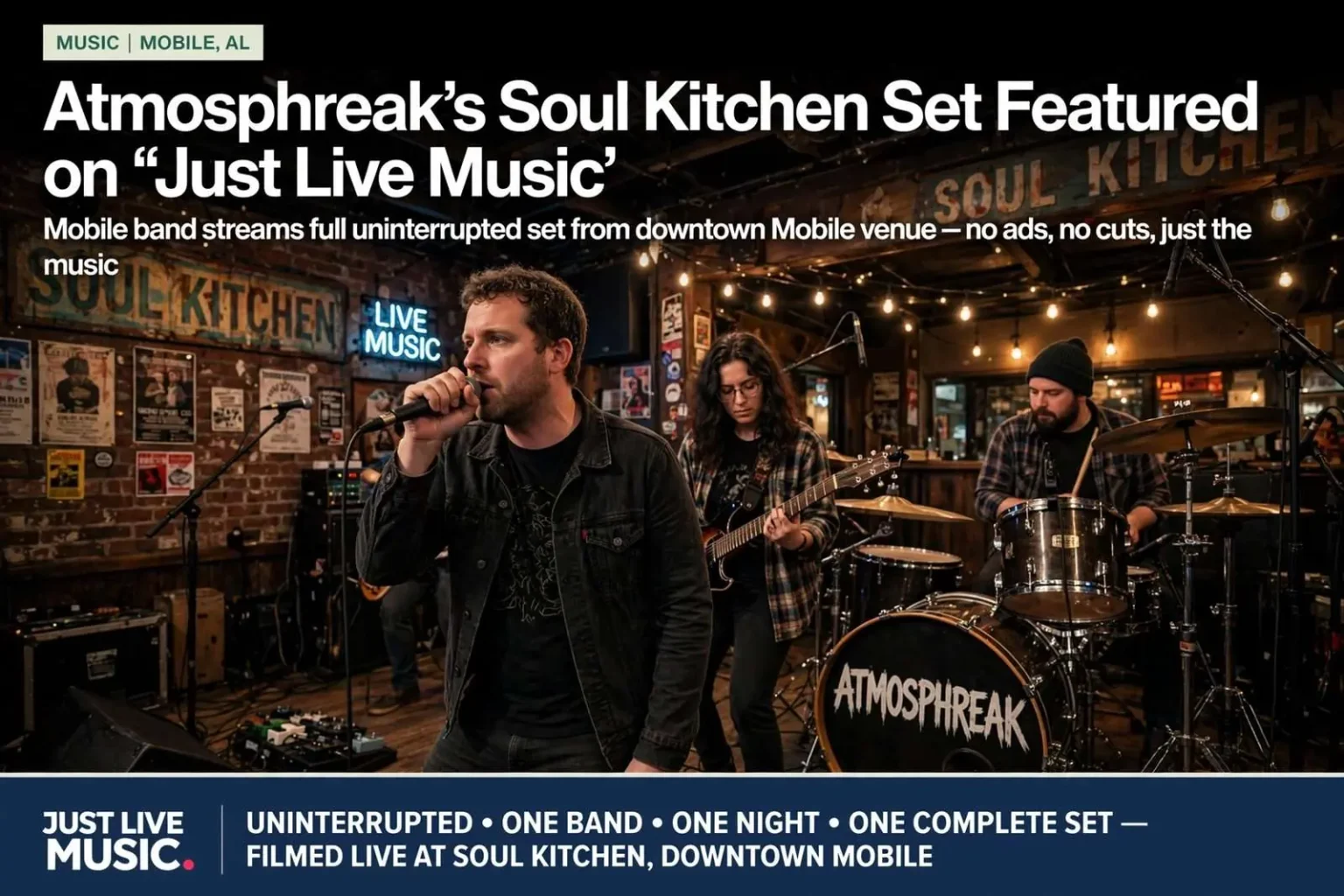
Mobile band Atmosphreak takes the spotlight in an episode of Just Live Music, the web series that films full uninterrupted sets at Soul Kitchen. The series keeps things deliberately stripped down: one band per episode, a brief meet-and-greet, and then the complete set with no commercial interruptions.
Instead of cutting to ads mid-song — which forces shows to be chopped up and trims how many songs make air — the production runs a small banner along the bottom of the screen to cover costs. The producers note a typical TV program burns six minutes an hour on commercials; on Just Live Music, those six minutes stay music.
The format gives viewers a fuller sense of what a band actually delivers on stage, song after song, which is exactly what the Atmosphreak episode sets out to capture from the Soul Kitchen stage in downtown Mobile.
The premise is simple enough that it raises the question of why nobody does it: point cameras at a band, let them play their set from first note to last, and put it on screen the way the people in the room experienced it. No host interviews mid-show, no ad breaks slicing the setlist, no editing down to a radio-friendly single and a snippet of the rest. Just Live Music builds its entire identity around that refusal, and the Atmosphreak episode puts a homegrown Mobile act at the center of it.
The choice of venue matters as much as the choice of band. Soul Kitchen has spent years as one of downtown Mobile’s central live music rooms, a stage that hosts touring acts and local bands on a regular schedule and draws the kind of audience that comes to hear a set, not to talk over one. Filming there gives the series a real room — real sightlines, real crowd noise, real acoustics — rather than a television studio dressed up to look like a club.
What gets lost on regular TV
The series’ producers frame their format as a correction to how television has always treated music. A typical broadcast hour carries six minutes of commercials, and music programming pays that cost in the worst place: the songs. To make room for advertising, a televised set gets chopped into fragments, the pacing gets dictated by break timing rather than the music’s own arc, and bands that open strong or build slowly across a set get trimmed to whatever fits the remaining airtime.
Any working musician will tell you that a live set is a single sustained shape — the way the band sequences songs, when it breathes, how the energy gathers across an hour. Cut the middle out and what remains is not the band’s show; it is a highlight reel pretending to be one. That is the gap Just Live Music set out to close, and its solution is old-fashioned in the extreme: film the whole thing, let the setlist stand as the band wrote it, and monetize the screen without interrupting the sound.
The small banner running along the bottom of the picture is the compromise that makes the format possible. Sponsorship messages ride along quietly instead of stopping the show, a trade-off most viewers will take without hesitation when the alternative is a song cut off in the middle. The producers’ arithmetic makes the case plainly — those six minutes an hour that television spends selling things are six minutes an hour that this series spends playing them.
One band, one night, one complete set
Each episode follows the same lean structure. One band, filmed for a single episode. A brief meet-and-greet that introduces the musicians as people rather than a stage presence. Then the complete set, uninterrupted, from the first song to the last number the band plays that night.
The meet-and-greet segment does more work than its brevity suggests. Live music television has a long history of treating bands as interchangeable providers of soundtrack, and a few minutes of conversation — where the band is from, what it plays, what the songs are about — gives the set that follows a context that makes it easier to hear. For a local band like Atmosphreak, playing for an audience that extends well beyond the people who were in the room at Soul Kitchen that night, the introduction is the difference between being seen and being understood.
The format also documents something that usually disappears. A band’s live show exists in full only for the people present when it happens; everyone else encounters it in fragments — a phone video, a single, a friend’s description. An episode that preserves the entire set, filmed properly in a real venue, becomes a record of where the band stood on a specific night: the arrangements as played, the songs as sequenced, the crowd as it responded. Bands that grow from local scenes into regional draws rarely have that kind of complete early documentation, and the series is quietly building an archive of it for the Gulf Coast.
Mobile’s scene, on screen
The Atmosphreak episode arrives at a moment when Mobile’s music community has more stages, bands and audiences than it gets credit for outside the city. Downtown’s venues — Soul Kitchen chief among them — host original music several nights a week, and local acts fill the calendar around the touring shows. What the scene has historically lacked is wider visibility: a Mobile band’s reputation tends to stop at the city limits unless the band hits the road, and most working local bands cannot tour often enough to build a following that way.
A web series changes that calculus. Unlike broadcast television, which reaches whatever audience a channel happens to have, an episode posted online travels to whoever searches for it, shares it, or follows the band — and it stays there. A viewer in another state who wants to know what a Mobile band sounds like live can watch the entire set rather than a ninety-second clip. For the band, the episode functions as both a performance and a calling card; for the city’s scene, each episode is one more piece of evidence that the music happening here deserves the wider audience.
Filming at Soul Kitchen rather than a made-for-TV set keeps that story honest. The room’s character — its sightlines, its crowd, its sound — is part of what viewers see, and the series’ refusal to interrupt means the venue’s atmosphere carries through the whole episode instead of being reset at every commercial break. The band plays the room, and the room shows through.
For Atmosphreak, the episode is a full hour-plus demonstration of what the band does: not a single song promoted by the constraints of television time, but the complete set, first song to last, exactly as the band built it for the Soul Kitchen stage. That is the promise the series makes to every band it films, and it is why the format’s small banner at the bottom of the screen is a fair price — six minutes an hour that stay music instead of commercials, and a Mobile band finally shown whole.
The economics behind the format are worth spelling out, because they explain why so little television looks like this. Commercial television exists to deliver audiences to advertisers, and programs are built around that purpose — the breaks are not an imperfection, they are the business model. A music series that refuses the breaks has to refuse the model with them, which is why Just Live Music sells a quiet banner instead of loud interruptions and keeps its production lean: one band, one night, one camera crew at Soul Kitchen rather than a stage production.
That lean approach also frees the filming itself. Without ad breaks to build toward, cameras can follow the set’s natural rhythm — lingering on the crowd between songs, catching the band’s quiet moments rather than cutting away — and the episode that results feels closer to a documentary than a broadcast. The meet-and-greet segment that opens the episode sets that tone: a few minutes of introduction, then the band left alone to play.
Why a complete set matters for a band like Atmosphreak
Local bands live and die on live performance. A Mobile band without a record label or national touring circuit builds its audience the same way bands always have — one show at a time, room by room, until the people who saw the set tell the people who missed it. A filmed, uninterrupted set collapses that timeline: it is a show anyone can attend, at any time, and it shows the band doing the thing that wins fans — playing.
A full set also lets listeners hear depth that singles hide. A band’s repertoire is more than its catchiest song, and the sequencing of a live show — what opens, what follows, what closes — is a craft in itself that gets lost when television takes one track and a chorus. The Atmosphreak episode preserves those choices, and viewers who respond to one song can hear the others in the order the band intended, with the transitions and pauses intact.
There is a final, practical benefit for the band itself. Footage of a complete, well-filmed live set becomes the raw material of a band’s next step: booking agents outside Mobile can see the show without traveling to it, venues in other cities can gauge the draw, and fans can share something better than a shaky phone clip. An episode of Just Live Music is, in that sense, an investment a band keeps drawing on long after the night at Soul Kitchen has passed.
For the series, the Atmosphreak episode is one more entry in the argument it has been making since it started: that music on screen should be music first, and that the six minutes an hour television spends on commercials — six minutes that, multiplied across a career of televised sets, amount to thousands of songs listeners never got to hear — belong to the bands instead. At Soul Kitchen in downtown Mobile, for one episode, they did.


