
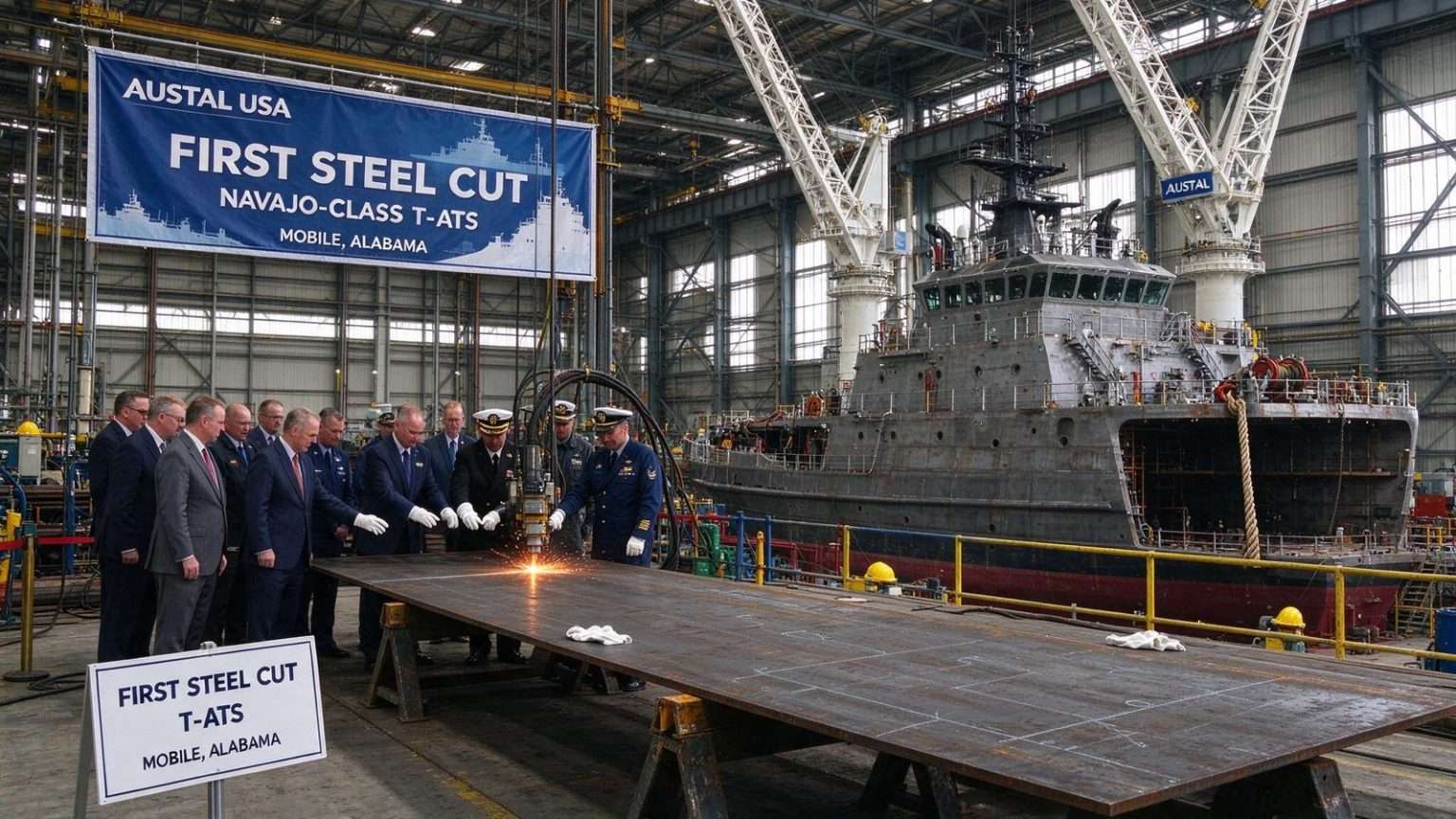
MOBILE, Ala. — The city’s largest private employer is entering a new chapter: Austal USA kicked off construction of its first steel-hulled ship at its Mobile riveryard, marking a major shift for a shipbuilder long known for aluminum vessels. The company held a ceremony marking the start of fabrication of a Navajo-class Towing, Salvage and Rescue Ship, known as T-ATS.
U.S. Rep. Jerry Carl joined Austal executives and Navy officers for the event, which celebrated the award the company landed the year before. The contract opened a production line unlike any Austal has run in Mobile, and the first cuts of steel signaled the beginning of a shipbuilding era that will define the yard’s next decade.
According to the Navy, T-ATS ships will provide ocean-going tug, salvage and rescue capabilities to support fleet operations, built on a multi-mission common hull capable of towing heavy vessels. The class replaces the older Powhatan-class fleet tugs and Safeguard-class salvage ships that have served the fleet for decades, consolidating those missions into a single modern platform.
What the Navajo Class Does
The Navajo-class ships are workhorses rather than warships, but the fleet cannot operate without them. Open-ocean towing moves disabled vessels, barges and dry docks across thousands of miles of water; salvage missions recover stranded or sunken craft and clear harbors after storms; and rescue missions answer emergencies at sea, from sailor medevacs to disaster response along the coasts.
The multi-mission common hull design means one ship type can perform all three roles, carrying the towing gear, salvage equipment and rescue capabilities in a single package. Ships in the class are crewed by civilian mariners under the Navy’s Military Sealift Command, freeing Navy sailors for warfighting billets while the auxiliary fleet handles the logistics and support work that keeps ships moving.
For the Navy, the class is part of a broader rebuilding of the auxiliary and support fleet, and for Austal it is the entrance ticket to a market the Mobile yard had never accessed: steel shipbuilding for the United States Navy.
Why the Switch to Steel Matters
The design represents a departure for the Mobile shipyard. Austal’s existing military production lines, the Littoral Combat Ship and the Expeditionary Fast Transport program, are both aluminum-hulled platforms, built with the aluminum fabrication expertise of the company’s Australian parent. Aluminum keeps those ships light and fast, which is precisely what their missions demand.
Steel is a different material with a different industrial rhythm. Heavier, slower and built to different standards, steel hulls require different welders, different panels and different production flow, which is why Austal invested in new steel fabrication facilities at the Mobile riveryard before the first plate was cut. Moving into steel opens the door to additional Navy auxiliary and support ship programs and helps steady the workload at the yard as earlier aluminum contracts wind down.
The workload question is central to the yard’s future. The Littoral Combat Ship production run, which made Mobile one of the Navy’s busiest construction sites, is finite, and every shipbuilder faces the challenge of bridging from one program to the next. The T-ATS contract, with multiple ships in the class, provides that bridge, and it positions Austal to compete for the steel-hulled programs the Navy will award over the coming years.
Austal’s Place in Mobile
Austal operates one of the largest shipbuilding facilities on the Gulf Coast along the Mobile River, and the company ranks among the biggest private employers in the city, supporting thousands of jobs in the region. The yard’s sheds and cranes dominate the Mobile riverfront, and the company’s payroll ripples through the regional economy in subcontractors, suppliers, training programs and the service businesses that grow around any major industrial employer.
The yard’s growth story is one of the defining industrial stories of modern Mobile. Austal arrived in the city in the early 2000s and expanded rapidly after winning Navy contracts, building the aluminum-hulled Littoral Combat Ships and Expeditionary Fast Transports that put the city’s name on hulls serving around the world. Generations of Mobile-area welders, pipefitters and shipfitters have trained into the trade on those programs.
Rep. Jerry Carl’s presence at the fabrication ceremony reflected the district’s stake in the yard’s future. Mobile’s congressional representatives have historically championed the shipbuilding industry, and the shift to steel gives the region’s federal delegation a new set of programs to support in the annual defense and Navy budget cycles.
The Navy’s Gulf Coast Shipbuilding Hub
The central Gulf Coast has become one of America’s most important shipbuilding regions, with major yards in Mobile, Pascagoula and the Louisiana parishes building much of the Navy’s surface fleet. The concentration of yards, suppliers and skilled labor means competition for Navy work plays out across state lines in the same regional labor market, and each new program strengthens the whole ecosystem.
Austal’s entry into steel shipbuilding deepens the region’s portfolio. The Navy’s auxiliary fleet, logistics ships, tugs, rescue craft and support vessels, is the quiet backbone of naval operations, and the Navajo-class program distributes that work to yards capable of executing it efficiently. Mobile’s riveryard, with its riverfront access and expanding steel facilities, was positioned to compete, and the award the year before proved the case.
For the region’s workforce pipeline, the new program means years of steady steel fabrication work. Shipbuilding employment follows contracts, and a class with multiple hulls provides the continuity that allows workers to build careers rather than chase single-ship jobs. That continuity is what local community colleges and training programs build curricula around.
The Ceremony and What It Marked
Fabrication-start ceremonies are the shipbuilding industry’s public milestones, the moment a program moves from drawings and contracts to cut steel. For Austal, the event gathered company executives, Navy officers and Congressman Carl to mark the transition, and it carried the added weight of a first: the first steel hull the Mobile yard had ever begun for the Navy.
Such ceremonies also serve the workforce. Shipbuilders who have spent years on aluminum programs watched the yard’s identity change, and the public commitment of a new class gives employees, applicants and suppliers a reason to invest in the yard’s future. The Navy, for its part, uses the milestones to signal program progress to Congress, where every shipbuilding budget line is examined annually.
The award the company landed the year before set all of it in motion. Navy contract awards of this kind fund detailed design, material procurement and the long production ramp that leads from first steel to launch, and the Mobile yard’s ability to win the work confirmed its standing in the Navy’s industrial base.
From Aluminum Speed to Steel Endurance
The two materials define two philosophies of naval shipbuilding. Aluminum’s light weight lets a Littoral Combat Ship sprint at speeds conventional warships cannot match, and the same quality makes the Expeditionary Fast Transport the fastest way to move troops and cargo in theater. Steel trades that speed for toughness, endurance and the capacity to carry heavy towing and salvage gear across oceans.
The Navajo class needs those steel qualities. A ship designed to tow a disabled warship or a massive dry dock must anchor its strength in the hull itself, and salvage operations demand a platform that can take a beating and keep working. Steel’s repairability and ruggedness make it the only sensible choice for missions where the ship itself may be the tool of the rescue.
Running both production philosophies in one yard is rare in American shipbuilding, and Austal’s leadership has described the company’s future as a two-material operation: aluminum programs finishing out alongside the growing steel line. Managing that transition, with separate facilities, training tracks and quality systems, is the operational challenge behind the celebratory first cut.
What It Means for Mobile’s Economy
Each major shipbuilding program in Mobile supports thousands of direct and indirect jobs, and the steel program’s arrival extends the horizon of that employment. The yard’s expansion into steel fabrication involved new construction along the riverfront, new equipment and new hires, all of which entered the local economy before the first hull took shape.
The regional supplier network benefits as well. Steel plate, pipe, electrical systems, valves and the thousands of components a Navy auxiliary ship requires flow through Gulf Coast distributors and manufacturers, and programs that run for years allow those suppliers to invest alongside the yard. Mobile’s port infrastructure and industrial riverfront make the city a natural hub for that supply chain.
The long-term stakes are larger than one class of ships. The Navy’s shipbuilding plans call for a growing fleet over the coming decades, and yards that prove themselves on auxiliary programs position themselves for the larger hulls that follow. Austal’s first steel ship is therefore more than a tug, salvage and rescue vessel in embryo; it is the test case for whether Mobile can build the Navy’s workhorse fleet for a generation.
For now, the yard marks the milestone that matters today: steel cut, fabrication underway and a new chapter open for the city’s largest private employer, with a Navajo-class hull rising on the Mobile River and the nation’s fleet operations standing to gain the tug, salvage and rescue capability the class promises.


