
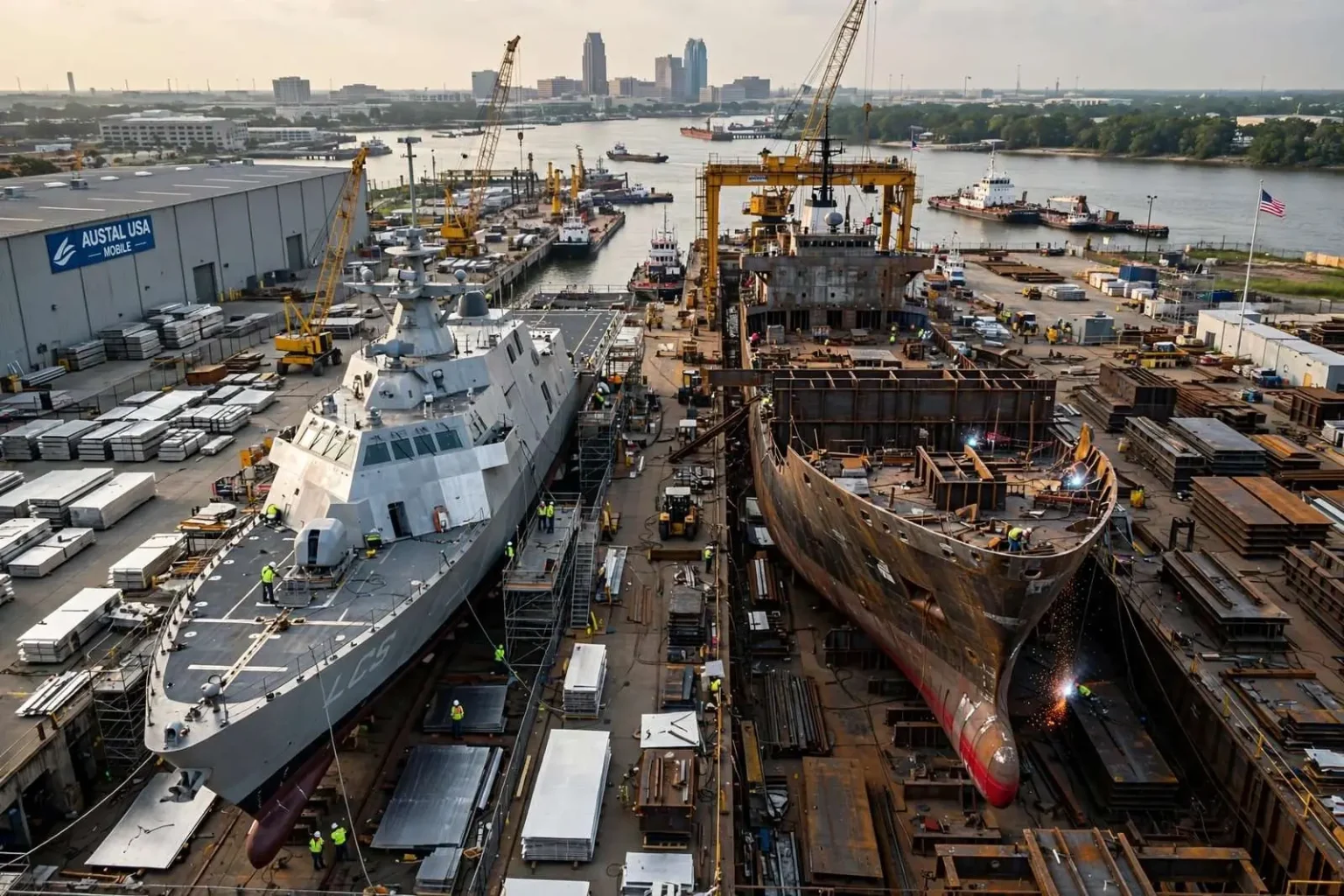
Austal founder John Rothwell expects the company’s Mobile shipyard to stay busy long after the Navy stops ordering Littoral Combat Ships, with the American operation converting at least half of its capacity to steel shipbuilding. The forecast from the Australian shipbuilding pioneer — who built Austal from a Western Australia ferry yard into the Navy’s aluminum-hull specialist — amounts to a strategic pivot for the Mobile River yard, which has spent nearly two decades as the backbone of the LCS program.
Speaking in a podcast interview with Blenheim Partners, Rothwell said he believes Austal USA could still land additional orders for its aluminum Expeditionary Fast Transport vessels, but the same is not true for the aluminum-hulled LCS. “There are probably no more (aluminum) warships,” Rothwell said, summing up the Navy’s direction: the surface fleet of the future is expected to be built predominantly of steel, and the yards that want to keep building warships will need to build in that material.
An even split ahead
The U.S. Navy has ordered 19 Independence-variant LCS from Austal since 2006, and six of the final seven were under construction in Mobile when Rothwell spoke. The program, which pairs Austal’s trimaran design with Lockheed Martin’s systems integration, made the Mobile yard one of the largest industrial employers on the Gulf Coast and filled its massive riverfront facility with hull after hull of the fast, flight-deck-topped warships.
The military has ordered 15 Spearhead-class EPFs since 2010, with two of the final three then being built on the Mobile River. The EPF, a 338-foot aluminum catamaran capable of carrying vehicles and troops at speeds conventional transports cannot match, shares its DNA with the commercial ferries that built Austal’s reputation and has served in missions ranging from disaster relief to special operations support.
To prepare for what comes next, the Navy awarded Austal a $50 million grant to convert part of its production to steel, which the company is matching with its own investment. Steel shipbuilding requires different panels, different welding and handling equipment, and different fabrication lines than aluminum — the conversion is a physical rebuilding of parts of the yard, not a paperwork exercise.
Rothwell said he expects the Mobile operation to be split evenly going forward — half of it continuing to build aluminum ships, the other half focused on steel. The balance preserves the aluminum expertise that made the yard valuable while opening the door to programs that would otherwise be closed to a non-steel builder. Rothwell said the U.S. government encouraged the conversion because it will be needed to meet the Navy’s future steel-ship requirements, an acknowledgment that the industrial base — not just the design offices — constrains what the fleet can order.
The logic behind the government’s push is straightforward. American shipbuilding capacity has contracted for decades, and the Navy’s construction plans regularly exceed what the remaining yards can build. Every major yard that can handle steel naval work adds national capacity, and a Mobile operation split between aluminum and steel effectively becomes two shipyards in one — able to bid on the full range of auxiliary, support and combat programs the Navy and Coast Guard expect to fund.
For Mobile, the stakes are employment at scale. The Austal USA campus along the Mobile River, directly across from the city’s downtown skyline, supports thousands of direct jobs and many more in the supplier network that feeds it — machine shops, paint and coating contractors, electrical houses and the service economy that surrounds a major industrial payroll. A yard that pivots smoothly into steel work keeps that ecosystem intact through the transition; one that stalls does not.
Ferries and fleet servicing
Beyond warships, Rothwell pointed to growing worldwide demand for high-speed aluminum ferries, the commercial cousin of the EPF design. Austal built its name on fast ferries — the company’s craft carry commuters and vehicles on routes from Asia to Europe to the Caribbean — and the global push toward faster, more efficient passenger and vehicle vessels has kept order books full across the commercial market. Mobile’s aluminum line remains well positioned to compete for that work alongside defense contracts.
He also said Austal planned to open a dry dock in the San Diego area to service LCS hulls and other Navy ships, extending the Mobile-built vessels’ working lives. The service business is a natural extension for the builder: the Independence-variant fleet will sail for decades, and the ships require regular maintenance windows that are easier to schedule at a dedicated West Coast facility near the fleet’s homeports than thousands of miles from the building yard.
The servicing plan also reflects a broader shift in how the Navy manages its fleet. With schedules stretched across the surface force, the service has pushed to shorten maintenance availabilities and expand the pool of yards certified to handle naval work. A San Diego dry dock dedicated in part to LCS-class hulls would give the aluminum trimarans a home-turf maintenance option and give Austal a revenue stream that continues long after the last new hull leaves Mobile.
Rothwell’s comments carry weight because of who is making them. He founded the company that became Austal in Western Australia in 1988, grew it through the fast-ferry boom of the 1990s, and led the push into American naval construction that produced the Mobile yard in the 2000s. Few figures in the industry know both the commercial ferry market and the American defense business as intimately, and his reading of the Navy’s intentions — no more aluminum warships, but a long future for aluminum auxiliary and commercial vessels — will shape how suppliers and workers plan for the years ahead.
The transition period will define the yard’s next decade. Six of the final seven LCS hulls were in various stages of construction when Rothwell spoke, and the EPF line had two of the last three in the water-and-steel pipeline. Production will keep the halls busy through the delivery of those ships, but the yards’ long-term outlook depends on what comes next: steel programs the converted lines can win, EPF or ferry orders that keep the aluminum side full, and the maintenance work that begins in San Diego.
What it means for Mobile
For the city, Austal’s evolution is the latest chapter in a shipbuilding story that runs from the World War II-era yards that once lined the Mobile River to today’s campus of assembly halls and floating outfit piers. The industry has always cycled — feast and famine written in hull numbers — and the yards that survive are the ones that retool ahead of the curve rather than behind it. Rothwell’s half-aluminum, half-steel blueprint is exactly that kind of bet: made early, funded partly by the customer, and aimed at the fleet the Navy says it intends to build.
The Gulf Coast industrial base has been watching closely. Between Austal’s aluminum-to-steel conversion, the region’s other major yards and the supplier network that stretches across south Alabama, the coast’s shipbuilding workforce is one of its most valuable economic assets — and one that does not rebuild quickly once scattered. A steady, diversified order book is what keeps welders, pipefitters and electricians in the trade; Rothwell’s plan is designed to provide one.
Whether the mix settles exactly at fifty-fifty matters less than the direction. The aluminum era that made Austal USA is ending as a warship story, but the yard Rothwell built on the Mobile River intends to keep building — in both metals — for decades to come.
The podcast format of Rothwell’s remarks gave the interview unusual range for a shipbuilder’s public commentary. Rather than a press release or an earnings call, the Blenheim Partners conversation let him talk through the industry’s history — the ferry routes that funded the early company, the decision to chase American naval work, and the competitive landscape of U.S. shipbuilding — with the perspective of a founder who no longer answers to quarterly expectations.
His verdict on the aluminum warship question lands hardest on the LCS program’s legacy. The Independence variant was the product of a specific moment in naval planning, when speed, shallow draft and a large flight deck were priced above armor and tonnage. The trimaran delivered exactly that — and its aluminum construction, chosen for speed and payload, became a liability when the Navy shifted its surface strategy toward larger, more survivable steel hulls. The design was not wrong so much as the requirements moved.
The EPF line, by contrast, has shown the durability of the aluminum approach in the roles it was built for. Spearhead-class ships have executed humanitarian missions, theater logistics runs and special operations support across every fleet, and the Navy has returned to the class repeatedly since 2010. A builder that keeps the aluminum workforce sharp on EPFs and commercial ferries preserves exactly the skills the aluminum side of the yard was created around.
For now, the cranes along the Mobile River continue to turn out hulls in both programs, and the conversion crews are building the steel capacity the next contract will require. Rothwell’s message to Mobile is effectively a promise: the yard’s future is not the end of LCS, but a broader industrial base — half aluminum, half steel, with ferries, transports and fleet servicing filling the schedule between warship deliveries.