
Austal USA Breaks Ground on Major Shipyard Expansion in Mobile
Austal USA broke ground on three new facilities at its Mobile shipyard, with employment projected to reach 3,600 as it expanded shipbuilding.
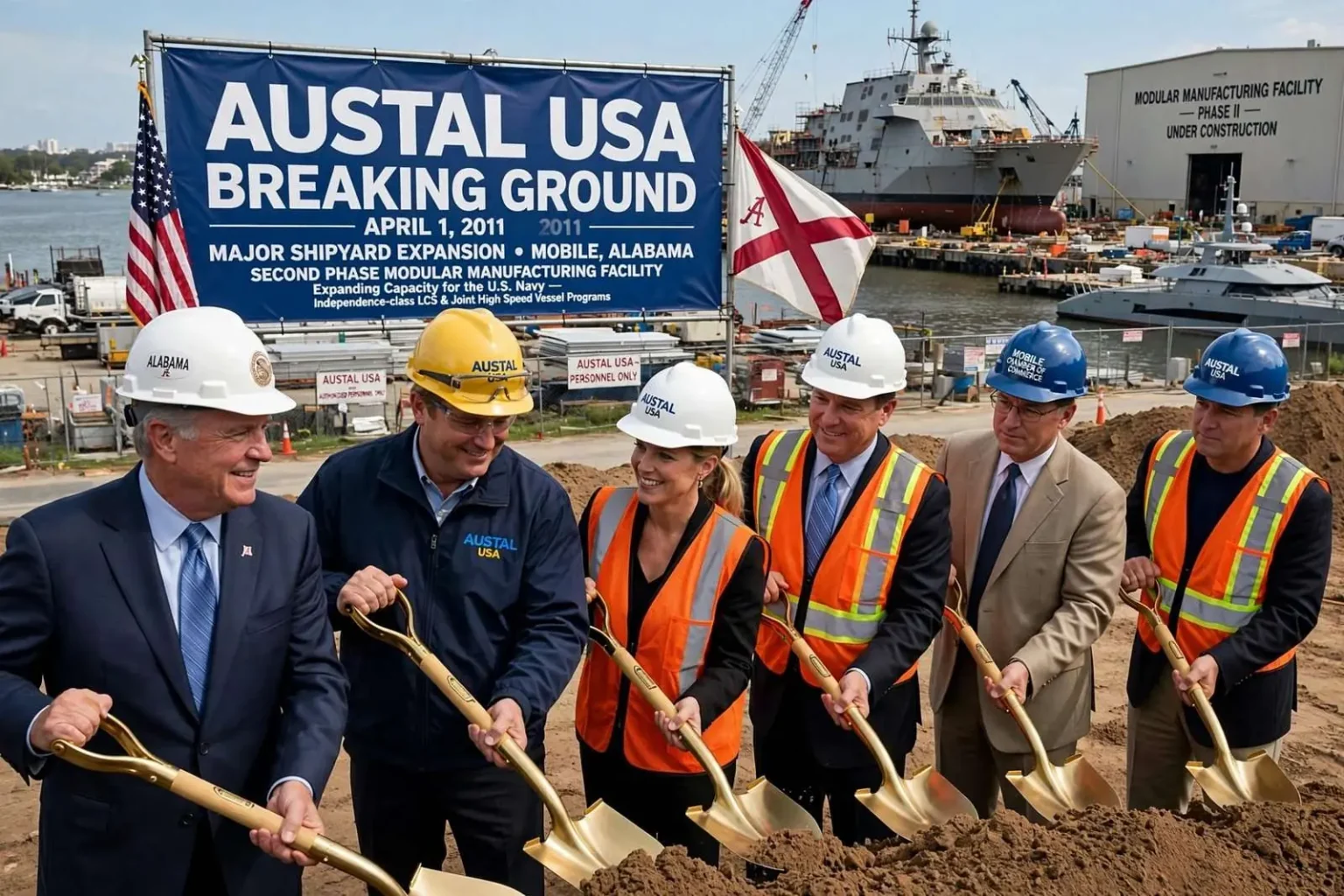
A Landmark Day on the Mobile Waterfront
Austal USA marked a significant milestone on April 1, 2011, breaking ground on three new facilities at its Mobile, Alabama shipyard in a ceremony that underscored the company’s growing importance to the region’s economy and the nation’s naval fleet. The groundbreaking drew state and local leaders to the Mobile River waterfront, where the Australian-owned defense contractor had already transformed the landscape into one of the busiest shipbuilding sites on the Gulf Coast. The event signaled that the company’s rapid rise was not a short-term surge but a sustained build-out of capacity.
The expansion includes the second phase of the company’s Modular Manufacturing Facility, a new office complex, and an additional waterfront assembly bay. Together, these projects represent a major investment in the shipyard’s capacity to build vessels for the United States Navy. Modular construction — building ship sections indoors before moving them to the water — is the approach that has distinguished the yard, and a second phase of that facility directly increases how much work can proceed under cover at one time.
At the time of the groundbreaking, Austal USA was already engaged in construction of the Independence-class Littoral Combat Ship (LCS) and the Joint High Speed Vessel (JHSV) for the Navy, two programs that had transformed the Mobile waterfront into one of the most active shipbuilding sites on the Gulf Coast. Running both programs simultaneously is a demanding production challenge, since the vessels are built from aluminum and require specialized fabrication and handling. The new facilities were designed to support exactly that kind of parallel workload.
Employment Surge Along the Gulf Coast
Governor Robert Bentley attended the ceremony and highlighted the dramatic growth the company had brought to the region. According to the governor, Austal USA’s workforce had grown from just 113 employees in May 2004 to more than 2,000 by early 2011 — a nearly twentyfold increase in less than seven years. Few private employers anywhere in Alabama could match that trajectory, and it made the shipyard one of the most closely watched economic stories in the state.
With the second expansion underway, employment at the shipyard was projected to climb to approximately 3,600 workers. Governor Bentley praised the positions as high-quality jobs that would allow Alabama residents to contribute to building some of the most advanced vessels in the Navy’s fleet. Each hiring wave at a shipyard of this size ripples outward — through suppliers, trades contractors and training programs — multiplying the direct employment numbers across the region.
A Pillar of Mobile’s Economy
The expansion solidified Austal USA’s role as one of the largest private employers in the Mobile area and a cornerstone of the region’s defense manufacturing sector. The Australian-owned company had steadily increased its footprint since establishing its American operations in Mobile, drawn by the city’s deep-water port access, skilled labor pool, and strategic location on the Gulf of Mexico. Those advantages remain the reasons defense work of this scale is possible on the northern Gulf: oceangoing vessels need immediate access to deep water, and a seasoned maritime workforce feeds a production line that cannot afford idle days.
The new facilities were expected to enhance the shipyard’s ability to sustain its double-barreled production load. The Modular Manufacturing Facility’s second phase expands covered fabrication space, the office complex consolidates the growing engineering and program-management staff, and the additional assembly bay increases outfitting capacity along the waterfront. For a yard building both combatants and high-speed transport vessels, the constraint is rarely demand from the Navy — it is floor space and skilled hands.
What the Programs Mean for the Navy
The Independence-class Littoral Combat Ship is a fast, shallow-draft combatant designed for operations close to shore, with a trimaran hull that provides stability and generous internal volume for mission modules. Austal’s Mobile yard builds the class alongside its parent company’s designs, and the ships’ aluminum construction requires fabrication expertise that few American yards possess. The Joint High Speed Vessel, meanwhile, gives the military a rapid transport platform capable of moving troops and equipment at speeds conventional cargo ships cannot approach.
Both programs made Mobile a fixture in Navy planning. Every hull delivered from the Mobile River joins a fleet facing operational demands in the Gulf of Mexico, the Caribbean and overseas theaters, and the industrial base that builds and sustains them has become strategically important to national defense. An expanded Mobile yard strengthens that base — a fact reflected in the ceremony’s guest list and in the tone of the officials who spoke.
A Workforce Built From Scratch
The human side of the growth is as consequential as the steel and concrete. A workforce that numbered 113 people in 2004 could not simply appear at 2,000 seven years later — it had to be recruited, trained and retained. Shipbuilding hires welders, pipefitters, electricians, shipfitters and painters, many of whom learn their trades on the job or through regional training programs. The yard’s expansion gave Mobile-area residents a path into defense manufacturing without leaving the Gulf Coast, and it put a premium on the region’s community colleges and skills programs, which supply much of the pipeline for maritime trades.
The projection of roughly 3,600 workers meant the hiring push was far from over. Every expansion phase brings another wave of job fairs, background screenings and training classes, and it deepens the yard’s dependence on a labor market shared with other Gulf Coast industry. Wages and benefits tied to Navy programs tend to be competitive, which helps the yard retain skilled tradespeople in a market where experience is the scarcest commodity.
Why Mobile Won This Industry
Mobile’s selection as the home of Austal’s American operations was no accident. The city offers a deep-water port on the Mobile River with direct access to Mobile Bay and the Gulf of Mexico, a long maritime heritage from generations of cargo handling and ship repair, and industrial land suited to large-scale fabrication. Add a right-to-work labor climate and state leadership willing to court defense manufacturers, and the ingredients that produced a twentyfold employment increase become clear.
The benefits flow across the broader economy. Suppliers of aluminum plate, marine equipment and industrial services feed the yard; service businesses from restaurants to logistics firms absorb the spending of thousands of additional employees; and the Port of Mobile’s profile as a working waterfront rises with every vessel launched. For city and county officials, the 2011 groundbreaking was evidence that the strategy of courting shipbuilding investment had paid off.
Looking Ahead From April 2011
The three facilities under construction gave Austal USA room to grow into its Navy commitments rather than merely keep pace with them. A second Modular Manufacturing Facility phase, a larger office complex and an added waterfront assembly bay together formed the physical backbone for a workforce headed toward 3,600. For Mobile, the April 1 ceremony marked the moment a fast-rising shipyard stopped being a promising newcomer and became a permanent pillar of the Gulf Coast’s defense economy — with more vessels, more jobs and more of the Navy’s fleet taking shape on the Mobile River.
The Broader Gulf Coast Shipbuilding Cluster
Austal’s expansion did not happen in isolation — it strengthened a Gulf Coast shipbuilding corridor that stretches from New Orleans through Pascagoula and Mobile to Pensacola. The region is home to some of the nation’s most important naval and commercial yards, and Mobile’s rise added a second major defense anchor alongside its neighbors. That clustering matters: skilled tradespeople can move between yards, suppliers can serve multiple customers from regional warehouses, and the Gulf Coast argues with one voice when Washington weighs where to build the fleet.
For Alabama’s elected leaders, the shipyard’s growth also validated the state’s industrial-recruitment playbook. Incentives, workforce training partnerships and infrastructure investment had helped land and expand the operation, and the 2011 numbers — from 113 employees to more than 2,000, with 3,600 projected — became a standard talking point in economic-development pitches across the state. Every Independence-class hull slid down the ways as evidence that coastal Alabama could compete for the most sophisticated manufacturing work available.
Reading the Numbers Behind the Ceremony
The arithmetic of the expansion explains why the groundbreaking drew a governor. Adding 1,600 workers to a 2,000-person payroll over the life of the build-out means roughly thousands of new households supported in the Mobile area, additional demand on schools, roads and housing, and a larger tax base for city and county budgets. Payroll at that scale also insulates the region’s economy against downturns in other sectors, since Navy construction programs run on multi-year contracts that smooth employment across economic cycles.
The dual production lines amplify that stability. The Littoral Combat Ship and Joint High Speed Vessel programs are not tied to the same budget rhythms, and building both spreads risk across two customer demands. A yard that can keep both lines moving — the central purpose of the new facilities — offers its workforce steadier employment than a single-program yard can promise.
On April 1, 2011, the shovels in the ground marked more than three buildings. They marked the moment when Mobile’s bet on a young defense shipbuilder hardened into one of the largest and fastest-growing industrial operations on the Gulf Coast, with the Navy’s fleet as its customer and the region’s workers as its most valuable resource.