
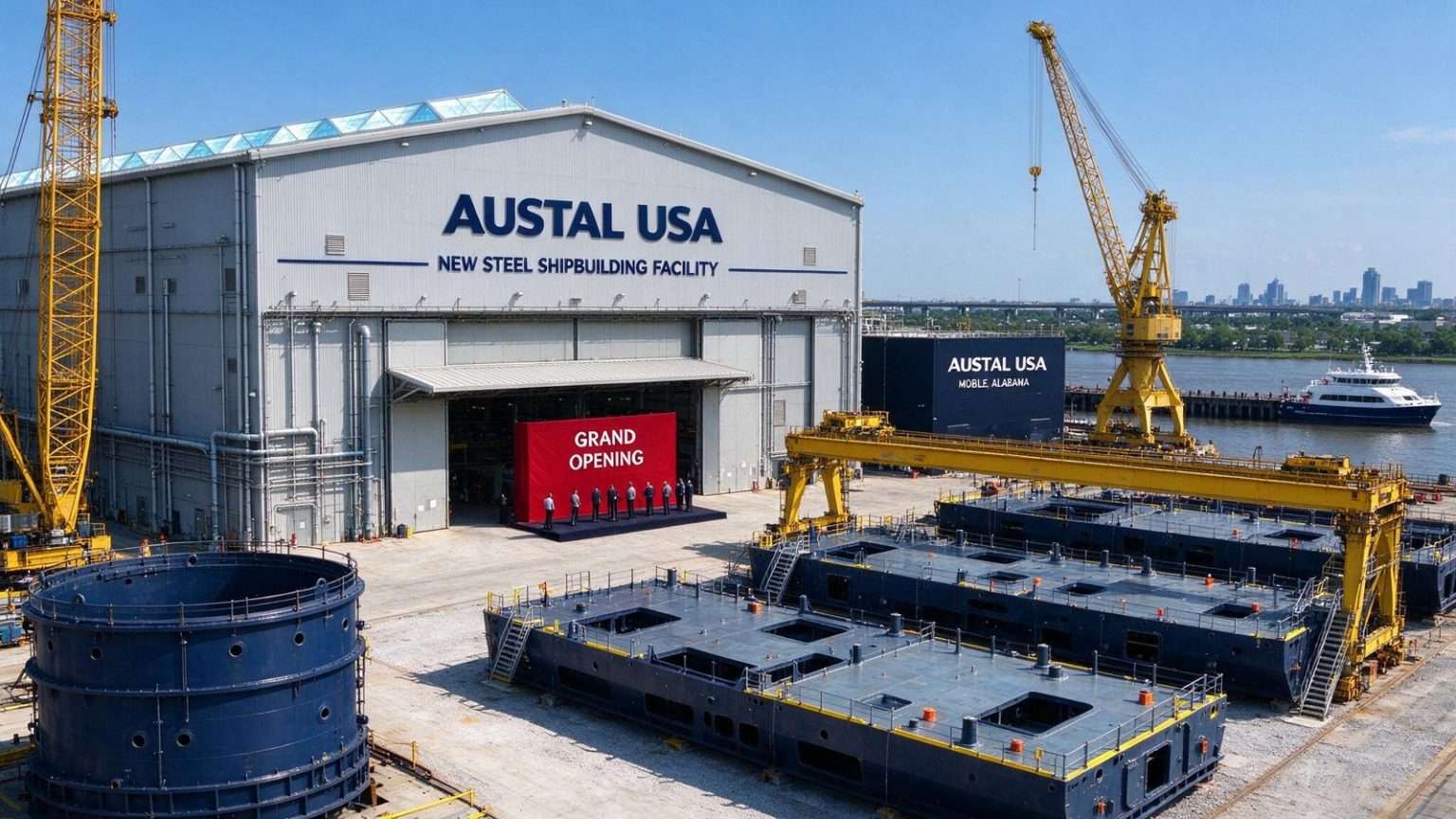
MOBILE, Ala. — Austal USA celebrated the opening of a new steel shipbuilding facility on Tuesday, marking a major expansion for the Mobile shipbuilder that had long worked exclusively with aluminum. The steel production line at the company’s riverfront yard will be capable of building both steel and aluminum ships for the U.S. Coast Guard and Navy, giving the Port City shipyard a production footprint that spans the two hull materials used across most of the federal fleet.
For more than two decades, Austal USA has been known as Mobile’s aluminum shipbuilder. The yard, a subsidiary of Australia-based Austal Ltd., rose to prominence building Independence-class littoral combat ships and Expeditionary Fast Transport vessels for the U.S. Navy — aluminum-hulled designs prized for speed and shallow draft. Aluminum construction, however, has historically limited which ship classes the yard could pursue, since much of the Coast Guard’s large cutter fleet and a substantial share of the Navy’s auxiliaries are built from steel. The new line is designed to close that gap and let the company bid on work that previously went to yards elsewhere on the Gulf Coast and beyond.
Austal USA President Rusty Murdaugh said the investment will allow the company to continue growing its business in Alabama for many years to come. Company officials described the opening as the culmination of a build-out that reshaped large portions of the riverside campus, adding fabrication halls and outfitting space alongside the existing aluminum production areas that remain in full use.
A $100 Million Bet on the Future of Military Shipbuilding
The project, which broke ground in early 2021, was backed by a $50 million Department of Defense contribution that Austal matched dollar-for-dollar, bringing the total to roughly $100 million. The cost-sharing arrangement reflected the Pentagon’s interest in expanding the industrial base available for military ship construction — a priority that gained urgency as Navy and Coast Guard shipbuilding demand outpaced the capacity of the nation’s existing yards.
Much of the new facility relies on robotics and computerized steel machinery, from automated cutting and forming equipment to precision welding systems that produce the heavy steel panels used in large hull sections. The company says employees will still play a central role in building ships at the new line, with skilled tradesmen and women operating the automated systems, assembling modules and carrying out the finishing work that machines cannot do alone.
The blend of automation and manual craft is increasingly the norm in modern American shipbuilding, where yards compete both on labor availability and on throughput. For Austal USA, the robotic steel line is intended to compress production timelines while keeping quality consistent across hull sections — an important consideration as the company courts Navy and Coast Guard programs that award contracts based in large part on a yard’s demonstrated ability to deliver on schedule.
The opening also arrives at a moment of sustained growth for the Mobile yard, which has expanded its workforce steadily in recent years as it layered new programs onto its original littoral combat ship work. Company officials have pointed to the steel facility as the foundation for that trajectory continuing well into the next decade, with the potential for additional hiring across engineering, welding, pipefitting, electrical and outfitting trades.
Gov. Kay Ivey, who attended the unveiling, drew a historical parallel between the new line and Mobile’s storied wartime shipbuilding past. “During WWII, Mobile workers built steel liberty ships that were critical to the war effort, and now in the coming years, Austal will look to deliver steel ships again needed by the U.S. Coast Guard and Navy,” Ivey said.
The comparison carried real weight in a city where shipbuilding helped define the 20th century. During World War II, the Alabama Dry Dock and Shipbuilding Company on the Mobile River employed tens of thousands of workers and turned out liberty ships by the dozen, transforming Mobile into one of the South’s great industrial ports almost overnight. That wartime boom drew families to the city from across the region and left an enduring legacy — neighborhoods, trade skills and a maritime culture that persists in today’s workforce.
Modern Mobile has carried that tradition forward in a different form. Alongside Austal, the city hosts major shipbuilding and ship repair operations on the Mobile River and in the surrounding region, and the Port of Mobile remains one of the busiest deepwater ports on the Gulf of Mexico. The concentration of marine trades — welders, pipefitters, electricians, naval architects and marine suppliers — has made the area a natural home for defense shipbuilding, and state leaders have courted the industry with workforce training investments and incentives for years.
Beyond the Shipyard
The expansion extends well beyond Austal’s own workforce. The new facility is expected to support approximately 240 suppliers in the Mobile area, making it a meaningful economic development win for the Port City. Those suppliers range from machine shops and steel fabricators to electrical houses, coatings specialists, marine equipment distributors and logistics firms — the broad network of businesses that keeps a working shipyard supplied day to day.
Economists who study shipbuilding regions often note that the multiplier effect of a yard extends far past its payroll. Every hull that moves through a facility like Austal’s generates orders for local vendors, overtime for transport and crane operators, and steady demand for the trades that maintain the yards themselves. A supplier base of that size also gives the region resilience: when one program slows, the network of skilled vendors remains in place for the next.
State and local officials have made defense manufacturing a centerpiece of their economic development strategy for the Gulf Coast, arguing that shipbuilding jobs are difficult to offshore and tend to anchor generations of skilled workers in a community. The steel facility’s opening gives Mobile another argument to make when courting additional defense work — and when persuading young Alabamians to train for maritime trades at the region’s community colleges and technical programs.
The announcement also lands as the Navy and Coast Guard work through ambitious shipbuilding plans that call for dozens of new vessels over the coming decades, from large cutters to auxiliary and support ships. Industry analysts have repeatedly identified industrial base capacity as the binding constraint on those plans, which is precisely the constraint Austal’s expansion is designed to help relieve.
Mobile Mayor Sandy Stimpson, also on hand for the opening, said he believed Mobile was on its way to becoming the model for naval shipbuilding in the country. “That it is being done in Mobile is something all Mobilians will hopefully embrace and enjoy — this jewel that we have here,” Stimpson said.
Stimpson’s remarks reflected a broader civic pride in the city’s maritime identity. Mobile’s riverfront has been reshaped over the past two decades by public and private investment, from downtown redevelopment to the modernization of port facilities, and the shipbuilding sector has been a consistent anchor of that transformation. City officials have frequently cited the cluster of maritime employers as a stabilizing force in the local economy, providing wages that support families across the metro area and careers that do not require leaving the Gulf Coast.
What the Steel Line Means for Mobile
For workers, the new facility signals a sustained demand for the skills that steel construction requires. Heavy plate welding, steel fabrication and shipfitting are trades with established training pipelines in the region, and yards that operate both aluminum and steel lines can offer workers broader, more varied careers. Company officials have emphasized that the automated systems augment rather than replace the workforce, with the most intricate assembly and quality work still performed by hand.
For the Navy and Coast Guard, a second steel-capable yard on the Gulf Coast adds optionality at a time when fleet renewal schedules have strained the industry. Distributed production across multiple yards has become a favored approach for keeping programs on schedule, and Mobile’s combination of deepwater access, an experienced labor pool and a mature supplier network positions the city to absorb a growing share of that workload.
The dual-material capability also hedges against shifts in federal procurement. Shipbuilding priorities change with budgets, threat environments and administration decisions, and a yard that can build in either aluminum or steel can pivot among ship classes as demand moves. That flexibility has been central to Austal USA’s pitch that the Mobile operation will remain a growth engine rather than a single-program operation.
For now, the opening ceremony marked the transition from construction to production. The steel line’s first years will be watched closely across the industry, both as a test of the public-private investment model that funded it and as a measure of how far Mobile’s shipbuilding renaissance can run. Nearly eight decades after Mobile welders laid keels for the war effort, the city’s riverfront is once again positioned to build steel ships for the nation’s fleet — this time with robotics on the floor and a supplier network of hundreds behind it.