
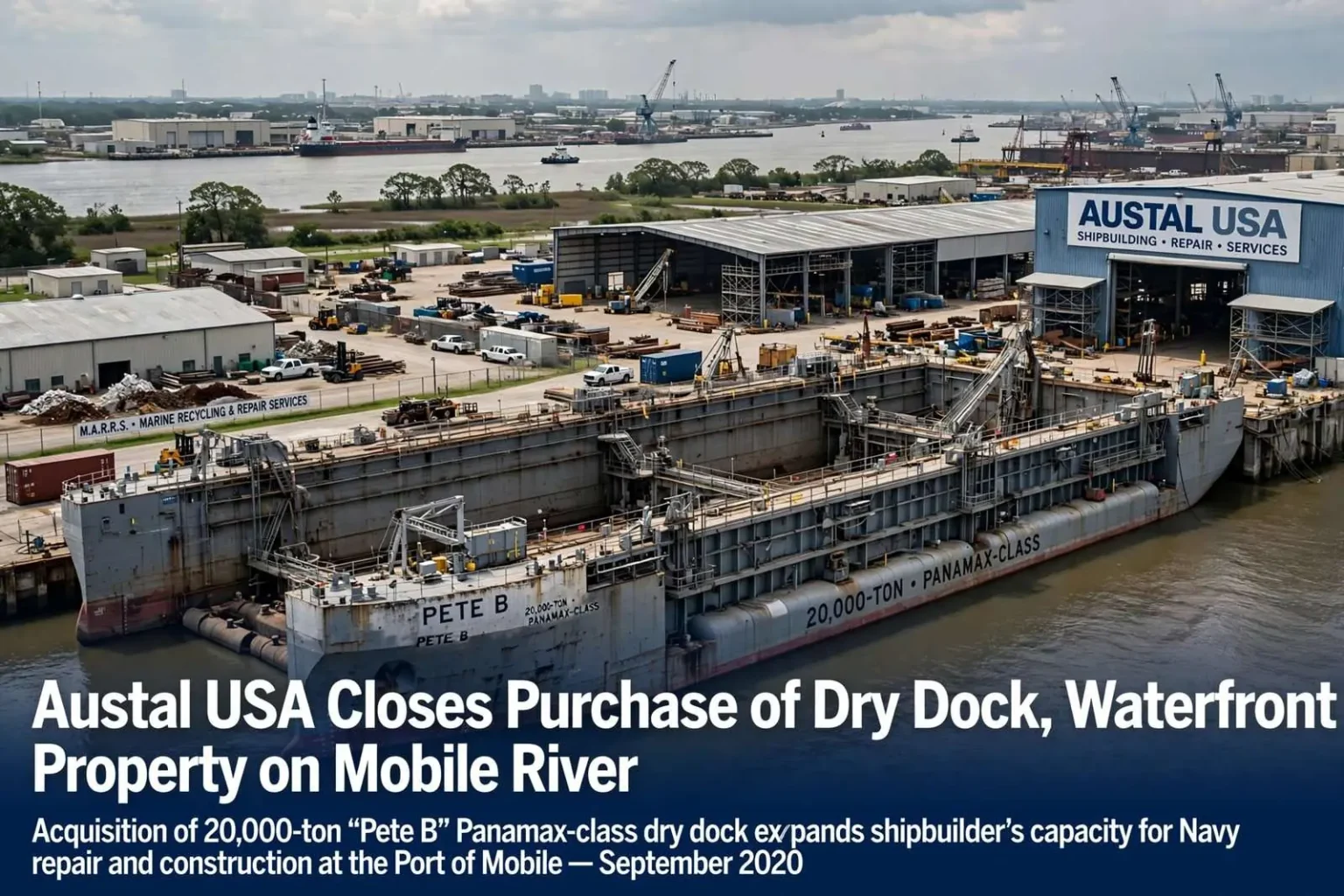
Austal USA has finalized a major waterfront acquisition along the Mobile River, purchasing land, buildings, and an existing dry dock previously held by World Marine of Alabama, an indirect subsidiary of Modern American Recycling and Repair Services of Alabama (M.A.R.R.S.). The deal, announced in September 2020, positions the shipbuilder for expanded construction and service work at the Port of Mobile.
The acquisition gives Austal the waterfront footprint to take on work its current site cannot absorb — heavy repair, larger hulls and the industrial services that surround new construction — and it arrives as the company’s order book for U.S. Navy vessels continues to grow.
What the Purchase Includes
The transaction covers the 20,000-ton “Pete B” Panamax-class floating dry dock, 100,000 square feet of covered repair facilities, and 15 acres of waterfront property along the Mobile River and the Gulf of Mexico. The new property sits adjacent to M.A.R.R.S., allowing closer collaboration on the company’s core recycling operations.
A floating dry dock is the workhorse of heavy ship repair — a flooded basin that sinks to let a vessel float in, then pumps out to lift the ship clear of the water so crews can work on hulls, propellers and systems that are unreachable at a pier. A 20,000-ton Panamax-class dock is sized for major commercial and government vessels, and owning one outright changes what Austal can promise customers: repair and refit work it previously had to schedule elsewhere or decline.
The covered repair space matters as much in a Gulf Coast climate as the acreage. One hundred thousand square feet under roof means hull work, blasting, coating and fabrication that can proceed through summer heat, thunderstorms and hurricane season — the kind of schedule protection that keeps repair contracts profitable.
Expanding Capacity for Navy Contracts
The acquisition builds on Austal USA’s growing steel and aluminum business portfolio, which includes U.S. Navy multi-ship contracts for the Independence-variant Littoral Combat Ship (LCS) and the Expeditionary Fast Transport (EPF). The company also has active research and development programs focused on unmanned and autonomous surface vessels, plus an expanding global services business with operations in San Diego and Singapore.
At the time of the announcement, Austal USA had delivered 22 new construction ships since 2012 — 11 trimaran LCS and 11 EPFs — many of which have deployed around the world. That production record made the Mobile yard one of the most productive naval shipbuilding facilities in the country, and it created the downstream demand that a repair capability now serves: hulls that Austal built need maintenance, upgrades and repairs for decades, and doing that work in Mobile keeps the follow-on dollars in the same yards that built the ships.
The move into unmanned and autonomous vessels signals where the company expects the Navy’s demand to head. Autonomous surface programs are among the fastest-growing lines in naval shipbuilding, and the yard that demonstrates the capability early positions itself for contracts that do not yet exist in the numbers the LCS and EPF programs reached.
Leadership Frames the Deal as Demand-Driven
Austal USA President Craig Perciavalle emphasized that the move was about meeting customer demand. “As we’ve consistently done over the course of our history, we’re adding capability to meet the growing demand from our customers,” he said. “Our business remains focused on continuing to manufacture highly capable and cost effective ships while providing world-class global services and support.”
The statement follows the trajectory Austal has traced in Mobile since it began delivering ships there. New construction built the yard’s reputation; services and sustainment extend the revenue from each delivered hull over a decades-long service life; and repair capacity is the bridge between the two. Owning a dry dock turns that strategy into infrastructure.
Mobile’s Shipbuilding Corridor
Mobile has continued to anchor one of the nation’s busiest commercial shipbuilding corridors, and Austal’s waterfront expansion signals that the defense shipbuilder is investing for the long term. The Mobile River’s industrial reach hosts a cluster of yards, repair facilities and maritime service companies that together make the city one of the Gulf’s working ports — a place where new construction, heavy repair, recycling and port operations share the same waterfront.
That clustering is an economic advantage that is hard to replicate. Skilled welders, pipefitters, electricians and marine tradespeople live throughout the region, suppliers stock material nearby, and the port itself brings commercial traffic that keeps tug, barge and repair businesses busy between Navy projects. When one yard expands, the whole corridor’s labor pool and supplier base deepen, which in turn makes the next expansion easier to justify.
The deal also reflects the mobile-in-motion character of the port’s industrial real estate. Property that supported one industry — in this case, ship repair and recycling under World Marine and M.A.R.R.S. — passes to another as demand shifts, without the land ever leaving maritime use. For the neighborhoods and businesses that surround the river, each such transition keeps the working waterfront working.
What It Means for the Local Workforce
Expanded repair and service capacity means jobs, and the timing matters for a region that has watched shipbuilding employment climb over the past decade. Repair work is labor-intensive in ways that complement new construction: it needs the same trade skills but on different schedules, often in surges when a vessel comes into the dock. A yard with both can smooth employment across the year, retaining crews between new-construction milestones.
The acquisition also supports the training pipeline that has grown around Mobile’s maritime industry. Regional programs that train welders, fabricators and marine technicians feed yards throughout the corridor, and every expansion of permanent industrial capacity strengthens the case for students to enter those programs — and for programs to keep investing in the equipment those trades require.
For Austal’s existing workforce, the added acreage and facilities extend a career ladder that has been growing longer as the company’s portfolio has widened. Employees hired for aluminum new construction now have paths into steel fabrication, autonomous vessel programs, and the services business that spans from San Diego to Singapore.
The Dry Dock Advantage in the Repair Market
Owning the “Pete B” changes Austal’s position in the Gulf repair market in concrete ways. Dry dock availability is the choke point of ship repair on the Gulf Coast; vessels queue for dock space, and repair yards without their own docks must subcontract the lifting work, splitting revenue and surrendering schedule control. A yard that controls a 20,000-ton Panamax dock can commit to dock dates, quote complete repair packages and keep the vessel — and the customer relationship — under its own management from arrival to departure.
The dock also broadens the class of vessels Austal can handle. Panamax-class dimensions suit the commercial ships, government vessels and mid-sized Navy auxiliaries that move through the Gulf, and a dock that can lift them opens repair and refit work far beyond the LCS and EPF hulls the company built itself. Every commercial contract that fills the dock between Navy availabilities improves the economics of owning it.
Location amplifies the value. The property sits on the Mobile River with direct Gulf access, minutes from the Port of Mobile’s container and bulk terminals, where commercial traffic generates constant demand for inspections, repairs and regulatory surveys. A dry dock positioned at that crossroads can move between Navy work and commercial customers as demand shifts, smoothing utilization across the year.
The location also keeps work in Mobile that once left for Gulf yards elsewhere. Repairs lifted, quoted and completed on the river stay on the river, and with them the wages, suppliers and port traffic that follow every vessel in the dock.
A Signal to the Navy and to Competitors
For the Navy, the purchase reads as a commitment. Shipbuilding programs are long; a hull delivered today needs a sustainment partner for thirty years, and service branches weigh a contractor’s installed capacity when they decide where to send future work. A yard that buys its own dry dock is telling the Navy it plans to be in the repair business on the Gulf Coast for the life of the fleet it built.
For competitors, the move raises the bar. Austal arrived in Mobile as an aluminum specialist and has since pushed into steel, services, autonomous programs and now heavy repair — each step taken while its rivals were consolidating or retrenching. Vertical expansion of this kind, timed to a healthy order book, is how a yard converts a construction boom into a durable industrial presence.
The September 2020 announcement closes one chapter of that story and opens another. The land, the buildings and the “Pete B” dry dock are now Austal USA’s, the adjacent M.A.R.R.S. operations continue next door, and the yard that has delivered 22 ships since 2012 has the room and the equipment to build, repair and support the next generation of vessels from the same Mobile River waterfront where its growth began.