
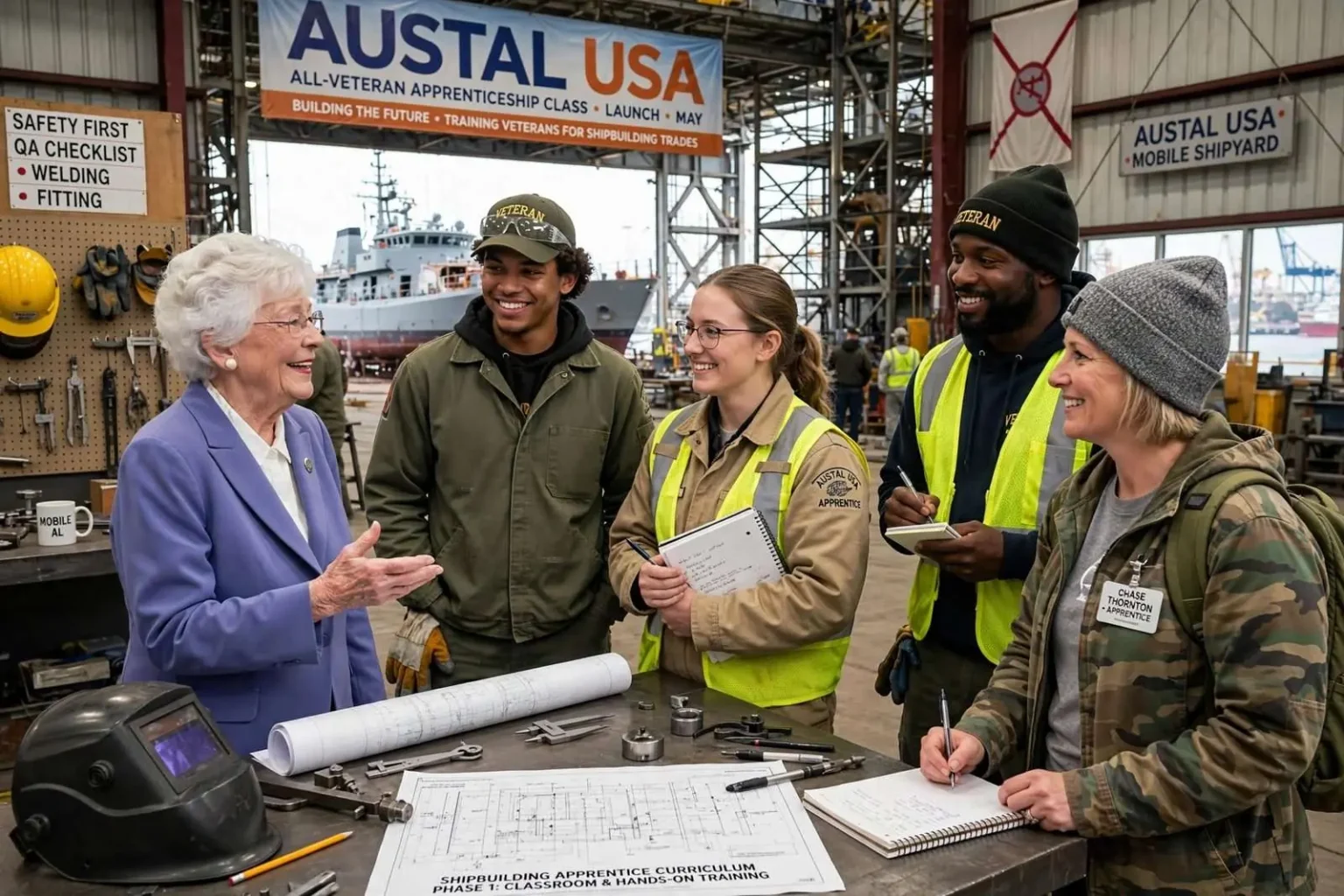
MOBILE, Ala. — Gov. Kay Ivey visited Austal USA’s Mobile shipyard Wednesday morning as the company highlighted a new apprenticeship program made up entirely of military veterans. The visit put a state-level spotlight on a workforce experiment that pairs two of Alabama’s most reliable strengths — its shipbuilding industry and its veteran population — and company officials used the occasion to show the governor how the first class is progressing.
The four-year program takes men and women with military backgrounds and trains them in shipbuilding trades. Apprentices move through a curriculum designed to take someone with service experience — but no shipyard background — and turn out a journeyman tradesman capable of working on Navy vessels, learning welding, fitting and the other crafts that keep a major shipyard running.
A path from uniform to trade
The first all-veteran class started in May, with the first two years devoted primarily to classroom instruction and the final two spent largely in hands-on, on-the-job training at the yard. The structure mirrors the classic apprenticeship model that has trained skilled tradesmen for generations — book learning first, then supervised production work — adapted to the particular demands of military ship construction, where standards are unforgiving and quality assurance is built into every weld.
Ivey addressed employees during the visit, speaking about the company’s value to the state’s economy. The governor’s appearance underscores how significant the shipyard has become to Mobile and to Alabama as a whole: a major industrial employer on the Mobile River, a cornerstone of the city’s waterfront economy, and one of the state’s most visible advanced-manufacturing operations. When the yard hires and trains hundreds of workers, the effects ripple through the region’s suppliers, schools and service businesses.
Veterans in the program described it as a bridge between military service and a civilian career. The transition out of the military is one of the most disorienting moves a working person can make — a wholesale change of culture, location and daily rhythm — and programs that recognize service skills while teaching new ones fill a genuine gap in that transition.
“It’s been a great opportunity because not many people know that coming out of the military it’s kind of difficult for a veteran to find a job,” said apprentice Chase Thornton, who added that he was grateful to find the apprenticeship with Austal. His account reflects what employment researchers have documented for years: veterans bring discipline, technical training and reliability that employers want, but translating a military occupational specialty into a civilian job title is harder than it sounds.
Why veterans fit the shipyard
The program reflects a broader challenge for Gulf Coast manufacturers: skilled-trade positions at Mobile’s largest industrial employer have historically been hard to fill, and veterans — already accustomed to technical work, discipline and shift-based schedules — have proven a natural fit for shipyard jobs. Shipyards run around the clock on complex production schedules, and workers who have already lived under military structure tend to adapt to that environment faster than entry-level hires from outside.
The match runs deeper than temperament. Modern Navy shipbuilding is, at bottom, advanced manufacturing — precision welding, electrical systems, hydraulics, electronics and quality control — and many service members already hold training in adjacent fields. An apprentice who maintained aircraft or drove heavy equipment in uniform arrives with mechanical intuition that no classroom can teach, needing only the specific shipyard applications layered on top.
For the company, the all-veteran approach also addresses retention, one of the persistent costs in industrial training. Training a welder or fitter takes years, and workers who leave for another employer take that investment with them. Apprenticeship graduates who feel invested in — and who finish their program with a career path rather than a job — are the workers most likely to stay, and veterans hired into a program built around their experience have shown exactly that kind of loyalty.
Apprenticeships and Alabama’s workforce push
The Austal program fits squarely within Alabama’s broader push to rebuild the apprenticeship model as a workforce-development tool. For decades, the state’s economic development strategy has centered on recruiting manufacturers — automotive plants, aerospace operations, shipbuilders — and each of those employers has confronted the same bottleneck: finding enough skilled tradespeople to staff the floor. Registered apprenticeships, which pay workers while they train, have re-emerged as the answer that industry, community colleges and state agencies have rallied around.
The four-year structure of the Austal program reflects the seriousness of the commitment. A shipyard trade cannot be learned in a semester; it takes years of repetition under experienced journeymen to produce a worker who can meet Navy construction standards. Programs of this length represent a substantial investment in each apprentice — wages, instruction, materials and supervision — which is precisely why the model works best when the employer is stable, growing and committed to the region, as the Mobile shipyard has been.
For the apprentices themselves, the earnings math is part of the appeal. Unlike a traditional degree path, an apprentice earns from the first day, with pay that rises as skills accumulate, and graduates finish four years later with a recognized trade credential, years of paid experience and, typically, no educational debt. For veterans leaving service, that combination — immediate income, structured advancement and a clear endpoint — can be the difference between a struggling transition and a launched career.
Shipbuilding on the Mobile River
The Mobile shipyard sits on the Mobile River in the heart of the city’s working waterfront, part of a shipbuilding tradition on the Gulf Coast that stretches back generations. Modern Navy construction at the yard involves aluminum-hulled warships built to exacting military specifications, a process that demands highly trained welders and craftsmen working under strict quality assurance. Every hire the yard makes in a trades program is a hire for work that has no tolerance for shortcuts.
The yard’s growth has made workforce its defining challenge. As production schedules have expanded, the competition for skilled workers across the Gulf Coast — shipyards, refineries, chemical plants and fabrication shops from New Orleans to Pensacola — has intensified, and every employer is fishing in the same talent pool. Programs that create new tradesmen, rather than bidding existing ones away from neighbors, strengthen the whole region’s industrial base, which is the argument the company made in hosting the governor to showcase it.
The veterans’ program adds a human dimension to that industrial story. Each apprentice in the first all-veteran class represents both a service member finding a footing after uniform and a shipyard gaining a worker already shaped by technical training and discipline. If the model proves out over the four-year arc, it offers a template other Gulf Coast manufacturers can copy — one that solves a hiring problem, eases a transition problem and honors military service all in the same program.
What comes next for the class
The first class is still in its classroom-heavy years, with the hands-on production phase ahead. When those apprentices move onto the floor full-time in the program’s second half, the yard will learn what the model really produces: tradesmen formed by a curriculum built specifically for them. The governor’s visit, and the company’s willingness to spotlight the program, suggests confidence in the answer — and a bet that Alabama’s veterans will keep proving the fit between military service and shipyard work for classes to come.
The bigger picture for Mobile’s workforce
Mobile’s economy has been diversifying around its port and industrial base for years, and the shipyard sits at the center of that story. Every expansion in production ripples outward — suppliers across the region add shifts, trade contractors hire, and workers trained at the yard carry skills that command premiums across the Gulf Coast. That is why state leaders treat the yard’s workforce pipeline as infrastructure in its own right, as essential to the region’s future as the roads and cranes that move the products.
The veteran focus also connects Mobile to one of its deepest identity threads. The city’s military ties run from the Gulf’s naval presence to the retirees and former service members who settle along the Gulf Coast after their careers end. A shipyard that deliberately recruits from that population is doing more than filling jobs; it is building on the natural alignment between the region’s people and its industry.
For the apprentices of the first all-veteran class, the immediate horizon is classroom work, then the yard, then a trade that will carry them for decades. For the company and the state, the program is a test of a bigger idea: that the surest way to solve a skilled-trade shortage is to build the workers you need, starting with the ones the military already trained. The early returns, by every account offered at Wednesday’s event, point toward a model worth expanding.