
Austal USA Opens Its Doors Saturday for Major Mobile Hiring Push
Austal USA hosts a job fair Saturday in Mobile as the shipyard hires 1,200 workers over 18 months. What to bring, where to go, and how to apply.
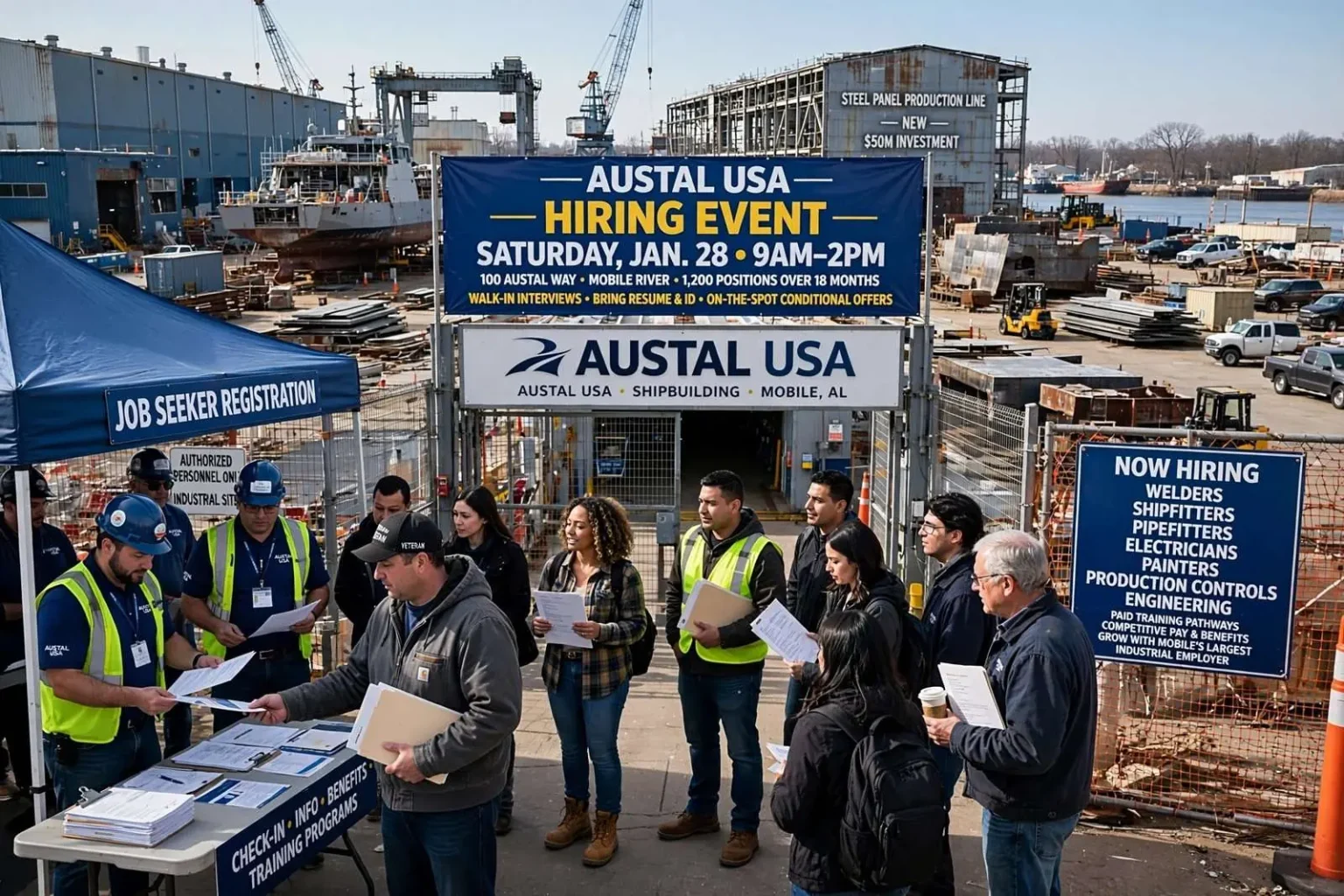
Shipbuilder Austal USA will open its Mobile shipyard to job seekers this weekend, hosting a hiring event that arrives as the company works through one of the busiest stretches in its history. The job fair runs Saturday, Jan. 28 from 9 a.m. to 2 p.m. at the company’s shipyard at 100 Austal Way along the Mobile River. Candidates should bring a resume and identification, and everyone who attends will be entered into a drawing for a $500 gift card, according to the company. Hiring events at the yard have drawn long lines in past years, and company officials say applicants can expect to move through registration, meet hiring managers from production and support departments, and in some cases receive conditional offers on the spot.
1,200 Positions Over 18 Months
The event is part of a broader expansion plan: Austal intends to add roughly 1,200 workers over the next 18 months, reinforcing its position as Mobile’s largest industrial employer. The shipyard’s workforce has historically spanned welders, shipfitters, pipefitters, electricians, painters, and production control specialists, along with engineering and program management staff. The scale of the planned hiring reflects a full order book across multiple Navy ship classes, and company officials have described the pace of new awards as unlike anything the yard has handled since it opened on the Mobile River waterfront. The growth also ripples outward: each shipyard job typically supports additional positions at suppliers, subcontractors, and service businesses across the region.
The hiring push follows a period of real uncertainty for the yard. In 2020, the Pentagon chose a competitor for the Navy’s frigate program, a decision that raised questions about Austal’s future workload because the yard had pitched a derivative of its Independence-variant littoral combat ship design. Rather than retrench, the company pivoted. A series of new awards followed, spanning additional littoral combat ships, the Navy’s Spearhead-class expeditionary fast transport vessels, and auxiliary and support ship programs, along with repair and sustainment work that keeps hulls moving through the yard between new constructions. The episode became a case study in how a yard’s fortunes can turn on a single contract decision — and how diversification can insulate a workforce from the next one.
Investment in Steel and the Yard’s Future
A key piece of the expansion is physical. The company invested $50 million in CARES Act funding to build a modern steel panel production line, a shift that matters because aluminum hull fabrication has been Austal’s signature capability since the yard opened, while steel opens the door to a wider family of Navy and commercial vessels. The steel line allows the yard to pursue auxiliary ships, tugs, and other hull types that were previously outside its portfolio, and it supports a longer-term strategy of diversifying beyond the littoral combat ship program as that class winds down. Steel production also changes the skill mix the yard needs, adding trades and machine operators alongside the aluminum specialists who built the trimaran fleet.
Company leadership has been emphatic that the investment signals permanence rather than a holding pattern. “We’re not going anywhere,” Austal USA President Rusty Murdaugh said when discussing the company’s trajectory, a message aimed as much at the workforce and city officials as at Navy leadership. Austal’s parent company is headquartered in Australia, and the Mobile yard has grown into the company’s largest operation, employing thousands of workers directly and supporting a supplier network that reaches across the Gulf Coast into Mississippi and the Florida Panhandle. Local officials have counted Austal and its neighbors along the river as the engine of a maritime industrial cluster that now ranks among the fastest-growing in the country.
What Job Seekers Should Know
For prospective applicants, Saturday’s event offers a chance to apply and interview without navigating the online process first. The company has emphasized that entry-level production positions come with paid training paths, and Austal has partnered with local institutions on workforce development pipelines for trades that remain in short supply regionally. Shipbuilding wages and benefits have historically been competitive with the Gulf Coast’s other large industrial employers, and the yard’s continued growth has made maritime trades among the most in-demand skills in the Mobile area. Applicants are typically advised to dress for a worksite visit, bring documentation that establishes eligibility to work, and be prepared to discuss any prior trade, construction, or military experience, all of which transfers well to ship production.
Job seekers who cannot attend Saturday’s event can find openings and application details through the company’s careers website. With roughly 1,200 positions to fill over 18 months, hiring officials expect the event to be the first of several recruitment pushes. For Mobile, the expansion is more than a jobs story: the yard’s growth has anchored the city’s identity as a Navy shipbuilding center, drawn suppliers and skilled workers to the region, and kept the Mobile River skyline busy with hull sections moving from fabrication halls to the waterfront. Each new hire represents another link in a supply chain that extends from the city’s neighborhoods to Navy fleets deployed around the world.
The hiring drive also lands in a regional labor market that has grown tighter as industrial employers expand along the Gulf Coast. Shipyards, aerospace plants, and chemical facilities in the Mobile area compete for many of the same skilled trades, and companies have responded with signing bonuses, tuition support, and apprenticeships. Austal’s training partnerships have included programs that pay students while they learn welding and fitting in classroom and shop settings, pathways designed to convert applicants with no maritime background into production workers within months. Workers who complete the training often find that shipyard experience travels well, with yards and manufacturers across the region recruiting from the same talent pool.
The Yard’s Place in Mobile’s Economy
For two decades Austal has been a fixture of the Mobile River’s east bank, growing from a startup operation assembling high-speed ferries into a Navy shipbuilder whose hulls are a familiar sight from the city’s riverfront parks. The yard’s growth has shaped everything from downtown apartment demand to enrollment in trade programs at area schools. City and state officials have courted that growth with incentives and infrastructure investments, viewing shipbuilding as a durable anchor industry less vulnerable to offshoring than many manufacturing sectors because of the Navy’s requirement to build warships domestically.
The jobs fair also comes at a moment when the Navy’s shipbuilding plans are under scrutiny in Washington, with debates over fleet size, shipyard capacity, and the industrial base that must support both. Analysts have repeatedly identified yard workforce as the binding constraint on expanding the fleet — hulls cannot be built without trained hands, and the industry has lost a generation of tradespeople to retirements. Efforts like Austal’s push to add 1,200 workers are watched in the Pentagon as much as in Mobile, because they test whether American yards can scale up at all. For the candidates walking through the gate Saturday with resumes in hand, the stakes are personal, but the outcome matters far beyond the $500 gift card drawing: it helps decide how fast the Navy’s next ships reach the water.
Company officials have described the current period as the busiest in the yard’s history, with multiple hulls under construction simultaneously and repair work adding to the load. The production tempo has visible effects across the yard: material deliveries arrive by the truckload, subcontractors stage modules along the riverbank, and launching schedules cluster as the Navy takes delivery of completed ships and moves them toward commissioning. Workers describe the pace as demanding but steady, with overtime widely available — a contrast to the layoffs and furloughs that periodically swept the industry in earlier decades.
How Hiring Events Work
Job fairs of this kind serve both sides of the market. For the company, they concentrate a large volume of candidates into a single day, letting recruiters screen in person and sort applicants into trades where they can be most useful. For workers, they remove the anonymity of online applications — a resume handed to a hiring manager, followed by a conversation, often moves faster than a web portal that can take weeks to produce a callback. The identification requirement reflects the site’s security posture: Austal’s yard is a controlled industrial facility working on national defense programs, so employment processing includes background checks and, for many roles, U.S. citizenship or permanent residency requirements tied to the Navy contracts.
The $500 gift card drawing is a small touch in a competitive hiring market, but the substance of the pitch is the career arc behind it. Entry-level production workers who stay in the trades can progress to lead positions, supervision, and quality roles, and the yard’s growth has historically promoted from within. The 18-month hiring window suggests openings will remain available for workers who miss this event, though competition for the most skilled trades means that earlier applicants generally have the best position numbers. For a city that has watched its riverfront evolve from cotton docks to warship ways, the line of applicants stretching along Austal Way is the clearest possible sign that shipbuilding has become, once again, one of the surest paths to a middle-class paycheck on the Gulf Coast.


