Two Dead, Three Hurt in Baldwin Beach Express Head-On Crash Near Robertsdale
Braxton Freckman, 28, of Spanish Fort and Kimberly Moody, 33, of Mobile were killed Sunday evening when their northbound truck crossed the median of the Baldwin Beach Express and struck a Ford F-250 head-on. A Summerdale couple and a 1-year-old were hurt and have since been released.
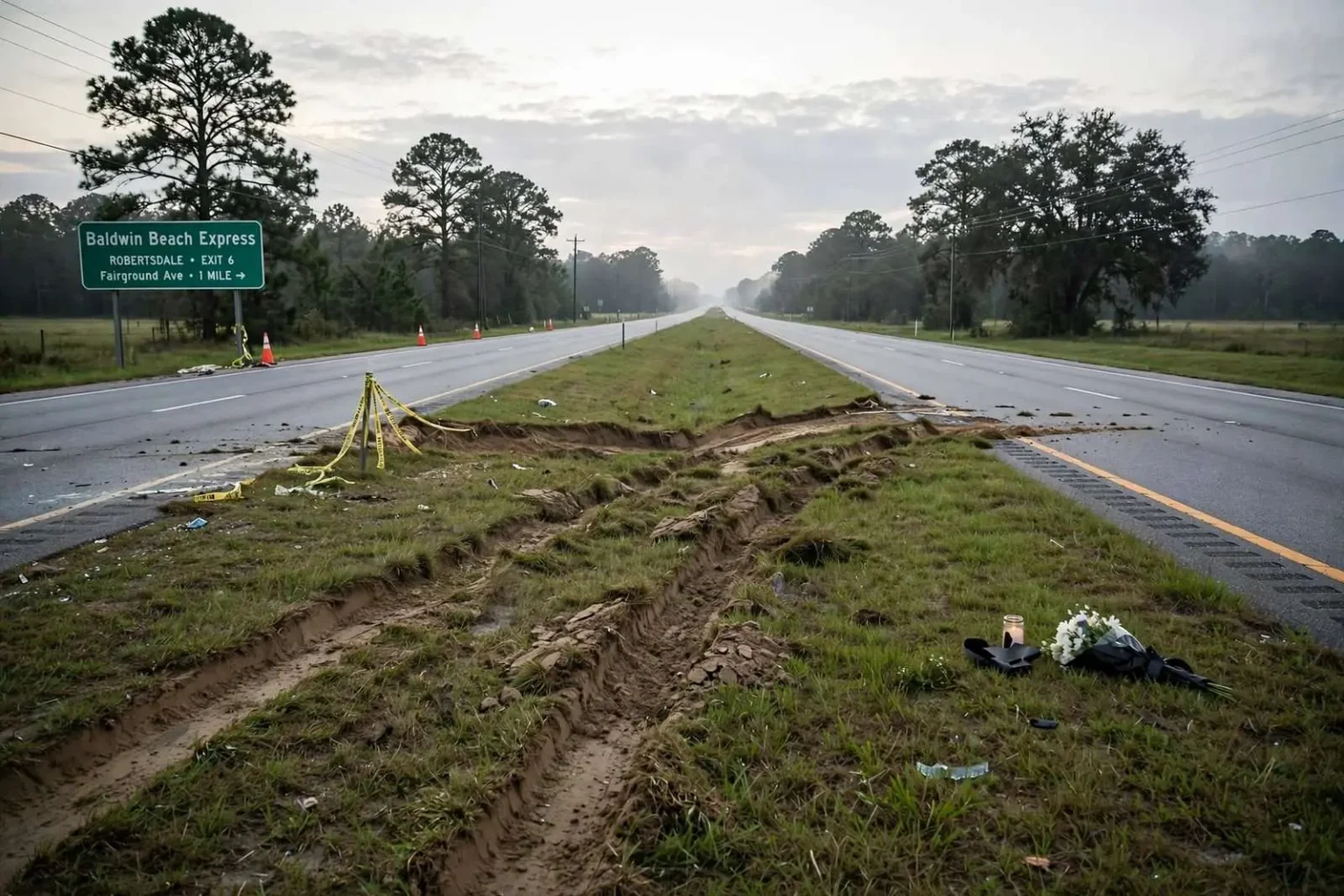
ROBERTSDALE, Ala. — The wreckage was gone by Monday morning. What remained on the Baldwin Beach Express was a scar in the grass median, a scatter of debris along the shoulder, and a young man crouched in the middle of it all.
Fletcher Carlisle had come to the spot where, hours earlier, a friend of his died in a head-on collision. He said he wanted to stand in for the people who could not.
“She has family that is all over, and they might not be able to be here, but they can be here through me,” Carlisle said.
What Happened
The Robertsdale Police Department said officers were called just after 7 p.m. Sunday — the department has placed the time of the two-vehicle crash at about 7:15 p.m. — to the Baldwin Beach Express north of Fairground Avenue, on the stretch that runs between Fairground Road and East Silverhill Avenue.
According to police, a silver Toyota pickup was traveling northbound when it crossed the median into oncoming traffic and struck a Ford F-250 head-on.
“The silver truck that was northbound was occupied by a male and a female,” Robertsdale Police Chief Daniel Steelman said. “Both occupants of the vehicle are deceased.”
Police identified them as 28-year-old Braxton Freckman of Spanish Fort, who was driving, and 33-year-old Kimberly Moody of Mobile, who was a passenger. According to social media posts, the two were a couple.
Three people were in the second vehicle: a man, a woman and a 1-year-old child, all from Summerdale. First responders treated them at the scene and took all three to a local hospital. Police said Monday morning that they had been treated and released.
The department said the crash remains an active investigation and that no further information could be released.
A Friend in the Median
Carlisle described Moody as someone who was easy to be around and difficult to discourage.
“She was always someone who was down to laugh and have a good time,” he said. “She would be there for you if you needed her, so condolences to her family and her work family and the community. I’m just kind of taken aback by it all.”
Crashes of this kind tend to ripple outward through two or three counties at once. Freckman lived in Spanish Fort, Moody in Mobile, the injured family in Summerdale, and the crash happened in Robertsdale — four communities inside a roughly 30-mile radius, connected by the same handful of roads that people here drive every day without much thought.
The Road Where It Happened
The Baldwin Beach Express is one of the busiest pieces of pavement in Baldwin County and one of the newest. It was conceived as a relief valve: a north-south route running roughly parallel to Alabama 59, built to pull beach traffic off the two-lane and small-town stretches of that older highway and give drivers a faster, more direct shot between Interstate 10 and the Gulf.
It has largely worked. On summer weekends and holidays the Express carries a substantial share of the traffic moving between the interstate and the beach communities, and it is a familiar route for Baldwin County commuters year-round. As reported here in the same holiday period, the Express handled a heavy share of Labor Day departure traffic, with the Buc-ee’s travel center at its northern end drawing lines of cars waiting to turn in and out.
The corridor’s design is typical of a modern rural arterial: multiple lanes in each direction separated by a grass median rather than a concrete barrier, with long sight lines, generous shoulders and relatively few intersections between the interchanges. Those characteristics make it efficient. They also mean that a vehicle that leaves its lane has room to travel.
Why Median Crossovers Are So Severe
Traffic engineers treat cross-median crashes as their own category, separate from the run-off-road and rear-end collisions that make up most highway wrecks, because the physics are different in a way that shows up starkly in the outcomes.
In a rear-end collision, the two vehicles are usually moving in the same direction, so the energy involved is a function of the difference in their speeds. In a head-on collision between vehicles traveling in opposite directions, the closing speed is the sum of the two. Two pickups traveling at ordinary highway speeds toward one another can produce a closing speed well over 100 mph. Occupant restraint systems — belts, airbags, crumple zones — are engineered to manage a great deal of force, but a frontal impact at that closing speed sits at the outer edge of what any passenger vehicle can absorb.
That is why divided highways are treated as a safety feature in the first place, and why the median itself is a design decision rather than leftover space. A wide grass median gives a driver who drifts a chance to recover, and it slows a vehicle that leaves the roadway. But a grass median does not stop a vehicle the way a cable barrier or concrete barrier does, and above a certain speed a crossing vehicle can traverse it and reach the opposing lanes.
State transportation departments across the country, including in Alabama, have responded over the past two decades by installing high-tension cable barrier in medians on rural interstates and divided arterials where crossover crashes have clustered. Cable barrier is comparatively inexpensive, it is designed to deflect and absorb rather than stop a vehicle dead, and it can be repaired quickly after a hit. Whether a given stretch of road gets one is usually a function of median width, traffic volume and crash history.
Police have not said what caused the Toyota to leave its lane, and it would be a mistake to assume one. Investigators in crossover cases look at a standard list — speed, impairment, distraction, a medical event, a tire failure, an evasive maneuver, roadway conditions — and the answer often takes weeks to establish. The Robertsdale department has said only that the investigation is active.
What an Investigation Like This Involves
A fatal crash investigation is a slower and more technical process than the roadside cleanup suggests. Before the road reopens, investigators typically photograph and map the scene, document the final rest positions of both vehicles, measure tire marks and gouges in the pavement, and note where debris landed — all of which feeds a reconstruction of the vehicles’ paths and approximate speeds.
From there the work moves off the roadway. Most modern vehicles carry an event data recorder that captures a few seconds of information before an impact: speed, throttle and brake application, steering input, seat belt status. Downloading that data usually requires a warrant or the owner’s consent and specialized equipment. Toxicology results from the state forensic sciences laboratory can take considerably longer. Witness accounts and any available video — from dash cameras, nearby businesses or passing motorists — are gathered along the way.
All of that is why departments decline to characterize a cause early. It is also why families frequently wait months for a final answer.
The People Left Behind
The public record of a crash like this is a set of names, ages and hometowns. The private record is considerably larger. Two households in Spanish Fort and Mobile lost people on a Sunday evening in early September. A Summerdale family spent the night in a hospital with an infant and went home the next morning, which is its own kind of outcome.
Carlisle, standing in the median, was reaching for something the official account does not hold.
“She was always someone who was down to laugh and have a good time,” he said again.
The wreckage has been cleared. The road reopened. For everyone connected to the two trucks that met on the Baldwin Beach Express Sunday evening, the road ahead is a different one than it was.
If You Saw Something
The Robertsdale Police Department is continuing to investigate and has asked that anyone with information about the crash contact the department. Dash camera video from drivers who were traveling the Baldwin Beach Express in either direction around 7 p.m. Sunday can be particularly useful to reconstructionists, even when the driver does not believe they saw anything relevant.
What the Numbers Say About Alabama Roads
Fatal crashes on rural divided highways form a recognizable category in traffic safety data, and the pattern behind them is worth understanding for anyone who drives a corridor like the Baldwin Beach Express regularly.
Rural roads account for a disproportionate share of traffic deaths nationally relative to the amount of driving that happens on them. The reasons are structural rather than behavioral: speeds are higher, emergency response distances are longer, trauma centers are farther away, and the roadside environment offers fewer forgiving features. A crash that would be survivable in an urban setting with a trauma center eight minutes away is not always survivable when the nearest one is thirty.
Baldwin County adds its own variables. It is one of the fastest-growing counties in Alabama, and its road network carries a permanent resident population that has climbed steadily alongside a seasonal visitor population that multiplies traffic volumes on the same pavement. Growth of that kind puts more vehicles on roads that were designed for the traffic of a decade or two earlier, and it puts a substantial share of unfamiliar drivers on them — people navigating by phone, unfamiliar with the interchanges, and often at the end of a long drive.
Fatigue on a Sunday Evening
The timing of this crash — just after 7 p.m. on the Sunday of a holiday weekend — falls in a window that traffic safety researchers watch closely, and it is worth saying plainly that nothing is known about what caused this particular wreck.
What is known generally is that the end of a holiday weekend concentrates a specific set of risks. Drivers are returning home, often after several days of disrupted sleep. Traffic volumes are elevated. The light is failing. And the share of drivers who have consumed alcohol rises on holiday weekends relative to ordinary ones, according to federal crash data collected over decades.
Drowsy driving is the least discussed of those factors and among the hardest to measure after the fact, because there is no roadside test for it. Research using driving simulators and naturalistic driving studies has repeatedly found that sustained wakefulness degrades reaction time and lane-keeping in ways comparable to alcohol impairment, and that drivers are poor judges of their own alertness in the moments before a lapse. Lane departure — the mechanism in this crash — is the classic signature.
Again, investigators have not indicated a cause here, and it would be irresponsible to assign one. The point is narrower: the conditions that make a Sunday evening drive home the most demanding drive of a holiday weekend are the ones drivers are least likely to account for.
Resources for Families
For families dealing with the aftermath of a fatal crash, several practical resources exist in this region.
Alabama’s victim services network includes county-level victim service officers attached to district attorneys’ offices, who can help families navigate the investigative process and any subsequent court proceedings. The Alabama Crime Victims Compensation Commission administers a fund that can cover certain expenses, including funeral costs, for victims of qualifying incidents, though eligibility for traffic crashes depends on the circumstances.
Grief support in Baldwin and Mobile counties is available through hospital-affiliated bereavement programs, hospice organizations that extend counseling to the broader community, and congregations across the region. Support groups specifically for families who have lost someone in a traffic crash exist nationally and increasingly meet online, which removes the geographic barrier for people in smaller communities.
None of that changes the facts of a Sunday evening on a highway in Baldwin County. It is offered because families in this situation frequently do not know these resources exist until someone tells them.