Baldwin County Board of Education Names Marty McRae as Next Superintendent
The Baldwin County Board of Education has selected longtime educator Marty McRae, who has spent 36 years in the district, as the next superintendent of Baldwin County Public Schools.
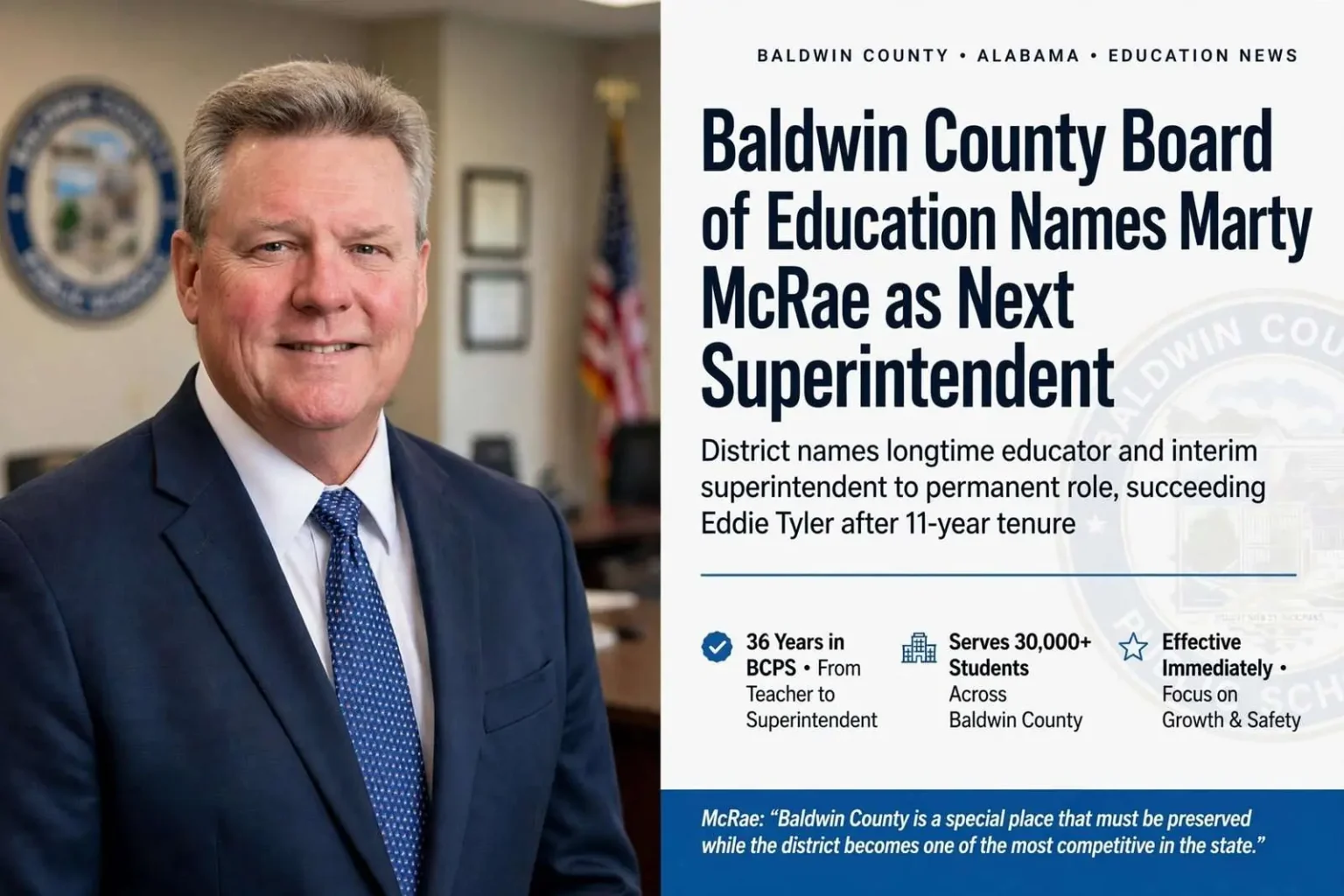
The Baldwin County Board of Education has selected Marty McRae as the district’s next superintendent, elevating him from interim superintendent to the permanent position effective immediately. McRae succeeds Eddie Tyler, who led Baldwin County Public Schools for 11 years and announced his retirement in March after a half-century in public education; Tyler’s last day was June 30, and McRae served as interim superintendent in the weeks between his departure and the board’s Thursday vote. The decision keeps the county’s top schools job in homegrown hands and hands the system’s leadership to an administrator whose entire career has unfolded inside the district he now runs.
A Career Built in One District
McRae brings 36 years of experience entirely within Baldwin County Public Schools, having served the district as a teacher, coach, technology coordinator, assistant principal, principal and assistant superintendent. That résumé — a full ladder of school-level and central-office jobs — is unusual even among long-tenured educators, and it means the new superintendent has personally held nearly every role he will now oversee.
He began his career as a math teacher and coach at Fairhope High School, later serving as the school’s technology coordinator and administrative intern. The early years in the classroom and on the coaching fields shaped the perspective he carried into administration: a superintendent who came up teaching algebra and coaching after-school practices sees budget sheets and bus routes through the eyes of the people who live under them.
He went on to serve as assistant principal at Fairhope High School from 2004 to 2010, then as principal of Spanish Fort High School from 2010 to 2015. Those years spanned a period of explosive change on the Eastern Shore, as both Fairhope and Spanish Fort grew from small towns into fast-expanding suburbs, with enrollment pressures to match.
McRae has also served as Baldwin County’s athletic director since 2015, a portfolio that put him in charge of one of the more visible parts of county school life. Friday-night football, baseball and softball complexes and the district’s athletic facilities carry outsized importance in Baldwin County communities, and the athletic director’s office manages the budgets, safety and scheduling behind all of it.
The dual enrollment and credit recovery portfolios carried particular weight in a county positioned between two states and several colleges. Dual enrollment lets high schoolers accumulate college credit through nearby campuses, easing both the cost of a degree and the transition out of high school, while distance learning extends course catalogs that a single school could never staff on its own. Credit recovery, meanwhile, has become a cornerstone of graduation-rate efforts, catching students who stumble rather than losing them.
The Central Office Years
He was assistant superintendent of Secondary Education from 2015 to 2022, overseeing and evaluating secondary school principals and supporting curriculum initiatives such as dual enrollment, distance learning and credit recovery programs. The work reached every high school and middle school in the county, from the classroom observation cycle to the programs that let students earn college credit or make up lost coursework on flexible schedules.
Most recently, McRae served as assistant superintendent for Prevention and Support/Student Services, overseeing transportation, child nutrition, attendance, alternative education, after-school programs, counseling and health services. It is the least glamorous and most operational corner of a school district — the departments that get thousands of children fed, transported, counseled and cared for every day — and it is where a district’s promises to its families succeed or fail.
In that role, he also led the rollout of districtwide safety initiatives, including surveillance systems, employee panic alerts and standardized emergency response protocols. School security spending and planning surged nationally over the last decade, and Baldwin County’s approach under McRae combined hardware — cameras and alert systems — with the less visible work of training staff to respond the same way across more than forty campuses.
Superintendent transitions carry unusual weight in Alabama’s county districts, where the board’s hire functions as both chief executive of a major enterprise and the public face of the schools. Baldwin County’s system is among the largest employers in the county, and decisions made in the superintendent’s office — calendars, construction, curriculum, staffing — ripple through municipal budgets and property values from Bay Minette to Gulf Shores.
The interim period gave the incoming superintendent a live audition. Moving from interim to permanent leadership is a common enough path that boards treat the months of caretaker service as an extended interview: the interim manages the budget cycle, the personnel calendar and the board meetings, and the board watches how the candidate handles exactly the job being offered.
The Selection Process
McRae and Tony McGee, superintendent of Mississippi’s Starkville-Oktibbeha Consolidated School District, were the board’s two finalists for the position, and both were interviewed earlier in the week before the board’s vote. McGee has steered a roughly $100 million project to build a new high school in Starkville, one of the most expensive public education construction projects in Mississippi’s history, experience that made him a serious contender for a district scrambling to build schools. The choice between an inside heir and an outside candidate presented the board with a familiar fork: continuity and institutional knowledge on one side, a fresh set of eyes on the other.
Several Baldwin County residents addressed the board ahead of the decision, urging members to weigh the long-term impact of their choice on students, teachers and families. Public comment at superintendent votes tends to draw the district’s most engaged parents and educators, and their message — that the decision would echo for years — framed the stakes for a system of the county’s size.
McRae holds a Master of Education from the University of South Alabama and a Bachelor of Science from Auburn University at Montgomery, along with administrative certification and Superintendent Academy completion from the University of South Alabama in 2020. His preparation is rooted entirely in Alabama institutions, from Montgomery to Mobile.
“I am deeply honored to have the opportunity to serve as superintendent of Baldwin County Public Schools,” McRae said. “Baldwin County is a special place that must be preserved while the district becomes one of the most competitive in the state.”
The Challenge: Growth
Board member Andrea Lindsey said the district is in a strong position but still has room to grow, adding that she expects McRae to build on the system’s momentum. The comment reflected the board’s posture in handing the system to a veteran of its own ranks: the expectation is not a turnaround but a continuation, with acceleration where the district lags.
Board member Jason Woerner, who backed McRae, pointed to the breadth of his district-level experience as the deciding factor, saying each promotion represented greater responsibility and accountability and that McRae’s work expanded well beyond a single school building to operations that affect students every day. A long list of Baldwin County educators and administrators vouched for McRae. After the vote, McRae said he was excited for Baldwin County, which he called a wonderful place, and that the district wants to continue a tradition many years in the making.
McRae said one of his early priorities will be managing the county’s rapid growth, including finding land and building new schools to keep pace with the influx of new residents. Few school districts in America face the arithmetic Baldwin County does: thousands of new residents arriving each year along the I-10 corridor and the Eastern Shore, each new subdivision translating directly into children who need desks, teachers and classrooms.
Baldwin County Public Schools serves more than 30,000 students and employs about 4,500 people, making it one of Alabama’s largest school systems. The district’s footprint spans the county from Gulf Shores and Orange Beach on the coast to communities along the Perdido River on the east, a geographic spread that multiplies every logistical challenge — bus routes alone cross some of the largest distances of any district in the state.
Site selection for new schools has become a genuine political exercise in the county, with fast-growing corridors competing for the next campus and older communities pressing for renovation of existing buildings. Land prices along the Eastern Shore complicate the equation further, and school construction has repeatedly appeared on local tax and bond discussions as growth outruns capacity.
Teacher recruitment stands alongside growth as the perennial challenge. Baldwin County competes for educators not only with neighboring Mobile County but with school systems across the state line and with the private sector along the growing Eastern Shore, where the cost of housing has climbed steeply. How the district pays, houses and retains its teaching force will shape the next decade as much as any new construction.
The district’s scale also gives it leverage. A system of 30,000 students can run its own career-technical programs at meaningful depth — health sciences, hospitality, construction trades tied to the coast’s building boom — and can negotiate for services and technology that smaller systems cannot. McRae’s career, from the classroom through the operations side, has given him a view of both ends of that scale: what a single school needs and what a system of this size can provide.
What Comes Next
McRae said district leaders are still finalizing their goals for the coming year and plan to share more details with staff and parents in the weeks ahead. The goal-setting exercise will land against a backdrop of the state’s ongoing education debates — testing, school choice, teacher recruitment — that every Alabama superintendent must translate into local practice.
“I cannot do this without our communities’ buy-in and without our parents’ buy-in,” McRae said. “I hope they will join me and partner with me on keeping this system at a level we all expect and deserve.”
For a district that has grown this fast, the ask is not decorative. Tax bases, volunteer networks, booster clubs and PTOs all scale with the population, and a system adding students by the thousand each year cannot maintain quality on central administration alone. The new superintendent’s first message made the bet explicit: the county’s schools will rise or fall with the communities that surround them.