Baldwin County Health Department Reported 2007 EEE Case in Gulf Shores Child
Archived WKRG coverage reported that a Gulf Shores child tested positive for Eastern Equine Encephalitis in 2007, according to the county health department.
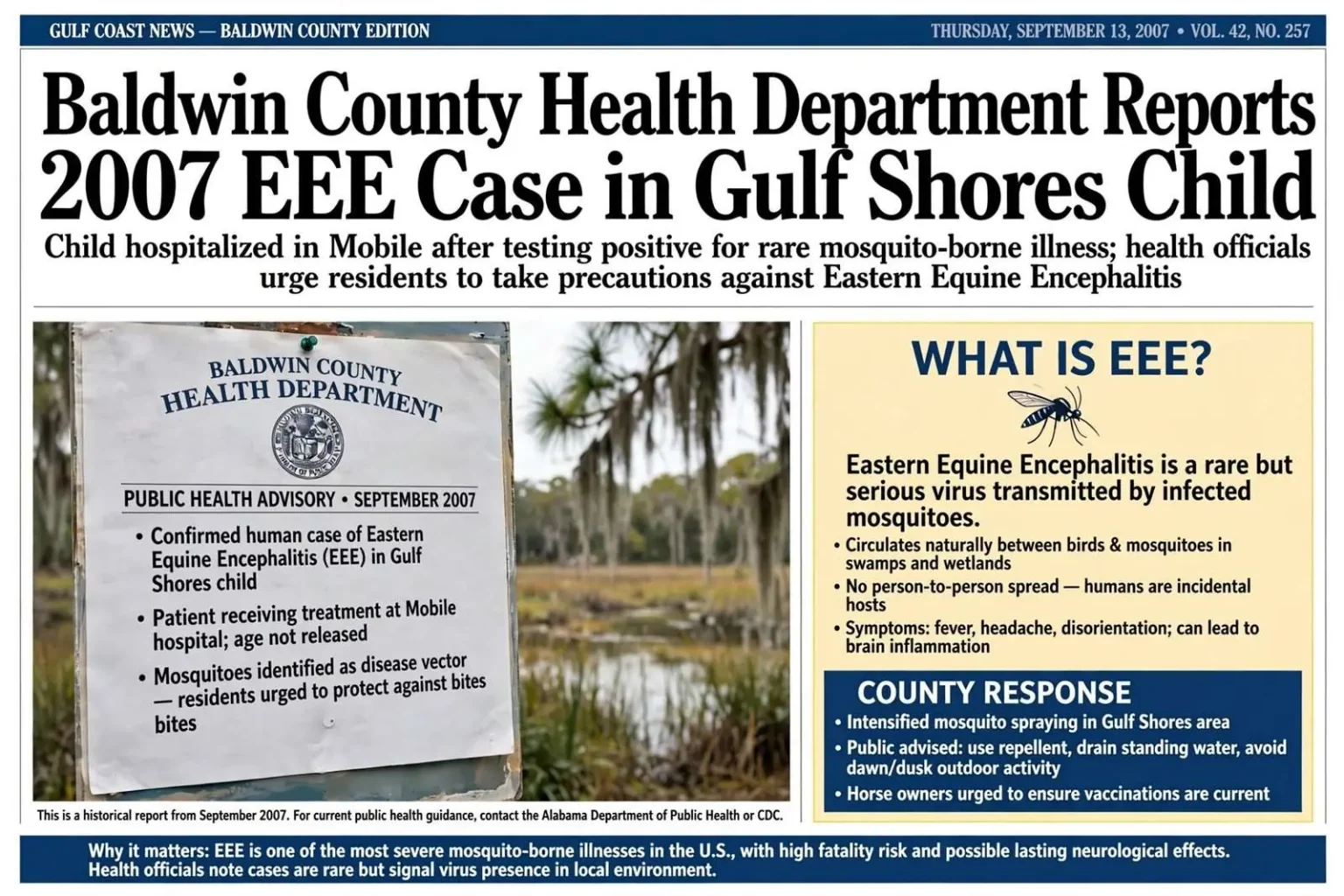
The Baldwin County Health Department reported in September 2007 that a child from Gulf Shores had tested positive for Eastern Equine Encephalitis, according to an archived local news account of the announcement. The report said the child was being treated at a hospital in Mobile, and that the child’s age was not released. Health officials identified mosquitoes as the disease vector and described the seriousness of EEE, a rare but severe mosquito-borne illness, in warning residents across the county to take precautions.
The confirmation of a human case in a coastal Baldwin County community drew immediate attention because of how uncommon — and how dangerous — Eastern Equine Encephalitis is. Health authorities regard EEE as among the most serious of the mosquito-transmitted diseases found in the United States, and a confirmed pediatric case prompted renewed mosquito-control efforts and public education across Baldwin County in the weeks that followed.
A rare and serious illness
Eastern Equine Encephalitis is a viral disease transmitted through the bite of an infected mosquito. Its name reflects its history: the virus was first identified in horses, which, like humans, are dead-end hosts — infected animals do not spread the virus onward. The natural cycle of the virus circulates between birds and mosquitoes in freshwater swamps, and humans become incidental hosts when a mosquito that has fed on an infected bird bites a person. Because the virus does not pass from person to person, a single case signals the presence of the virus in local mosquito and bird populations rather than a contagion risk to neighbors.
The severity of the illness is what makes even isolated cases a public-health emergency. Many people infected with the virus develop no symptoms at all, but those who develop the disease’s severe form — inflammation of the brain, or encephalitis — face a grave prognosis. EEE is recognized by the federal Centers for Disease Control and Prevention as one of the most severe mosquito-borne diseases in the country, with a significant fatality rate among symptomatic cases and a high likelihood of lasting neurological damage among survivors. There is no specific antiviral treatment for EEE; care is supportive, and recovery, when it occurs, can be long and incomplete. The onset of symptoms — fever, headache, chills, and in serious cases disorientation, seizures or coma — typically follows the infective bite by several days.
Why Baldwin County watches
Baldwin County’s geography places it squarely in the territory where EEE risk appears. The county stretches from Mobile Bay east to the Florida line and from the Gulf beaches north through pineywoods and river bottoms, and its coastal plain is threaded with swamps, marshes, retention ponds and tidal creeks — ideal habitat for the mosquito species that carry the virus. Gulf Shores, the resort city at the county’s southern edge, combines that wetland environment with a large summer population of visitors, making mosquito-borne illness surveillance a standing part of county public-health work.
The Baldwin County Health Department, part of the Alabama Department of Public Health’s network of county health offices, monitors for mosquito-borne disease by testing mosquito pools, sentinel chickens and reports of suspected human cases, and by coordinating mosquito-control activity with municipal and county crews. In years when the virus shows up in birds, horses or mosquito samples, the department issues public advisories urging residents to protect themselves. The September 2007 confirmation of a human case in Gulf Shores represented the point at which that surveillance system moved from advisory to alarm: a human infection meant the virus was present in the local environment and that prevention could no longer be optional.
Horses are also vulnerable, and in Alabama the appearance of EEE in horses often precedes or accompanies human risk. Veterinarians across the Gulf Coast region routinely urge horse owners to vaccinate their animals against both Eastern and Western Equine Encephalitis, and equine cases reported to the state in late summer are a standard early-warning signal used by health departments on the coast.
The response to a confirmed case
When a human EEE case is confirmed, county health departments follow a well-established playbook. Mosquito-control districts and municipal crews intensify spraying in the affected area, focusing on the species of mosquito most likely to have transmitted the virus. The health department renews its warnings to the public, and local news coverage — like the report of the Gulf Shores child’s illness — carries those warnings to the widest possible audience. Schools, parks departments and civic groups pass along reminders to eliminate standing water, the breeding ground where mosquitoes multiply in containers, gutters, ditches and neglected pools.
Public-health messaging in such situations concentrates on a short list of effective actions. Residents are urged to avoid outdoor activity at dawn and dusk, when the mosquito species most associated with virus transmission are most active; to wear long sleeves and long pants when outdoors; to use insect repellents containing DEET, picaridin or oil of lemon eucalyptus according to label directions; and to drain or treat standing water around homes. Window and door screens are checked, and horse owners are reminded to keep vaccinations current. None of these measures is complicated, but together they determine whether a virus circulating in the wetlands reaches another human host.
For the family of the Gulf Shores child, the medical response unfolded at a Mobile hospital. Because EEE is so rare and so serious, suspected cases are typically treated at facilities equipped for neurological intensive care, and Mobile’s hospitals — the referral centers for the central Gulf Coast — serve that role for Baldwin County’s population of more than 150,000 as well as for visitors to the beach communities. The decision not to release the child’s age reflected standard confidentiality practice in health-department communications about medical cases.
2007 on the Gulf Coast
The Gulf Shores case came in a year when mosquito-borne illness was very much on the minds of Gulf Coast health officials. The region’s long, hot, wet summers reliably produce heavy mosquito populations, and West Nile virus — which arrived in Alabama earlier in the decade — had made mosquito surveillance a routine part of public-health work statewide. Eastern Equine Encephalitis, though far rarer than West Nile in human cases, commands greater urgency because of its severity, and any human case in the southeastern United States is treated as a serious signal about the local environment.
Baldwin County in 2007 was one of Alabama’s fastest-growing counties, with subdivisions spreading across former pine forest and farmland and the beach communities swelling with tourists each summer. That growth brought more people into contact with the wetland edges where the virus circulates among birds and mosquitoes, and it stretched the mosquito-control resources of municipalities and the county. Health departments in such fast-growing coastal counties have to balance development pressure with environmental surveillance, and the 2007 EEE case was a reminder of why that balance matters: the habitat that attracts new residents and visitors to the coast is the same habitat that sustains the virus.
What EEE means for Gulf Coast residents
For residents of Gulf Shores and the rest of coastal Alabama, the 2007 case illustrated an enduring fact of life on the northern Gulf Coast: mosquito-borne disease is a seasonal risk that never fully disappears, and personal prevention is the most reliable defense. The viruses that matter locally — Eastern Equine Encephalitis, West Nile virus and, in other years, St. Louis encephalitis — all follow the same basic pattern, circulating in bird and mosquito populations through the warm months and occasionally reaching humans or horses. Public-health agencies cannot eliminate the viruses from the environment; they can only monitor them, control mosquitoes where possible, and teach residents how to reduce their own exposure.
Surveillance on the coast has continued in the years since 2007, with the state and county agencies testing mosquitoes and sentinel animals each season and issuing advisories when the viruses appear. The practical guidance has stayed largely the same across the years, because the biology has not changed: the risk peaks from late summer through early fall, at dawn and dusk, in and near wetlands, and the precautions — repellent, protective clothing, screens and the elimination of standing water — remain the surest protection for families.
It is worth emphasizing how uncommon symptomatic EEE cases are. Most summers pass in Alabama without any human cases at all, and the appearance of one in a specific community is newsworthy precisely because of its rarity. But rarity cuts both ways: because cases are so infrequent, there is no population immunity, no widely deployed vaccine for people, and no established treatment — so each case, like the Gulf Shores child’s in September 2007, is met with the full attention of the public-health system.
This article is a historical account of a 2007 public-health report as preserved in archived local news coverage. It describes the Baldwin County Health Department’s announcement, the facts reported at the time, and general background about Eastern Equine Encephalitis. It is not a current outbreak notice, and it is not medical guidance. For current information about mosquito-borne illness in Baldwin County or anywhere else, use guidance from current public-health authorities, including the Alabama Department of Public Health and the Centers for Disease Control and Prevention, and contact a qualified clinician with any medical concerns.