Baldwin County Board Closed Fairhope Alternative School in 2009
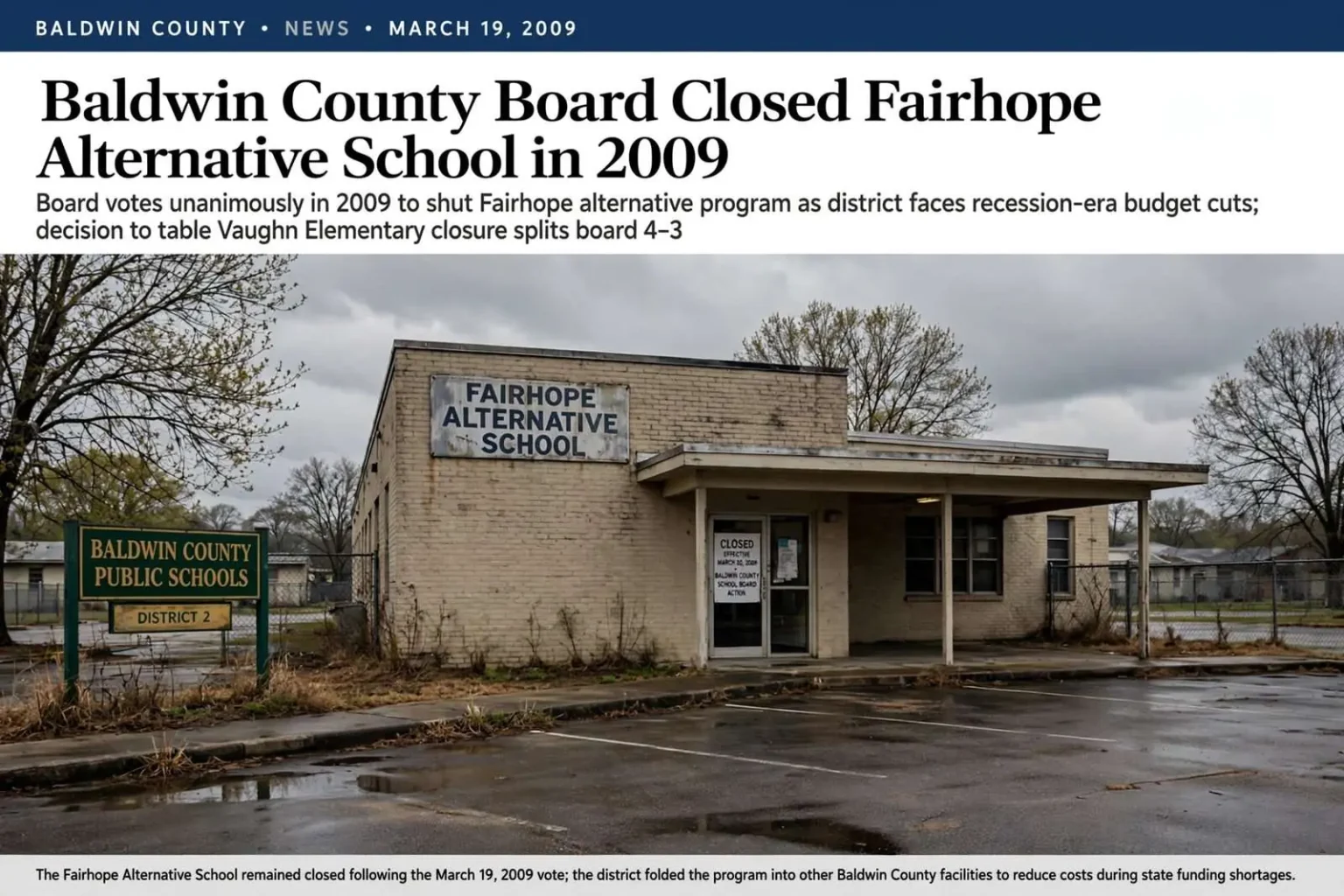
The Baldwin County School Board voted unanimously in 2009 to close the Alternative School in Fairhope while delaying a decision on Vaughn Elementary in Stockton.
Originally reported March 19, 2009.
The Baldwin County School Board voted unanimously in 2009 to close the Alternative School in Fairhope, according to an archived local news report, a decision that folded the alternative program’s operations back into other district facilities as the system worked to trim its budget.
The board delayed a decision on closing Vaughn Elementary in Stockton, voting 4-3 to table that issue. The split vote reflected the tension running through the entire budget process: board members who wanted to move quickly on consolidations faced colleagues who argued that a small rural school could not be evaluated on the same timetable as an urban program.
School officials described the decisions as part of a longer effort to save money. The spring of 2009 found Alabama school systems absorbing the first shocks of the national recession, with state education funding — the foundation of most district budgets — under pressure as sales and income tax receipts fell across the state.
This article records the 2009 board action and does not describe current Baldwin County school operations. The system has changed considerably in the years since, through growth, new construction and repeated rounds of reorganization driven by enrollment shifts and funding cycles.
The alternative school decision
Alternative schools occupy a particular place in a district’s operations. They serve students who have been removed from traditional campuses for disciplinary reasons, students who need a nontraditional setting to finish their education, and sometimes both. Closing such a program does not make its students disappear; it redistributes them.
In voting unanimously to close the Fairhope Alternative School, board members agreed that the program’s functions could be absorbed elsewhere in the system at a lower cost. The alternative students served from the Fairhope area would be reassigned to other arrangements, and the district would shed the cost of operating a separate campus — utilities, maintenance, staffing and transportation all factor into a building’s total price.
The unanimous vote suggested the closure was one of the less controversial items on the consolidation list. Alternative programs, though valued by educators, generally serve a small population and draw less community resistance than closing a neighborhood elementary school, where the affected families are numerous and local identity is bound up in the building.
That contrast was visible in the board’s handling of the second question that night: Vaughn Elementary in Stockton, where the vote to table the issue rather than close it reflected a community’s stake in keeping its school open.
The Vaughn Elementary question
Vaughn Elementary served the Stockton community in northern Baldwin County, one of the small rural communities in a county better known for its fast-growing coastal towns. Small rural schools like Vaughn are expensive per student to operate — a building must be staffed, heated, cooled and maintained regardless of how few classrooms are filled — but they are also, for the communities around them, the most visible institution the county operates.
The 4-3 vote to table the decision was a compromise in the moment, not a resolution. Tabling meant the question would return at a later meeting, giving supporters time to organize and giving board members time to look for alternatives — transfers of grade levels, shared staffing, or budget movements that could keep the school alive without unbalancing the district’s finances.
For the Stockton area, the stakes were about more than bus routes. Rural schools anchor their communities: they host gatherings, employ residents, and define whether a crossroads community feels like a place or a memory. School board members from northern Baldwin County have historically weighed those realities alongside the spreadsheets, and the split vote showed exactly that division around the table.
The budget pressure behind the votes
School officials framed both decisions as part of a longer effort to save money, and the timing explains why. Alabama funds its schools primarily through the Education Trust Fund, which draws on income taxes and sales taxes. When the economy contracts, school funding contracts with it, often with a lag that hits districts hardest a year or two after the downturn begins.
Baldwin County Public Schools, one of the larger systems in the state, spans a county of enormous geographic and economic variety — from the beaches and developments of the Gulf shore to agricultural communities in the north. Operating schools across that spread means long transportation routes, many aging buildings in the county’s older communities, and explosive growth demands along the Highway 98 and Interstate 10 corridors.
The district has gone through multiple rounds of consolidation and construction over the decades, and the 2009 meeting was one episode in that longer pattern. Closures and consolidations are the hardest budget tools a board can use, because the savings are real but the costs are paid by specific communities — which is why the board closed one program unanimously and could not even agree to vote on another.
What the 2009 decisions meant locally
For Fairhope, the closure of the Alternative School removed a program many residents may have known little about, but it also signaled the direction of the district’s budget thinking as the recession deepened. Programs that serve small populations were examined first, and the alternatives — larger class sizes elsewhere, deferred maintenance, reduced staffing — were weighed against keeping a separate campus open.
For Stockton, the tabled vote meant another season of uncertainty. Families with children at Vaughn Elementary faced the possibility that the school their community had relied on for generations could be closed by a board vote at a future meeting. That kind of limbo is hard on small communities: enrollment decisions, teacher assignments and PTO planning all depend on knowing whether the school has a future.
The archived report of the meeting preserves the texture of that moment: a unanimous vote on one closure, a 4-3 tabling on another, and a board working through the arithmetic of a downturn with communities watching from the audience.
Regional context
The communities and regions mentioned in this report are part of Alabama’s diverse geographic landscape, and the 2009 deliberations illustrate how one county’s decisions ripple across its boundaries. Baldwin County’s population growth over the years since has repeatedly reshaped its school map, with new schools rising along the coast while small northern campuses fight for survival in every budget cycle.
Institutions such as the board and the school system play pivotal roles in their respective communities, providing essential services, employment, and civic leadership. Decisions made in a boardroom in Bay Minette, where the district is headquartered, echo in Fairhope’s budgets, Stockton’s community life and every other corner of a county that covers more square miles than nearly any other in Alabama.
The themes at play — government and civic affairs, education and schools — reflect issues that directly impact residents’ daily lives. A closure decision touches property values, commuting patterns, family choices about where to live, and the confidence a community has in its local institutions.
Understanding the broader regional context helps illuminate how individual events and decisions resonate across community boundaries. The interconnected nature of these issues means that developments in one area — a funding shortfall in Montgomery, an enrollment surge in Foley — often have implications for others, creating the complex web of community dynamics in which every school board vote is ultimately decided.
As of the 2009 report, the Fairhope Alternative School’s closure was set and Vaughn Elementary’s fate was deferred, with the board’s long effort to save money continuing into the difficult budget years that followed.
How Alabama school funding shaped the era
The backdrop for the 2009 votes was a funding system that makes Alabama school boards unusually sensitive to economic swings. Because the Education Trust Fund depends on income and sales taxes, a recession translates directly into mid-year budget cuts, and districts must respond with hiring freezes, program reductions and, ultimately, closures. The 2009-2010 school years saw systems across the state making exactly the kind of decisions Baldwin County was weighing that March.
Boards typically exhaust less painful options first: leaving positions vacant, trimming supply budgets, delaying purchases. But personnel and facilities dominate any school budget, and once those deeper cuts begin, the questions become as much about geography as arithmetic — which buildings stay open, which programs are consolidated, and which communities absorb the change.
Baldwin County’s size makes those questions especially sharp. The county is one of the largest in Alabama by area, and its schools serve communities as different as Gulf Shores, Fairhope, Bay Minette and Stockton. A dollar saved by closing a small northern campus is a dollar of pain concentrated in a single community, while the same dollar might be raised along the growing coastal corridor through less disruptive means.
That tension ran through the 2009 meeting and through every similar meeting since. The unanimous vote to close the Fairhope Alternative School and the 4-3 tabling of the Vaughn Elementary decision, taken together, show a board applying the budget blade selectively — and pausing where the community cost was highest.
For readers reviewing this archived coverage years later, the meeting stands as a snapshot of that era: a growing coastal county, a recession tightening state funding, and elected board members voting, in public, on which corners of the county would carry the burden. The decisions of that night belong to their time, and the district’s present-day operations have been shaped by many subsequent votes — but the pattern the 2009 meeting displayed, of shared sacrifice balanced against local loyalty, has remained the defining dynamic of Baldwin County school governance.