Baldwin County Opens Homeownership Assistance Program for Households Hit by Hurricanes Sally and Zeta
Baldwin County has launched the Homeownership Assistance Program for households affected by Hurricanes Sally and Zeta. Applications open Sept. 21, with public meetings Sept. 15 and 16.
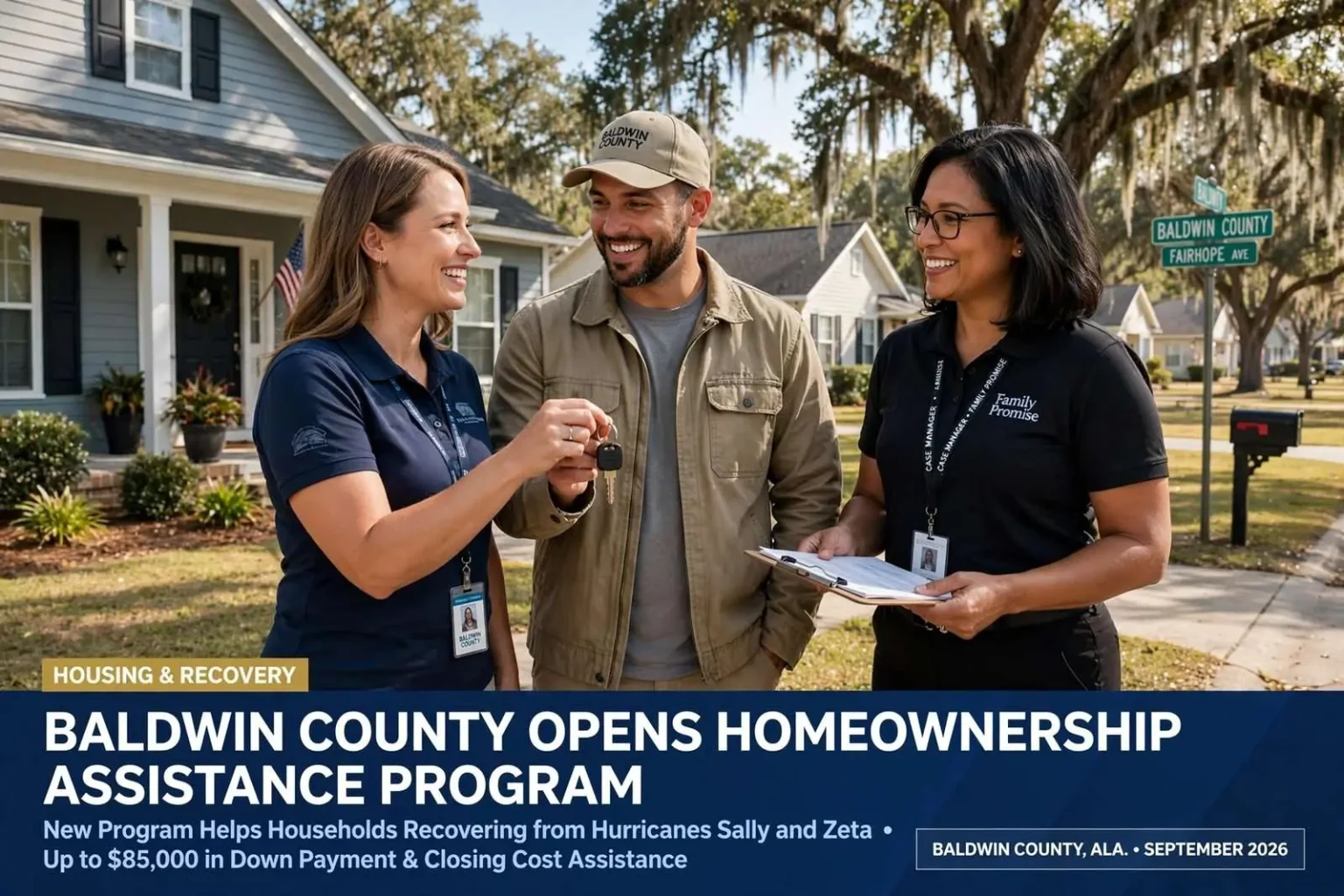
BALDWIN COUNTY, Ala. — The Baldwin County Commission has launched the Homeownership Assistance Program, a countywide effort to help income-qualified households still working to recover from Hurricanes Sally and Zeta. The program, known as HAP, is designed to close the gap between what families can afford and what a home actually costs — a gap that widened considerably for many households after the storms. County officials describe it as a recovery program aimed not at emergency relief but at the slower, harder problem of getting displaced and financially strained families back into permanent housing.
The launch comes roughly six years after Sally came ashore near Gulf Shores in September 2020 as a Category 2 hurricane, pushing a damaging storm surge through coastal communities from Dauphin Island Parkway east to Orange Beach and dumping flooding rains across the length of Baldwin County. Zeta followed about six weeks later, cutting across the region with destructive winds that downed trees and knocked out power for days. For thousands of households, the combined blows turned modest financial cushions into none at all.
The scale of the effort is unusual for a single Alabama county. The commission has allocated approximately $19 million to the program, enough to provide assistance to as many as 200 eligible households, drawing on money the state routed to Baldwin County for unmet recovery needs left over from the 2020 storms.
“Baldwin County has never offered a program like this before,” the county said in a statement describing the effort.
The problem the program addresses
Disaster recovery places sustained financial pressure on families long after the immediate emergency passes. Private insurance settlements and initial relief packages frequently fall short of covering the full cost of storm damage and housing recovery. Income-qualified residents are often left facing affordability gaps that prevent them from purchasing or maintaining safe, stable housing.
Baldwin County’s housing market has also changed substantially since 2020, with prices rising in a way that compounds the original loss. A household that could have replaced a damaged home five years ago may find the same purchase out of reach today. The county’s rapid population growth, its popularity as a retirement and second-home destination, and the general run-up in building costs across the Gulf Coast have all pushed prices upward while the storm-affected families have been trying to rebuild their savings.
Housing counselors who work with disaster survivors describe a common pattern: a family with insurance proceeds that seemed adequate in 2020 discovers, when it finally returns to the market, that those proceeds now cover a fraction of what a comparable home costs. Wages have not kept pace with the increase, and households that were already near the margin before the storms have had the least capacity to absorb the difference. That is the population HAP was designed for.
The program also recognizes that storm damage does not always end in a total loss that shows up clearly in an insurance claim. Roofs weakened by repeated wind events, interiors damaged by wind-driven rain, and deferred repairs that grow more expensive with time all erode a household’s finances quietly. Families in that position often cannot save for a down payment while they are still paying for repairs, which is why the county chose to build a program around purchase assistance rather than repair grants alone.
What assistance is available
HAP funds can be applied toward down payments — with assistance of up to 20% of a home’s purchase price — as well as interest rate buy-downs, principal write-downs and closing costs. Closing cost coverage includes inspections, appraisals, surveys and legal services. Initial home warranty premiums are also eligible.
The county has set a ceiling on what any one household can receive. “Individual awards may total up to $85,000, depending on household need,” the county’s statement said. “Eligible costs include down payment assistance and interest rate buy-downs and closing costs. Down payment assistance is limited to 20% of the total purchase price.”
Beyond those categories, the program may cover legal services tied to the homebuying process and buyer’s agent fees of up to 3% when those fees are not paid by the seller. Home inspections, homebuyer education, case management and lender coordination are also listed among the eligible costs, which means a household can be carried through the transaction itself rather than simply handed money toward it.
The combination is deliberately broad. Interest rate buy-downs and principal write-downs affect monthly affordability over the life of a loan, while down payment and closing cost help address the upfront barrier. Many applicants face both. A buy-down that lowers the note by a few hundred dollars a month can be the difference between qualifying for a mortgage and being turned away, and it does far more for long-term stability than a one-time check of the same size.
The closing cost piece matters more than many first-time buyers expect. Between the home inspection, the appraisal a lender requires, the survey that confirms property boundaries, and the attorney fees tied to closing, the costs of simply completing a purchase in Alabama can run into the thousands of dollars. For a family that has spent its savings on storm recovery, those line items are often the final obstacle. Coverage of an initial home warranty premium adds a measure of protection against the surprise repairs that come with an older or storm-touched house.
Because the assistance attaches to the purchase itself rather than to a specific repair, the program is also flexible in the kinds of homes it can serve. A household rebuilding in the same neighborhood it lost and a household relocating to a different part of the county can both be served by the same set of tools, as long as the purchase fits the program’s rules.
A forgivable loan, and a five-year commitment
The assistance is not a grant in the ordinary sense. Awards will be provided through a forgivable, no-interest loan agreement with the county, and recipients must occupy the home for at least five years from the closing date.
Structures of that kind are standard in publicly funded homeownership programs, and the logic behind them is straightforward. Because no interest accrues and the obligation is forgiven once the occupancy term is satisfied, a household that stays put ends up in the same position as if it had received a grant. The agreement exists to make sure the public money produces what it was meant to produce — a family living in a home it owns — rather than a quick resale at a profit.
For applicants, the practical effect is that the five-year clock starts at closing and should be weighed alongside the ordinary questions of commute, schools and monthly payment. A household that expects to relocate within a few years needs to understand the terms of the agreement before it signs one.
Who qualifies
To be eligible, a household must have earned 80% or less of the Area Median Income at the time of the storms. Applicants must also have been Baldwin County residents during Hurricanes Sally or Zeta. Former residents seeking to return may qualify, as may those who were purchasing a storm-damaged home at the time of the disaster.
The county lists the area median income used for the program at $102,400, and prioritizes households earning at or below 80% of that figure. Applicants must also meet at least one disaster tie-back requirement: living in Baldwin County during the disaster event, having been directly or indirectly affected by the storms, and having been approved to purchase a home or in the process of buying a storm-damaged home when the disaster struck.
Area Median Income is the federal benchmark that drives most housing assistance, calculated annually for the metropolitan area and adjusted for household size. The 80% threshold is a standard line in federal housing programs, and it captures working families well above the poverty line — teachers’ aides, maintenance workers, retail and service employees — who nonetheless cannot bridge the distance between local wages and local home prices without help.
The residency requirement ties eligibility to the storms themselves rather than to current address. A family that evacuated, doubled up with relatives elsewhere, or moved out of the county after the storms and now wants to come back is not shut out. The same is true for a household that was under contract to buy a home when the storms damaged it and watched the deal fall apart.
Key dates
The official application portal opens Sept. 21, 2026, on the Baldwin County website. Two public information meetings will be held to walk residents through the process and answer questions.
The first meeting is set for Tuesday, Sept. 15, 2026, at 5 p.m. at the Foley Satellite Courthouse, Large Meeting Hall, 201 E Section Ave, Foley, AL 36535. The second follows on Wednesday, Sept. 16, 2026, at 10 a.m. at the Fairhope Satellite Courthouse, Commission Chambers, 1100 Fairhope Ave, Fairhope, AL 36532. The two locations place the meetings on the south end and the Eastern Shore, the areas of the county where storm damage and housing pressure have been most concentrated, and the mixed morning and evening times are intended to accommodate both shift workers and retirees.
Residents who believe they may qualify are encouraged to attend one of the September meetings before the portal opens. Staff at the meetings can help families confirm whether their storm-period income falls under the threshold, explain what documentation to gather — proof of residency at the time of the storms, income records, and identification among them — The county said applicants will need documentation of annual income, including tax returns, along with identification and proof of residency during the disaster event, and that the specific documentation requirements will be spelled out in the application guidance.
First come, first served — and a waiting list
Timing matters because of how the county intends to process what it receives. Applications will be handled on a first-come, first-served basis rather than scored against one another, so an eligible household that applies early is in a materially different position from an equally eligible household that applies late.
Once the program is fully subscribed and all funds have been reserved for applicants receiving Conditional Award Letters, the county will maintain a waiting list of applicants who have met the eligibility requirements. If additional funds become available, or if applicants are removed from the program, the county said it will notify the next eligible applicant on that list.
A Conditional Award Letter is the point at which money is set aside for a specific household, subject to the applicant satisfying the remaining requirements. Reservations of that kind are why a program can exhaust its funds well before the last dollar is actually spent: each letter issued takes an award off the table for everyone behind it. For applicants, the takeaway is that a complete, well-documented application submitted soon after the portal opens is worth more than a perfect one submitted months later, and that landing on the waiting list is not the same as being rejected.
Funding and administration
HAP is funded by the U.S. Department of Housing and Urban Development through Community Development Block Grant – Disaster Recovery funds, distributed via the Alabama Department of Economic and Community Affairs. Family Promise of Baldwin County has been selected as the administrative provider.
Community Development Block Grant – Disaster Recovery money is a familiar instrument on the Gulf Coast. Congress appropriates the funds after major disasters, HUD allocates them to affected states, and the state — in Alabama’s case through ADECA, which administers federal community development funding — designs a recovery action plan that must win HUD approval before dollars flow to local programs. The model gives counties flexibility to address their most serious unmet needs, and in Baldwin County the assessment that guided the plan pointed to housing as the deepest one.
In addition to processing applications, Family Promise will provide homebuyer counseling and personalized case management throughout the purchase process — support that matters considerably for first-time buyers navigating inspections, appraisals and closing for the first time. The organization, long known in the county for its work with families facing housing instability, will stay with each household from the first counseling session through the day it receives its keys, an approach meant to prevent the application errors and missed deadlines that derail otherwise eligible buyers.
Counseling also protects buyers once they are under contract. A caseworker reviewing an inspection report or a lender’s closing disclosure can catch problems that a first-time buyer would miss, and the requirement that families complete counseling before receiving assistance is standard in programs of this type because it measurably reduces defaults later.
What it means for the county
For households that have spent years in rental units, doubled-up arrangements, or unrepaired homes, the program offers a route back to the stability that permanent ownership provides. Stable homeownership is tied to better outcomes in school attendance, health and family finances, and every family that moves out of temporary housing frees capacity elsewhere in the recovery system.
County officials have framed HAP as one part of a longer recovery arc, alongside infrastructure work and mitigation projects funded through the same federal stream. The September meetings and the portal opening mark the point at which the program stops being a plan and starts being help a family can actually apply for. Residents with questions are urged to attend a meeting, review the requirements on the county website, and prepare their documents now, before the application window opens on Sept. 21.
Update: Applications Open Sept. 21, and Every Applicant Gets a Case Manager
The program now has an opening date. Applications open Sept. 21 at 8 a.m. through the Baldwin County Commission’s online application portal, and funds will remain available until the program is fully subscribed.
Baldwin County Grant and Compliance Manager Katrina Taylor described the award as a first for the county.
“It is an amazing and a very rare, this is the first time that the Baldwin County commission has ever been awarded this grant,” Taylor said.
What Assistance Covers
“Through this program, eligible homebuyers can receive direct financial assistance such as down payment support, closing costs, interest rate buy downs, home buyer education, and case management,” Taylor said.
Who Qualifies
Taylor said the program is not limited to people who owned homes when the storms hit. Anyone who lived in Baldwin County in September 2020 — whether renting, owning or living with parents — may qualify. So may someone who was attempting to buy a home in Baldwin County at the time and was prevented from doing so by the storms.
“So what we would need is some proof that they were trying to purchase a home at that time,” Taylor said. “So if we get that, they are eligible as well.”
Household income must be at or below 80% of the area median income. There is no county-imposed cap on the price of the home, but applicants must be pre-approved by a lender before applying. Mobile homes can also qualify.
The county emphasized that this money is for buying a home, not repairing one, and that the home must be in livable condition.
A Case Manager for Every Applicant
The detail most likely to determine whether applicants actually reach closing is the case management structure.
“Baldwin County Commission has partnered with Family Promise and they have five active case managers,” Taylor said. “So, after the county does the initial review of the applications that are submitted and they have that income documents, their pre-approval lender, their proof of residency, then they’re going to be assigned a case manager that is going to walk them through the entire process through closing. And, this is for every applicant.”
Taylor said that matters because buying a home with federal assistance carries substantial paperwork and rules.
“When you’re dealing with federal funds, there’s so much red tape, and if you’re not doing the subject matter expert every single day with it, for a normal citizen, there is a lot of communication barriers,” she said. “They’re definitely that partner to really help us get to closing.”
Federally funded homebuyer assistance programs nationally lose a meaningful share of otherwise eligible applicants to documentation requirements and process complexity rather than to ineligibility. Assigning a case manager to every applicant, rather than only to those who request help, is a direct response to that pattern.