Baldwin County Lifts Curfew in Unincorporated Areas, Fort Morgan Road Exception Remains
Baldwin County has lifted its overnight curfew for unincorporated areas following Hurricane Sally, though a curfew remains in effect for residents along Fort Morgan Road as well as inside Gulf Shores and Orange Beach.
Baldwin County officials have lifted the public curfew that had been in place across unincorporated areas of the county in the weeks following Hurricane Sally, giving residents outside city limits more freedom to move about at night as recovery work continues. The rollback marks a milestone in the county’s slow return to normal routines after the storm, though it comes with an important exception and a reminder that the recovery is far from finished.
The decision came after the Chairman of the Baldwin County Commission consulted with the Baldwin County Sheriff’s Office on conditions across the unincorporated parts of the county. Officials said the improving situation on the ground, including progress by utility crews restoring power and clearing debris, supported easing the overnight restriction for most residents. Curfews imposed after disasters are meant to keep people off damaged roads during the most dangerous early days, and lifting one is generally a signal that emergency managers believe the acute phase has passed.
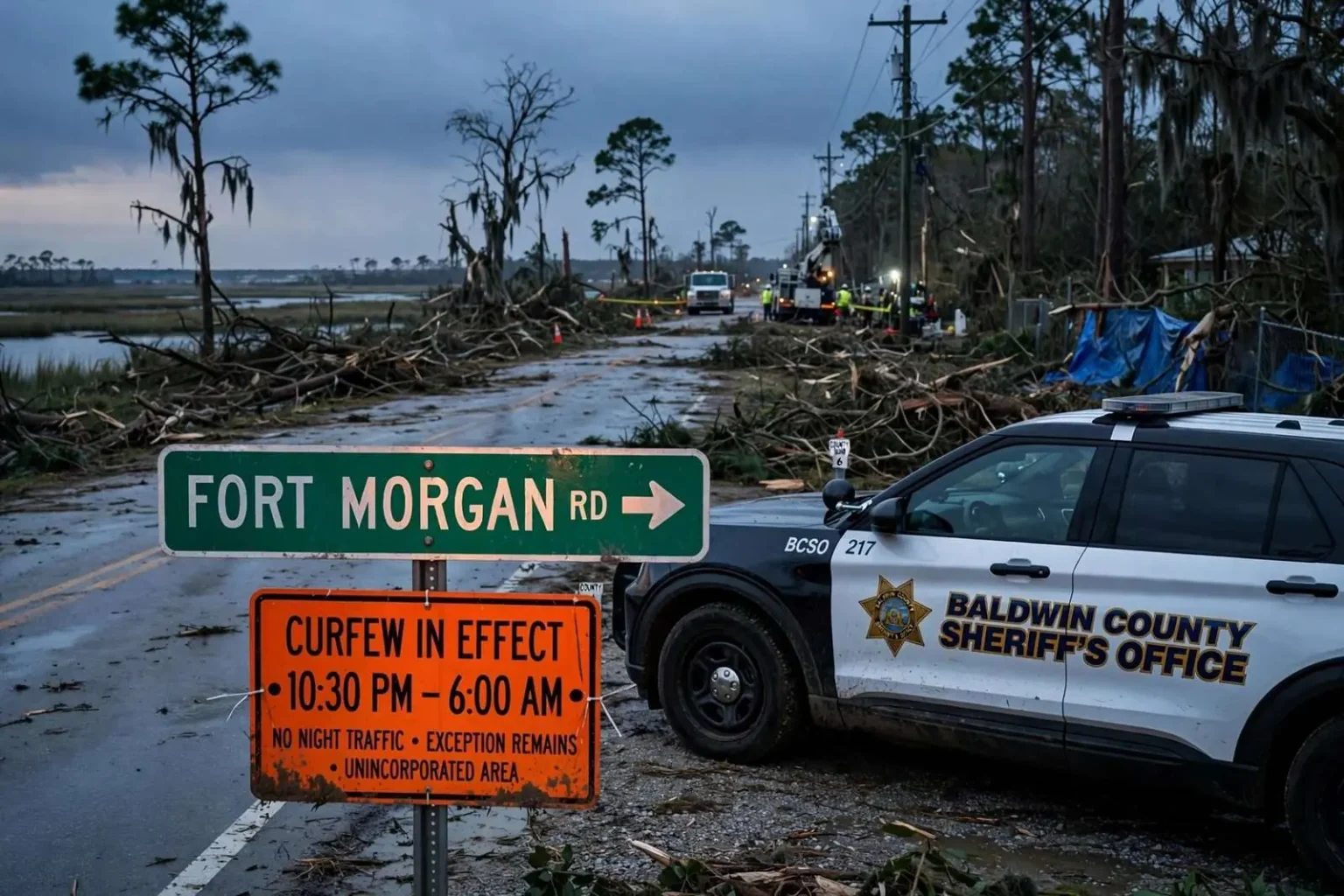
Despite the broader rollback, the Baldwin County Sheriff’s Office says one stretch of the county will remain under curfew for now. Residents living in the unincorporated area along Fort Morgan Road are still subject to a nightly curfew running from 10:30 p.m. to 6 a.m., a restriction that will stay in effect until further notice. Officials did not give a timeline for when that exception might be lifted, saying it depends on ongoing repair and safety conditions specific to that corridor.
Why Fort Morgan remains an exception
The Fort Morgan peninsula is a narrow strip of land that extends westward from Gulf Shores toward the historic fort at Mobile Point, guarded on one side by Mobile Bay and on the other by the Gulf of Mexico. When Hurricane Sally came ashore along the Alabama coast, the peninsula took the brunt of storm surge and wind damage, and its single road in and out makes any emergency there a logistical challenge even in the best of conditions.
That geography explains the cautious approach. With one evacuation route serving an unincorporated community of homes, condominiums and rental properties, overnight access restrictions serve a dual purpose on Fort Morgan: they keep residents out of areas where hazards may still be unresolved, and they limit traffic on a road where crews may still be working in the dark. Until utilities and road conditions along the corridor meet the standards officials are looking for, the overnight curfew there will remain in place.
The 10:30 p.m. to 6 a.m. window is typical of post-storm curfews, targeting the hours when visibility is lowest, emergency response is thinnest and looting or accidents are hardest to manage. Deputies enforcing the restriction are stationed in an area where addressing a single incident at night can mean closing the only road serving the entire peninsula, which is precisely the scenario emergency planners try to avoid during recovery.
Municipal curfews are separate
The Sheriff’s Office also reminded residents that the curfew changes apply only to unincorporated Baldwin County. The cities of Gulf Shores and Orange Beach continue to enforce their own separate curfews, and residents and visitors in those municipalities should follow local city guidance rather than assume the county’s rollback applies to them. The distinction matters in a county where a single address can sit outside city limits while a neighboring street falls inside them.
Baldwin County is geographically one of the largest counties in Alabama, and its incorporated cities operate their own governments, police departments and emergency declarations. Gulf Shores and Orange Beach, the two beachfront cities hit hardest by Sally, set curfew policy for their own boundaries, and both municipalities had sustained significant damage to their beachside infrastructure. Residents in those cities must look to municipal announcements, not county statements, for the current status of any overnight restriction.
The patchwork can be confusing in the weeks after a hurricane, when families are moving between damaged homes, staying with relatives or commuting to repair jobs across city lines. Officials have repeatedly emphasized that the burden of knowing which jurisdiction applies falls on the traveler, and that a curfew violation can carry consequences even when the driver is unaware a boundary has been crossed.
Recovery progress across the county
County officials are continuing to urge residents throughout Baldwin County to limit unnecessary travel, particularly after dark, while utility crews work to finish repairing damaged infrastructure in the wake of Hurricane Sally. Downed lines, storm debris and crews working along roadways remain a hazard in several areas, and officials say minimizing trips helps both public safety and the pace of ongoing repair work.
The pace of restoration after Sally was complicated by the storm’s slow movement, which pushed a prolonged surge into communities along Mobile Bay and piled debris across roadways in the county’s inland areas as well. Utility crews from across the region poured into Baldwin County in the days after landfall, working through a grid of damaged lines that stretched from the shoreline communities to the county’s rural northern sections. Each area that reaches full restoration removes one more reason for emergency restrictions.
Debris removal runs on a longer clock than power restoration, and residents outside city limits have watched stacks of vegetative debris and construction material grow along rural roads while contractors cycle through the county. Unincorporated Baldwin County’s road network is maintained by county crews, and clearing those corridors of storm wreckage has been a priority both for safety and for the overnight access that the curfew rollback now restores.
For residents, the lifting of the curfew means practical things resume: evening trips to the pharmacy, late shifts at work without a need to carry documentation, and the simple ability to move about after dark without worrying about a checkpoint. In disaster recovery, those ordinary freedoms are often the most noticed, even as many homes in the county remain under repair and blue tarps still dot neighborhoods from Bay Minette to the bay shore.
Questions about specific areas
Residents with questions about curfew status in their specific area, including whether a road or neighborhood falls inside city limits, are encouraged to contact the Baldwin County Sheriff’s Office or their local city government for the most current guidance. Emergency management officials have stressed that conditions can change quickly during recovery, and that restrictions may be tightened or eased as circumstances on the ground evolve.
The Sheriff’s Office serves as the primary law enforcement agency for the unincorporated county, a role that puts it at the center of the curfew enforcement question. Deputies have been briefing the public through official channels as orders change, and the office remains the point of contact for residents who are unsure whether a particular stretch of road falls under county or municipal authority.
For the Fort Morgan community, meanwhile, the guidance is unchanged: the peninsula’s overnight curfew remains in effect until further notice, and residents there should plan their movements around the 10:30 p.m. to 6 a.m. restriction while repairs continue along the corridor. Officials have indicated the exception will be lifted when conditions warrant, and the Sheriff’s Office will announce the change through its public channels when that day comes.
In the broader picture, the county’s decision represents a step forward in a recovery that officials describe as measured by neighborhoods rather than by the calendar. Hurricane Sally’s damage will take years to fully repair across the Alabama coast, but each easing of emergency restrictions marks the point where daily life reasserts itself over the storm’s disruptions, first street by street, and eventually across the whole county.
The legal mechanics behind a curfew are worth understanding, because they explain the county’s careful wording. Emergency curfews in Alabama flow from emergency declarations and are enforced by the agency with jurisdiction over the affected roads. When the Baldwin County Commission chairman, in consultation with the sheriff’s office, determines that conditions support lifting the restriction for unincorporated areas, that decision does not automatically extend to municipalities that issued their own orders under their own authority. Each jurisdiction reviews its own conditions and acts on its own schedule.
That layered structure reflects how the county actually responds to hurricanes. The county’s emergency management agency coordinates shelters, damage assessment and recovery operations across jurisdictional lines, while city halls in Gulf Shores and Orange Beach manage the situation inside their boundaries, where population density and tourism complicate every decision. Visitors recovering from the storm have often been caught out by the difference, assuming a county announcement covered their beach rental when in fact the city’s separate order still governed.
Utility restoration figures have driven most of the timeline. Electrical service in Baldwin County is delivered by a mix of providers, and the complexity of the repair job after Sally, with thousands of spans of line downed by falling trees across a heavily wooded county, meant that some neighborhoods waited weeks for power while others were restored within days. Curfew decisions tend to trail the restoration map, easing first in the areas where utilities and roads are whole and lingering where outages persist.
Traffic hazards remain part of the calculus even where the curfew has ended. Intersections across the county lost signals in the storm, and while crews have restored many, officials continue to remind drivers that a dark signal must be treated as a four-way stop. Combined with debris piles that narrow rural roads and the constant presence of heavy equipment, the after-dark driving environment still carries risks that officials say residents should weigh before making an unnecessary trip.
The economic dimension of the curfew rollback is real for the county’s working residents as well. Recovery work itself runs on long hours, with contractors, tree crews and repair teams often finishing jobs well after sunset. An overnight restriction complicates that labor, and easing it in most of the unincorporated county allows the rebuilding economy to run at the pace homeowners are demanding, even while the Fort Morgan corridor remains under tighter control.
For boaters and fishing families who live along the county’s waterways, the rollback also restores practical access to boat launches, fishing piers and waterfront property that many rely on for both livelihood and recovery of storm-damaged vessels. The county’s eastern shore and its bayside communities saw extensive damage to docks and boats, and evening hours are often the only time working residents can manage that cleanup.
Officials have not tied the eventual lifting of the Fort Morgan exception to any specific date, and they have resisted doing so. Post-storm timelines have a way of slipping, and emergency managers prefer to announce restrictions lifted rather than promise dates they cannot control. For now, the nightly 10:30 p.m. to 6 a.m. restriction on the peninsula stands, the rest of unincorporated Baldwin County moves freely, and the county’s recovery continues one repaired line and cleared road at a time.