Baldwin County Warns of Zoning and Permit Email Scams Using Real Case Numbers
Fraudulent emails are citing genuine Planning and Zoning case numbers and property details to make fake payment demands look credible. The county says it never requests wire transfers.
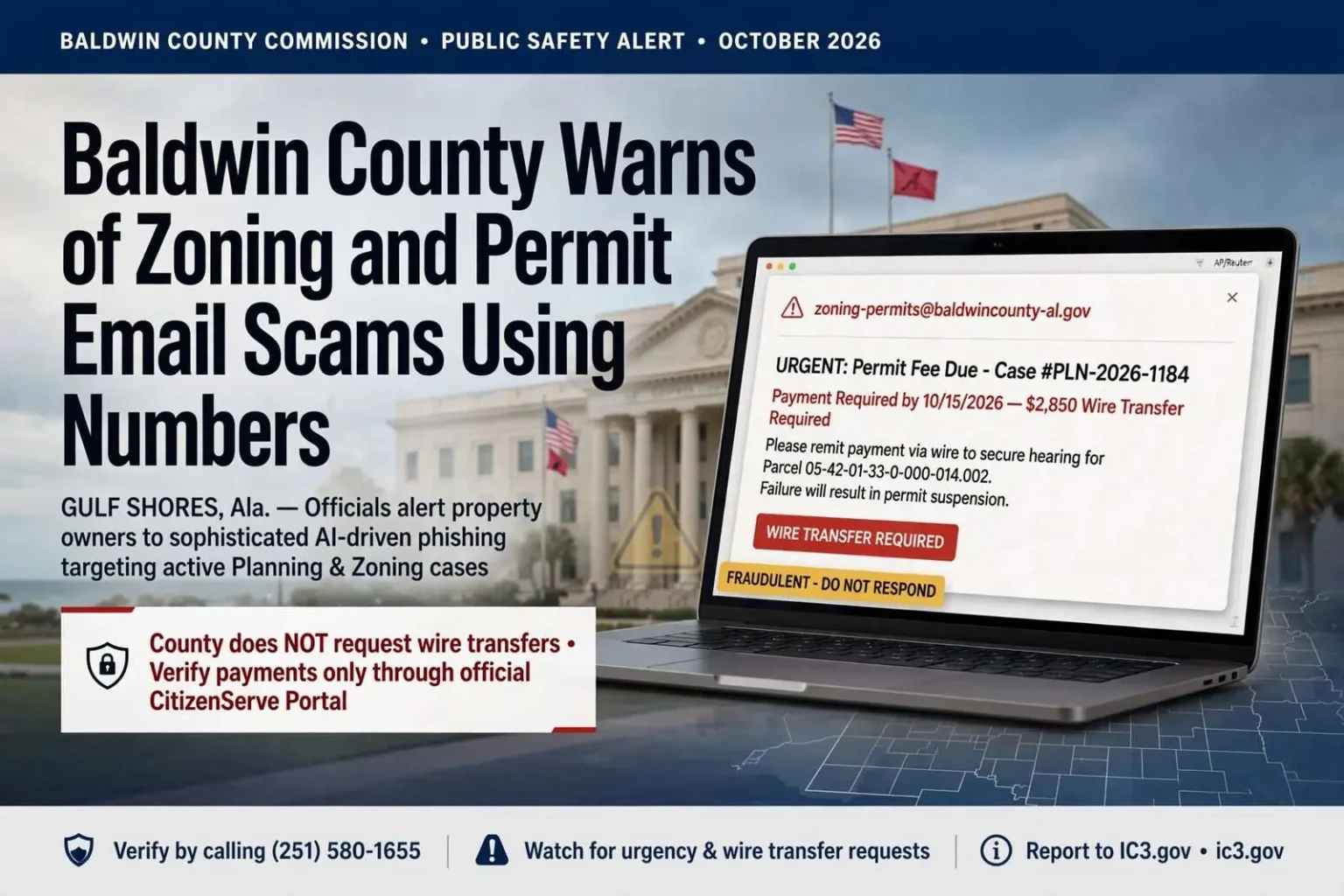
GULF SHORES, Ala. — The Baldwin County Commission is alerting the public to a growing scam targeting property owners and professionals involved in active Planning and Zoning cases.
Officials report that fraudulent emails are leveraging publicly available information — including real case numbers and property details — to make fake payment requests appear credible.
A National Pattern
The county’s warning follows a March 2026 nationwide Public Service Announcement from the FBI’s Internet Crime Complaint Center (IC3) about permitting and zoning fraud occurring across the country.
The scheme works because permit and zoning records are, by design, public. Case numbers, applicant names, parcel details and hearing dates are all available to anyone who looks. A fraudster does not need to breach a county system to obtain the details that make a fake invoice convincing — the details are already published.
Why These Scams Have Become Harder to Spot
While the scams themselves are not new, county officials say the rapid rise of artificial intelligence has dramatically amplified their sophistication, speed and believability.
Traditionally, phishing emails could be identified by misspellings, awkward phrasing and poor grammar. Generative AI tools have eliminated those telltale signs, allowing fraudsters to draft polished, professional-sounding messages that closely mimic legitimate business communications.
The speed advantage is equally significant. Officials note that AI can generate a convincing phishing email in about five minutes — a process that would normally take a human researcher roughly 16 hours, representing a 192-fold increase in operational speed.
Personalized at Scale
AI also enables highly targeted, hyper-personalized campaigns conducted at volume. By automatically scouring public data, corporate filings and social media platforms, these tools can customize a message with a recipient’s specific details, relationships and context.
That precision helps the messages bypass traditional email filters, because AI can generate polymorphic content — text that is unique to each recipient rather than a repeated template that filters can learn to recognize.
The practical consequence for a property owner is that the old advice no longer works reliably. An email that names your specific case, references your property correctly, uses your contractor’s name and reads like professional correspondence is no longer evidence of legitimacy.
What the County Says
Baldwin County officials stress that the presence of accurate case numbers or property information in an email does not guarantee its legitimacy. Modern fraudsters rely on exactly those precise details to lower a victim’s guard.
The county reminds the public that it accepts permit payments only through its official CitizenServe Portal or in person at designated county offices.
Baldwin County never requests wire transfers.
That last point is the single most useful test available. A wire transfer request purporting to come from the county is fraudulent by definition, regardless of how legitimate everything else in the message looks. Wire transfers are favored by fraudsters precisely because they are fast and effectively irreversible once sent.
How to Protect Yourself
Residents and professionals are urged to slow down and verify any payment request directly with the Baldwin County Commission before acting.
Verification means initiating the contact yourself — calling a number you already have or looking one up independently — rather than using a phone number, link or reply address supplied in the suspicious message. Contact information embedded in a fraudulent email routes back to the fraudster.
Urgency is the other reliable warning sign. Scam messages routinely manufacture a deadline: a permit about to lapse, a hearing about to be missed, a fee that must clear today. That pressure exists to prevent the recipient from doing exactly what the county recommends — pausing to check.
Who Is Most at Risk
The people most exposed are those with genuinely active cases: property owners in the middle of a rezoning request, builders and contractors managing multiple permits at once, engineers and surveyors, and real estate professionals coordinating closings against a permitting timeline.
Anyone juggling several active cases is more likely to accept an unexpected invoice as routine, simply because unexpected invoices are routine in that line of work.
Reporting Fraud
Suspected fraudulent emails or payment requests should be reported immediately to the FBI’s Internet Crime Complaint Center at ic3.gov.
Prompt reporting matters in wire fraud cases. When a transfer is reported quickly enough, the FBI’s recovery processes can sometimes freeze funds before they are moved beyond reach — a window measured in hours and days rather than weeks.
Property owners and professionals with questions about whether a payment request is legitimate should contact the Baldwin County Commission directly.