
Baldwin County Sheriff Hoss Mack mourns death of Lowndes County Sheriff John Williams
Baldwin County Sheriff Huey 'Hoss' Mack issued a statement mourning the death of Lowndes County Sheriff John Williams, who was killed Saturday night.
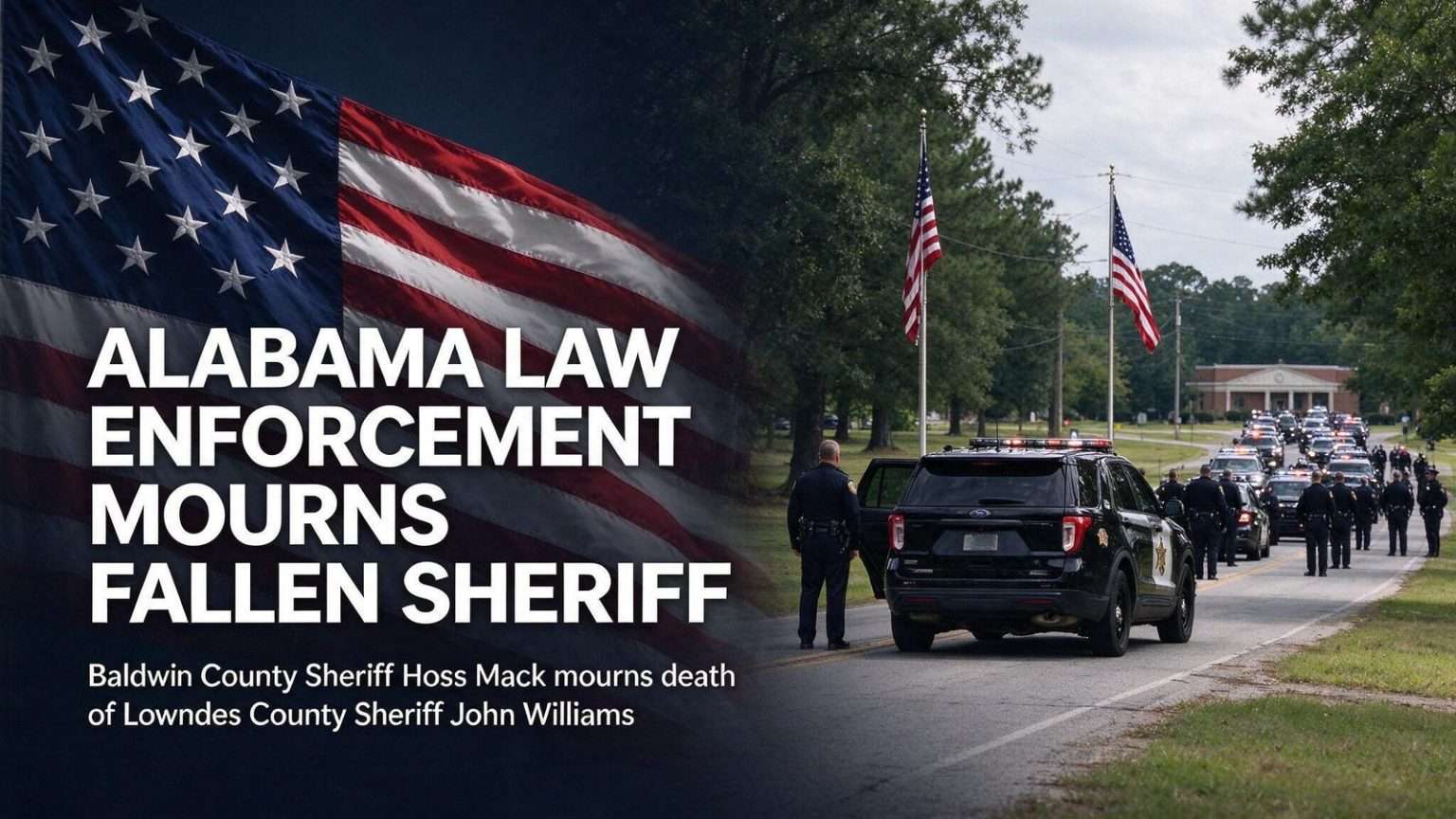
Baldwin County Sheriff Huey “Hoss” Mack has released a statement mourning the death of Lowndes County Sheriff John Williams, who was shot and killed Saturday night in his home county. “Tonight our hearts are heavy with the murder of Sheriff Big John Williams from Lowndes County. Our prayers are with his family. Big John was a personal friend of mine and a great sheriff, and a public servant for his county. This is a very unfortunate loss not only for Lowndes County but for the state of Alabama,” Mack said. Authorities say the shooting happened around 8:15 p.m. at a gas station in Lowndes County. Williams, the elected sheriff of the Lowndes County Sheriff’s Office, was killed in the line of duty, and news of his death moved quickly through law enforcement circles across Alabama, where sheriffs — particularly those who have held office for years — form a close professional community.
Mack’s statement carried weight beyond its words because of who was speaking. Huey “Hoss” Mack served as the sheriff of Baldwin County, the state’s fourth-largest county and one of its fastest-growing, for a tenure stretching back to the late 1990s, making him one of the longest-serving sheriffs in Alabama. A sheriff in that position knows personally nearly every other sheriff in the state, and the bonds between Alabama’s 67 elected sheriffs are reinforced by years of shared work through statewide associations, joint investigations, mutual aid during hurricanes and disasters, and the practical reality that rural agencies depend on one another constantly. When Mack called Williams “a personal friend of mine and a great sheriff,” it was the tribute of one county’s top lawman for another, offered in the immediate hours after the loss.
The tribute also reflected the particular character of the office Williams held. In Alabama’s rural counties, the sheriff is not just the chief law enforcement officer but one of the most visible and consequential figures in public life — a constitutional officer who runs the jail, handles court security and service of papers, leads the county’s small patrol and investigative staff, and is personally known to much of the community. A sheriff in a Black Belt county like Lowndes works with a fraction of the resources available to departments in Mobile or Baldwin County, and the job is deeply personal: residents call the sheriff directly, and the sheriff’s presence at churches, funerals, school events, and civic gatherings is part of the fabric of the county. Losing such a figure to violence, while performing the duties of the office, lands on a small community with singular force.
The Killing of a Sitting Sheriff
According to the information released at the time, the shooting occurred around 8:15 p.m. Saturday night at a gas station in Lowndes County. Details of the circumstances — what brought the sheriff to the location, what led to the gunfire, and what followed — were not included in the statement, which came from a colleague rather than the investigating agency. What was clear from the initial reports was the fact that a sitting sheriff had been shot and killed at a public commercial location in his own county, an event rare enough in Alabama history that it stood apart from the everyday toll of line-of-duty deaths and drew attention well beyond the county line.
Lowndes County sits in south-central Alabama, in the region known as the Black Belt for its rich dark soil and its history, stretching west of Montgomery toward the Selma area. It is among the smallest counties in the state by population, with a seat at Hayneville and communities scattered along the U.S. and state highways that cross it. The county has played an outsized role in the history of the civil rights movement — the March from Selma to Montgomery passed through Lowndes County, and the Lowndes County Freedom Organization, whose ballot symbol was the black panther, organized there in the mid-1960s. The sheriff’s office in such a county operates with a small, multi-role staff, and its elected head is a familiar figure rather than a distant administrator.
The death of a sheriff in the line of duty triggers a response pattern familiar across Alabama law enforcement. Investigations are typically handled with assistance from the Alabama Law Enforcement Agency and other partners, given that the victim is the county’s own chief law enforcement officer. Colleagues across the state issue statements, honor guards are assembled, and arrangements follow for the kind of law enforcement funeral that draws officers and deputies from dozens of counties. In the immediate aftermath, though, the reaction is quieter and more personal — calls between sheriffs, statements like Mack’s, and the grief of a county that knew its sheriff by name.
A Career of Public Service
The nickname by which Williams was widely known — “Big John” — spoke to the kind of presence he had in Lowndes County, and Mack’s description of him as “a public servant for his county” framed a career in terms his constituents would recognize. Sheriffs in small Alabama counties typically rise through the same office they eventually lead, working as deputies and investigators for years before standing for election, and they accumulate a depth of local knowledge — of families, of feuds, of who needs help and who needs watching — that no larger agency can replicate. That kind of sheriff cannot be replaced by a hire; the office passes to a successor, but the relationships, built over decades, go with the man.
For Baldwin County, Mack’s statement also served to connect his own community to the loss. Baldwin and Lowndes counties could hardly be more different — one a fast-growing coastal county of subdivisions and beach traffic, the other a rural county of farms and small towns — but the offices their sheriffs hold are members of the same constitutional family, and the death of one sheriff is felt by all of them. Mack’s language about the loss being felt “not only for Lowndes County but for the state of Alabama” reflected that institutional kinship: the murder of a sheriff is an attack on the order that all 67 sheriffs are elected to uphold, and it resonates in every county where an elected lawman puts on a badge in the morning.
The killing also renewed the familiar questions that follow every line-of-duty death in a small county — about the risks run by officers who often work alone, cover wide territories, and know the people they encounter personally. Rural Alabama sheriffs’ offices operate with limited staffing, and deputies and their sheriff routinely handle situations without backup nearby. That reality is part of why the death of a rural sheriff draws such reaction from fellow officers: those in the profession understand exactly how thin the margins are, and how quickly a routine encounter at a gas station on a Saturday night can turn fatal.
Remembering a Fallen Sheriff
In the days after such a loss, the customary observances take shape. Flags fly at half-staff, departments from across the region send delegations, and the funeral becomes one of the largest gatherings the county has seen. The Alabama Sheriffs Association and individual sheriffs typically assist the family and the office, and the honor traditions of Alabama law enforcement are carried out for one of their own — the honor guard, the last radio call, the firing volley and taps. For the Lowndes County Sheriff’s Office itself, the staff Williams led must continue answering the county’s calls while mourning the man who led them, a burden small agencies know well.
What remains in the public record from the immediate aftermath is Mack’s statement, the time and place of the shooting, and the fact that a sheriff was killed while serving his county. Those sparse facts carry the outline of a larger story that the investigation was left to fill. For Lowndes County, the loss was of a neighbor as much as an officer; for Alabama’s sheriffs, it was the murder of a colleague whose work they knew and shared. The words Mack chose — heavy hearts, prayers for the family, a friend and a great sheriff, a loss for the whole state — were those of an officeholder speaking about one of his own, and they stand as the record of how Alabama law enforcement received the news that Saturday night: with grief, and with the recognition that the state had lost a public servant whose value could not be measured by the size of the county he served.
The mourning extended beyond official statements. In counties across Alabama, flags at sheriff’s offices and courthouses were lowered, and fellow sheriffs echoed Mack’s themes in their own messages to their communities — that a colleague had died doing the work he was elected to do, and that the state’s law enforcement family would stand behind Lowndes County in the weeks ahead. For residents of Baldwin County who read Mack’s statement in local coverage, it was a reminder that the sheriff who serves their fast-growing county belongs to a statewide fraternity whose members share risks that most residents never see. The phrase “Big John,” used so naturally by another county’s sheriff, told its own story about how Williams was known among his peers: not as a title or an officeholder, but as a man whose nickname carried affection as well as respect.