Baldwin County Sheriff’s Sergeant Resigns as Overtime Records Come Under Investigation
A 22-year Baldwin County Sheriff's Office veteran resigned amid an internal investigation into overtime abuse and falsified time records.
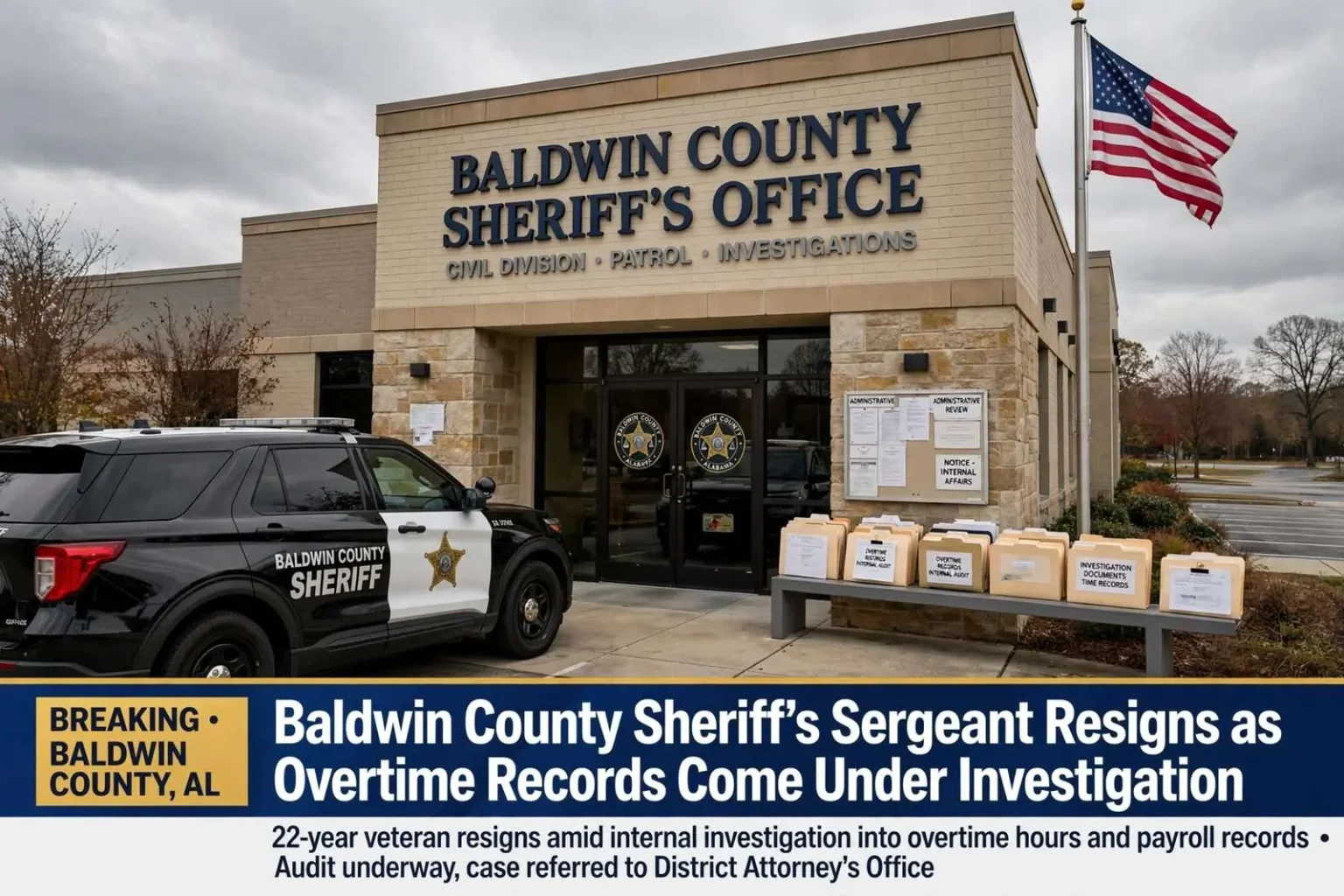
A 22-year veteran of the Baldwin County Sheriff’s Office resigned last month in the middle of an internal investigation into how he handled overtime hours and time records, according to a news release from the agency. The departure of a senior deputy mid-investigation is an unusual step for a department of the Sheriff’s Office’s size, and it has set in motion a review that extends beyond the agency’s own walls.
The Sheriff’s Office said it spent several weeks conducting an administrative review and internal investigation into the conduct of a deputy sheriff. Investigators were looking into allegations of overtime abuse and falsification of time records — accusations that, in a sheriff’s office, strike at the integrity of the payroll system and the public’s confidence in how tax dollars are spent.
Who was investigated
The subject of the investigation was Sgt. Carl Griffith, who had been assigned to the Civil Division of the Baldwin County Sheriff’s Office. Griffith resigned his position effective Nov. 20, before the internal affairs investigation could be completed. All of the alleged violations are said to have occurred in 2017.
The Civil Division handles some of the office’s most paperwork-intensive functions — serving lawsuits, subpoenas, evictions and other court orders, executing writs and managing the processes that move cases through the county’s courts. Because much of that work is performed in the field on flexible schedules, time and attendance records in civil divisions receive particular scrutiny in audits, since hours logged often cannot be verified by supervisors present at the scene.
The Sheriff’s Office said it also looked into whether anyone else may have been involved in or associated with the allegations, and at this point investigators say there is no evidence that any other deputy was involved. That finding contained the scandal to a single career — significant for an office whose deputies work across a county of more than 200,000 residents stretching from Mobile Bay to the Florida line.
Federal and state money involved
Because some of the overtime hours in question were reimbursed through federal and state funds set aside for special traffic enforcement, the case carries implications beyond the agency itself. The Baldwin County Sheriff’s Office notified both the Baldwin County District Attorney’s Office and the Southwest Regional Highway Safety Office in Mobile, the agency that administers some of that traffic enforcement funding.
Highway safety grants — the programs that fund enhanced patrols, DUI enforcement and occupant-protection details — are reimbursed on documented hours, meaning every shift claimed under the grant must be supported by activity records that auditors can verify. When overtime charged to such grants comes into question, the agency receiving the money is obligated to notify the funding administrator, and misused federal funds can ultimately require repayment and jeopardize future grants. The Southwest Regional Highway Safety Office, operating under the Alabama Department of Economic and Community Affairs’ law enforcement planning structure, administers those federal traffic-safety dollars for the southwest Alabama region, which makes it a mandatory stop in a case like this one.
A complete audit of the hours in question is underway, with the results set to be forwarded to the district attorney’s office once complete. Depending on the outcome of that review, the Sheriff’s Office said the former deputy could be required to reimburse the county for any misused time, and could also face prosecution.
Limited comment while investigation continues
Citing the ongoing criminal investigation, audit and referral to the district attorney’s office, the Sheriff’s Office said it would not be commenting further on the specifics of the case until those processes conclude. The posture is standard for Alabama law enforcement agencies: once an internal matter touches potential criminal charges, public statements are limited to confirmations of fact — a resignation, an audit underway, a referral made — while the underlying documentation moves through the channels that could result in charges.
That restraint serves several purposes at once. It protects the integrity of any potential prosecution, avoids prejudicing potential witnesses or future jurors, and shields the agency from claims that it tried its former deputy in the press. It also leaves legitimate public questions unanswered in the interim — how many hours are in question, over what period, and whether the office’s internal controls flagged the issue or a complaint did — questions the eventual audit may resolve.
How overtime abuse cases typically unfold
Cases of this kind generally follow a well-worn path in Alabama law enforcement. An internal affairs review establishes the factual record; payroll and grant documentation is audited; and the findings go either to the district attorney for charging decisions or back to the agency for civil recovery of the funds. Because resignation removes the officer from the department’s disciplinary reach, the criminal and financial processes become the only remaining accountability mechanisms — which is why the Sheriff’s Office’s references to possible reimbursement and prosecution matter.
Falsification of time records by a public employee can support charges ranging from theft of public funds to more specific offenses depending on the amounts involved, and restitution is a standard component of resolutions in cases where money was improperly collected. The audit’s findings will effectively set the ceiling of the exposure: the more hours the audit substantiates as improperly claimed, the larger the potential repayment and the stronger the case for prosecution.
The stakes for the Sheriff’s Office
For the Baldwin County Sheriff’s Office, the case is a test of internal controls that large county agencies rarely escape scrutinizing publicly. Sheriff’s offices operate on a mix of county funds, state supplements and grant reimbursements, and their payroll systems must track deputies across patrol shifts, court security, civil process, school resource assignments and grant-funded traffic details — a complexity that creates the gaps abuse can hide in and the records that eventually expose it.
The office’s handling of the matter — weeks of investigation, a referral to prosecutors, notification of funding agencies and a public accounting of the resignation — follows the sequence transparency advocates recommend. Deputies across the county’s patrol districts and specialty units will read the outcome as a signal of how the office treats time-record integrity, and county taxpayers, who ultimately stand behind every overtime dollar the agency claims, will see whether the audit produces recovery and, where warranted, charges.
Baldwin County’s growth raises the stakes
The case arrives in a county that has been one of Alabama’s fastest growing for a generation, where the Sheriff’s Office has expanded patrol districts, added substations in communities like Foley, Gulf Shores and Daphne, and taken on responsibilities that scale with population growth. Every expansion multiplies the payroll complexity — more deputies, more specialty assignments, more grant-funded details — and with it the importance of the kind of audit now underway. Baldwin County’s law enforcement budget has grown alongside its population for two decades, and oversight of how those dollars are spent has grown into a full-time institutional function.
The Civil Division assignment adds a further wrinkle. Civil deputies interact daily with the county’s court system, serving papers and executing orders on behalf of judges, attorneys and residents — work whose legitimacy depends on the office’s reputation for accuracy. A senior sergeant’s departure under an investigation touching time records resonates within that division precisely because its credibility is the product.
What happens next
The audit’s completion will mark the next public milestone. Once the hours in question are substantiated or dismissed, the findings go to District Attorney Robert Wilters’ office — the district attorney for the 28th Judicial Circuit, which covers Baldwin County — for a charging decision. In parallel, the Southwest Regional Highway Safety Office will evaluate whether grant funds were improperly claimed and what repayment or corrective action the grant agreements require.
Until then, the record stands as the Sheriff’s Office stated it: a 22-year veteran resigned effective Nov. 20 while under investigation for overtime abuse and falsification of time records allegedly committed in 2017; no other deputy has been implicated; and the financial and criminal reviews are moving forward on parallel tracks. For a department that serves a county of more than 200,000 residents with hundreds of sworn and civilian personnel, the case will be measured less by the conduct of one sergeant than by whether the systems built to catch it worked — and whether the money, if misspent, comes back.
Residents of Baldwin County’s growing communities — from the bayfront subdivisions of Daphne to the beach towns along Highway 182 — fund their sheriff’s office with the expectation that every overtime dollar buys actual patrol hours and actual traffic safety. The weeks ahead, as the audit lands on the district attorney’s desk, will show whether that expectation was honored in this instance, and what the office does when it was not.