Baldwin County suicide awareness walk among Gulf Coast efforts to prevent self-harm
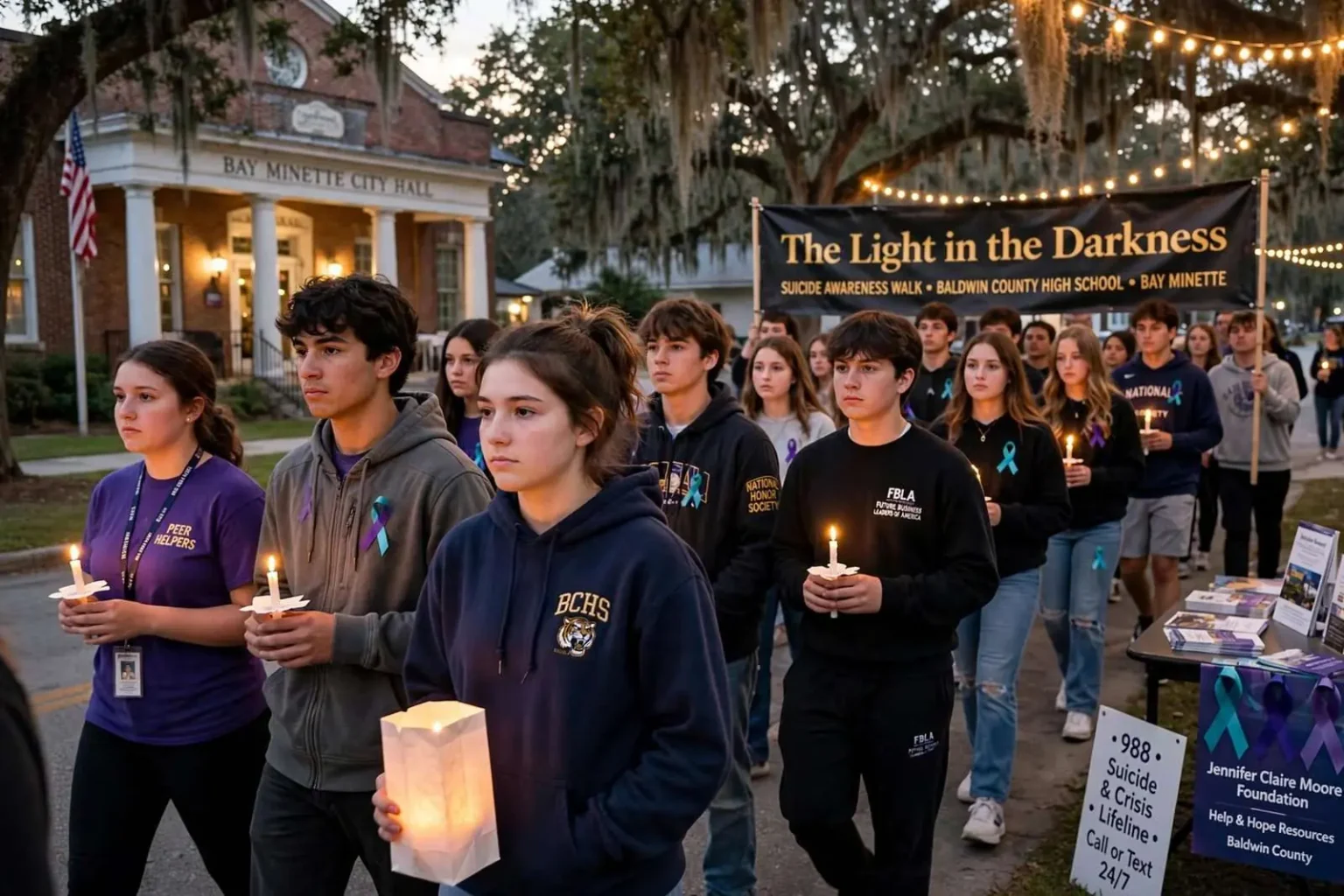
Baldwin County High School and Bay Minette hosted The Light in the Darkness Suicide Awareness Walk with the Jennifer Claire Moore Foundation.
September is Suicide Prevention and Awareness Month, and communities across the Gulf Coast marked it with events aimed at replacing silence with conversation. In Baldwin County, that effort took the shape of an evening walk in Bay Minette, organized by high school students who wanted their classmates, their neighbors and their families to know that support is available and that talking openly about self-harm can save lives. The message was deliberately simple: no one in the community has to face a crisis alone, and help is closer than most people realize.
Students at Baldwin County High School partnered with the City of Bay Minette to hold “The Light in the Darkness Suicide Awareness Walk.” The evening walk was organized to promote awareness, prevention and remembrance — recognizing those the community has lost, standing with those who struggle, and pointing families toward the resources that exist across Baldwin County and the wider Gulf Coast region.
An Evening Walk With a Purpose
The “Light in the Darkness” name reflects the message organizers hoped to send: even in the hardest seasons of life, help and hope remain within reach. Evening walks have become a familiar format for awareness events along the Gulf Coast because they are easy for families to attend after work and school, and because walking together gives participants a way to grieve, remember and connect without the pressure of a formal ceremony. The Bay Minette event blended all three purposes — awareness, prevention and remembrance — into a single gathering that welcomed anyone touched by the issue.
Bay Minette, the longtime seat of county government in northern Baldwin County, provided a fitting backdrop. The city sits inland from the beach communities that draw most of the county’s visitors, and it has a long tradition of civic collaboration between City Hall and the local schools. The partnership between Baldwin County High School and the city meant the walk had support on both sides — students supplying energy, outreach and volunteers, and the city supplying public space and official backing for an event devoted to public health.
Students Take the Lead
Much of the organizing work fell to BCHS student groups. The BCHS Student Council, Peer Helpers, National Honor Society and Future Business Leaders of America all helped put the event together, from early planning and publicity to setup and coordination on the night itself. Their involvement meant the walk was shaped by students who see the pressures their classmates face every day, rather than by outside consultants working from a distance.
Peer Helpers programs have become a fixture in Alabama schools over the past two decades. They train selected students to recognize when a classmate may be struggling, to listen without judgment, and to connect peers with counselors or other trusted adults. Pairing that kind of training with a public awareness event gives the lessons a visible stage and signals to the entire student body that reaching out for help is normal. Groups like the National Honor Society and the Future Business Leaders of America brought organizational muscle to the effort, handling the logistics that turn an idea into an actual event.
The high school band performed during the evening, adding music to a program built around reflection. School bands regularly appear at community observances across Baldwin County, and their participation lends such gatherings a familiar, hometown feel that few other elements can match. For families in attendance, the music was a reminder that the event belonged to the whole community, not to any single organization.
A Speaker Shaped by Personal Loss
Alabama State Rep. Frances Holk-Jones, who represents Baldwin County, served as the walk’s guest speaker. Her remarks reflected on the loss of her daughter, Jennifer Claire Moore, in 1997 — a death that reshaped her family’s life and, in the years that followed, touched thousands of teenagers across the county through the work done in her memory.
The family later endured a second loss, that of Holk-Jones’ husband. Rather than withdrawing from public life, the family went on to create the Jennifer Claire Moore Foundation, an organization dedicated to providing programs and resources to the Baldwin County community. What began as one family’s response to grief became a lasting institution for prevention and support.
The Jennifer Claire Moore Foundation
The foundation has grown into one of Baldwin County’s most recognized voices on teen suicide prevention. Its work pairs the hard-won understanding that comes with grief with practical programs for students, families and schools — the kind of sustained, local presence that a one-night event can start but cannot sustain on its own. Organizations like it give schools a partner they can call when a crisis hits a campus, and they give teenagers a place to turn long before a struggle becomes an emergency.
The need for such partners is real in a county of Baldwin’s size. Baldwin County is one of the fastest-growing counties in Alabama, and its school system ranks among the largest in the state. Growth of that pace brings new families, new campuses and new pressures, and school leaders have long acknowledged that public funding alone cannot keep every prevention program fully staffed. Community foundations, awareness walks and student-led groups are how that gap gets filled — one school, one city and one event at a time.
The Scale of the Problem in Alabama
The statistics behind the walk are sobering. In Alabama, the suicide rate was 16.4 deaths per 100,000 people in 2019, making it the 12th leading cause of death in the state, according to figures cited in the awareness materials distributed around the event. Numbers of that scale place Alabama’s rate above the national average and explain why local organizers treat prevention as a year-round responsibility rather than a theme confined to a single month on the calendar.
The figures carry another hard detail: about 67.5 percent of those deaths involved a firearm. Prevention advocates across the Gulf Coast use that fact to encourage families to think carefully about how weapons are stored at home, especially during periods of crisis for a teenager or an adult in the household. Reducing access to lethal means during a moment of despair is among the most consistently recommended steps in suicide prevention, and it is a step any household can take without waiting for a program or a professional.
Where Help Is Available
Anyone struggling with thoughts of self-harm can call or text the national suicide and crisis line at 988 to reach free, confidential support at any time. The line operates around the clock, every day of the year, and callers do not need to be in an acute emergency to use it. People who are worried about a friend, a child or a coworker can reach out as well, and counselors can talk through what to say and where to turn locally.
The three-digit number was created to make help easier to remember and reach than the long-standing 10-digit National Suicide Prevention Lifeline it replaced, though the older number continues to work as well. Trained counselors answer, listen and connect callers to local resources, and the text option offers the same support for those who cannot or would rather not speak aloud — an entry point many young people use first. Confidentiality means a call leaves no mark on a school record or an insurance file.
Awareness groups also urge residents to learn the warning signs that can accompany a crisis: talk of being a burden, withdrawal from friends and activities, dramatic changes in mood or sleep, and giving away belongings. None of these signs alone predicts anything, but each is a reason to ask a direct and caring question. Research consistently finds that asking someone directly about suicidal thoughts does not plant the idea — it opens a door.
The September observance has deep roots. Suicide Prevention and Awareness Month has been recognized nationally for decades, and across Alabama it has become the anchor point for school programs, memorial walks and counselor trainings that run through the fall. For the Gulf Coast, the timing works well: the new school year is underway, students are settling into new buildings and new social circles, and families are establishing the routines that either open the door to hard conversations or close it. Organizers in Bay Minette said the goal was to plant the conversation at the start of the school year rather than wait for a crisis to force it.
A Gulf Coast Message of Hope
Baldwin County’s walk was one of several observances across the Gulf Coast during Suicide Prevention and Awareness Month. From Mobile County to the Florida line, schools, churches and civic organizations used the month to hold walks, remembrance gatherings and training sessions aimed at ordinary residents rather than clinicians — the people most likely to be standing next to someone in trouble.
That community-level approach is the quiet point of an event like the one in Bay Minette. State statistics describe the problem, but they do not reach a struggling teenager on their own. A classmate trained to listen, a band playing on a school lawn, a legislator speaking plainly about her family’s loss, and a city willing to host the conversation together form the safety net that statistics never can.
For the students of Baldwin County High School, the evening ended with a walk through their own city, music from their own band and the knowledge that they had put their community’s attention where it matters most. For everyone else, the reminder stands ready: help is a call or a text to 988, free and confidential, at any hour of any day.