Baldwin County Schools Considered 300 Teaching Cuts in 2009
The Baldwin County School Board discussed cutting 300 teaching positions and other cost-saving measures during the 2009 school-finance crisis.
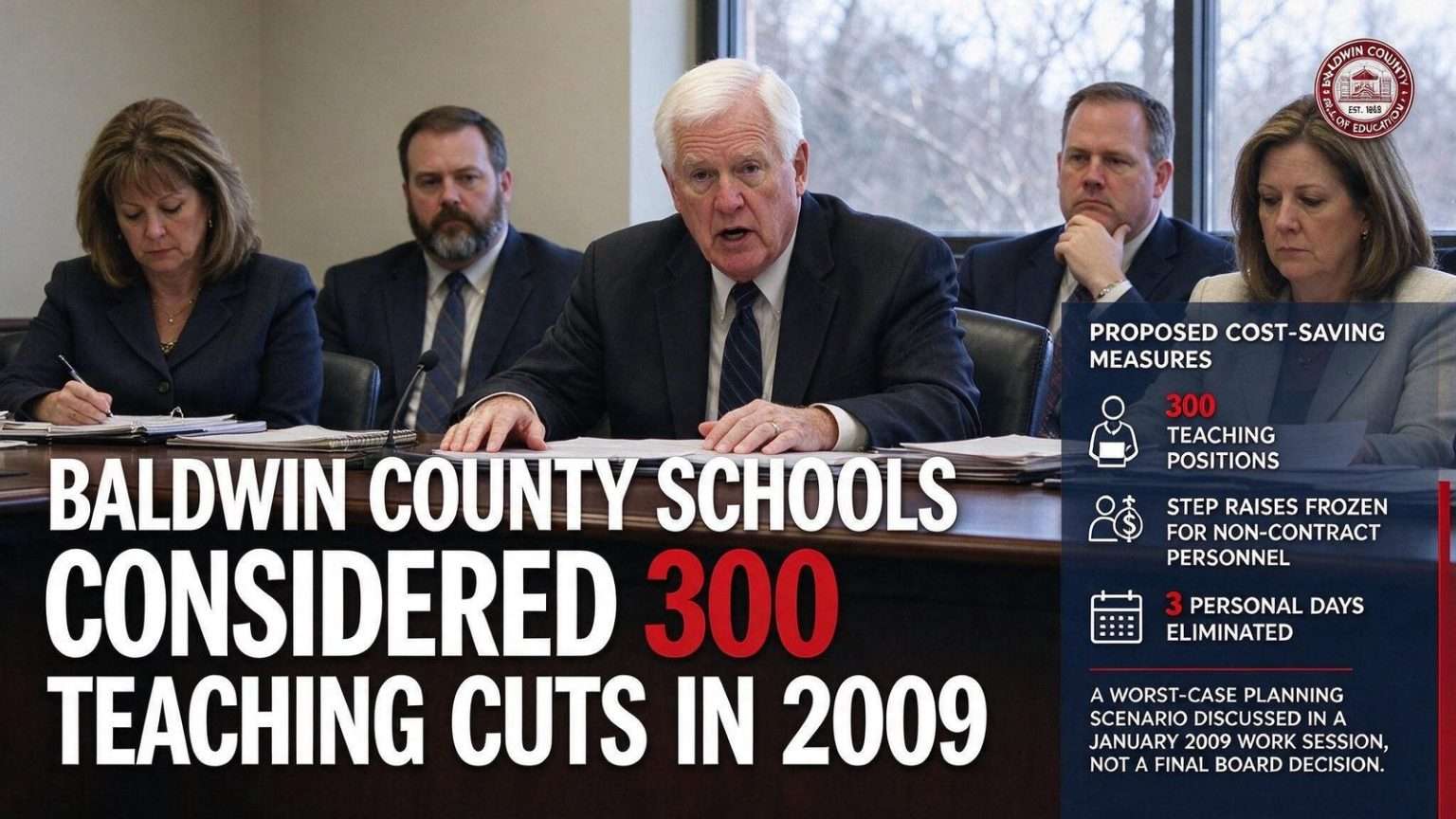
The Baldwin County Board of Education spent a January 2009 work session weighing a proposal that would have eliminated 300 teaching positions for the following school year, an early and stark signal of the budget crisis that was beginning to grip one of Alabama’s largest and fastest-growing school systems. The discussion came as districts across the state braced for the ripple effects of the national recession, which was cutting into the sales tax and other revenue streams that fund public education in Alabama. Baldwin County, with campuses stretching from the beaches of Gulf Shores and Orange Beach to the suburbs along the Eastern Shore, had spent years adding classrooms and teachers to keep pace with one of the fastest-enrolling student populations in the state. The prospect of trimming hundreds of positions reversed that trajectory almost overnight.
Alongside the teaching-position cuts, board members reviewed other cost-saving measures under consideration. Those included ending step raises for non-contract personnel, a move that would freeze the annual pay increases many support and hourly employees counted on, and eliminating three personal days for employees during the current school year. Each proposal targeted a different slice of the budget: salaries and benefits make up the overwhelming majority of any school district’s spending, so personnel-related savings are typically the first and largest levers officials reach for when revenue falls short. The board was expected to vote on the proposals later that week, giving administrators and employees only days to absorb the scope of what was being considered.
Why Baldwin County’s budget came under pressure
Alabama’s public schools depend heavily on sales tax collections, which rise and fall with the broader economy. When consumers pull back, education budgets feel the pinch within a single fiscal year, and school boards are left adjusting staffing plans on short notice. Baldwin County’s enrollment growth had masked some of that volatility for years, because new students brought additional state funding with them. But as the recession deepened in late 2008 and into 2009, housing construction slowed along the county’s booming Highway 181 and Highway 104 corridors, retail sales softened, and the district’s budget projections turned sharply negative.
The January work session was an early sign of a squeeze that would persist for years. In the budget cycles that followed, Baldwin County schools went on to make further staffing and program reductions, trimming positions through attrition and layoffs while cutting back on programs that families had come to expect. Districts statewide faced similar arithmetic: the state’s education trust fund saw significant shortfalls during the same period, forcing local boards to choose between raising local taxes, drawing down reserves, or cutting the people and programs that define a school system. Baldwin County’s choice, at least in that first round, appeared to be deep personnel cuts, with the 300-position proposal standing out for its scale.
The distinction between what a board discusses in a work session and what it ultimately approves matters for anyone reading accounts of that period. A work session is where options are laid out and debated; nothing is final until a formal vote. The 300-teaching-position figure represented the upper boundary of the district’s planning at the time, a worst-case scenario used to frame the size of the budget gap. It does not reflect a final board decision or the actual staffing levels the district carried into the following school year, and it should not be read as a description of current conditions in Baldwin County schools.
What step raises and personal days mean for school employees
For the district’s non-contract personnel, the discussion of ending step raises carried real weight. In most Alabama school systems, step schedules provide predictable annual increases based on years of service, giving bus drivers, custodians, aides and other support staff a measure of financial planning certainty. Freezing those steps shifts the burden of a budget shortfall directly onto the lowest-paid portion of the workforce. Similarly, personal days are a modest but meaningful benefit, and eliminating three of them mid-year effectively reduced take-home flexibility for employees who had already budgeted around the full allotment.
The 2009 episode has since become a reference point in Baldwin County for how quickly a growing district can pivot to retrenchment when the economy turns. Later rounds of budget pressure in the decade that followed forced more reductions, and the county’s experience was mirrored in Mobile County and across the Gulf Coast, where school systems learned to budget conservatively and rebuild reserves. The January 2009 work session stands as the moment the scale of the coming crisis first became public, when a board accustomed to growth began publicly discussing the loss of hundreds of teaching jobs.
Residents following the issue at the time wanted to know three things: how many positions would actually be cut, whether the cuts would fall on classrooms or on administration and support roles, and what the board would do about local tax options that could soften the blow. Those questions shaped school board elections and budget hearings in Baldwin County for years afterward. What the January session made clear was that no part of the district’s operations, from teacher salaries to the personal days of support staff, was off the table as administrators confronted the first full budget year of the recession.
Baldwin County’s budget crisis did not end with that January vote, and the years that followed showed how a single work session can preview a decade of hard choices. The district continued to confront the same structural reality: a reliance on sales tax revenue that ebbs and flows with the economy, an enrollment base that kept demanding new classrooms, and a state funding formula that left local boards to make up shortfalls on their own. The 300-position proposal discussed in the work session remained the clearest single illustration of the gap the district was facing, even after the board settled on whatever final combination of cuts, freezes, and reserve draws it approved later that week.
For parents in communities like Fairhope, Foley, Daphne and Robertsdale, the practical effect of the era’s budget cuts showed up in crowded classrooms, fewer elective offerings, and stretched support services. Teachers who survived the reduction rounds carried larger loads. Programs that were not state-mandated were the most vulnerable, since districts have little discretion when it comes to core academic requirements but wide discretion over enrichment, electives and extracurricular support. Each round of cuts chipped away at the margins that distinguish a strong district from a merely adequate one.
How the cuts reached individual schools
Behind the boardroom arithmetic, the implementation of any large reduction falls on individual campuses. Principals in Baldwin County, as in any district facing personnel cuts, must absorb losses while keeping legally required class sizes and services intact, which usually means reassigning staff, combining sections, and stretching specialists across multiple schools. In a county as large geographically as Baldwin, where a teacher assigned to Gulf Shores cannot simply be shifted to a Spanish Fort vacancy without a long commute, geography adds another layer of friction to every staffing decision the district makes.
Lessons from the 2009 crunch
The episode also illustrates how school boards communicate, or fail to communicate, during a fiscal emergency. Discussing a 300-position cut in a public work session serves a purpose: it tells employees and residents the true magnitude of the problem rather than letting a slow drip of announcements do the talking. But it also creates anxiety that can outrun the actual outcome, since the figure discussed is a planning scenario rather than a decision. That tension between transparency and alarm is a recurring feature of school finance in Alabama, and Baldwin County’s January 2009 session is a textbook case of it.
The broader context matters too. The recession that forced Baldwin County’s hand was national in scope, and Alabama’s education budget shortfalls during that period hit every county to some degree. What made Baldwin County’s situation distinctive was the combination of rapid growth and shrinking revenue: the district needed to keep building for thousands of new students even as the money to staff those classrooms was drying up. That squeeze, visible for the first time in the January 2009 work session, defined the district’s budget politics for the rest of the decade and shaped the tax and funding debates that residents still recognize today.
This account documents proposed actions considered by the board during a single work session, not final board decisions, and not current staffing levels in Baldwin County schools. Readers researching the district’s present-day budget should consult current Baldwin County Public Schools financial reports and board minutes, since staffing, enrollment and revenue have all changed substantially in the years since the recession-era cuts. What the record preserves is the moment the crisis became visible: a board, a proposal, a list of cost-saving options, and a vote expected within the week.