Baldwin County Traffic Fatalities on the Rise: Speeding, Distraction and DUI Lead the Causes
Baldwin County traffic fatalities are climbing again, with serious wrecks clustering on the Beach Expresses, U.S. 98, County Road 32 and rural roads. Crash records point to five main causes, led by speeding, distraction and impaired driving.
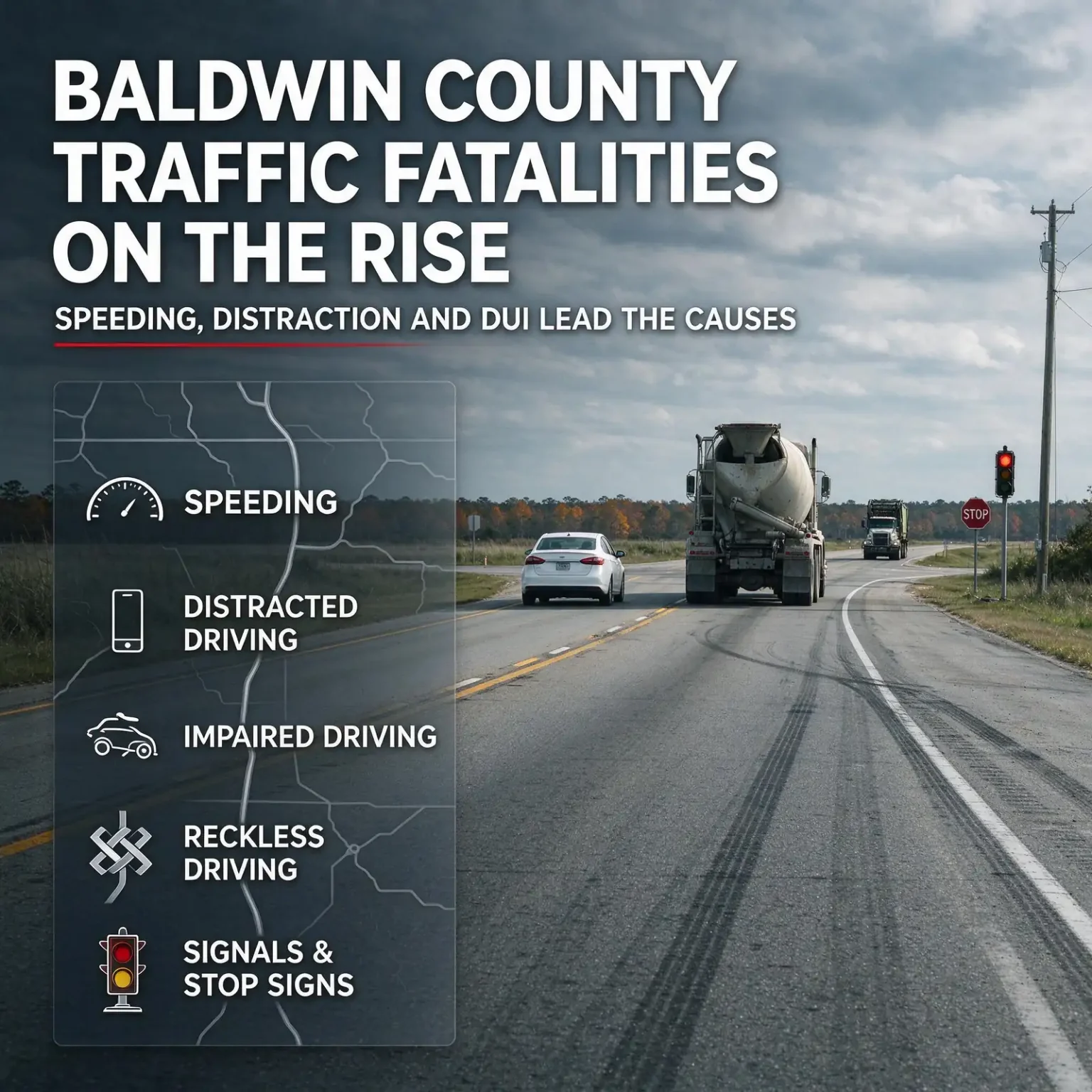
BALDWIN COUNTY, Ala. — Baldwin County traffic fatalities are climbing again, mirroring a renewed rise in deaths on roads across the country, and a review of local crash records points to a familiar set of causes: speeding, distracted driving, impaired driving, reckless behavior and drivers who ignore traffic signals and stop signs.
The trend has been hard to miss this fall. In just the first three weeks of October, two drivers were killed in a head-on collision on the Baldwin Beach Express near Robertsdale, two people died when a car left Alabama 59 near County Road 32 in Summerdale and struck a utility pole, and a crash at Wilters Road and the Baldwin Beach Express in Robertsdale on Oct. 19 left people seriously injured and required two medical helicopters.
What the numbers show
An analysis of traffic wrecks in Baldwin County over the past two years, drawn from public records and a crash database maintained over the past three years, sheds light on the pattern behind those headlines.
The county typically records just under 30 traffic deaths a year. In a few lower years, the total has hovered around 22 or 23. While those numbers may seem modest compared with large metropolitan areas, each represents a life lost and a family changed, and the toll is significant for a county whose roads were, in many places, built for a far smaller population.
Many of the most serious and deadly wrecks happen again and again in the same high-traffic areas, including:
- The Baldwin Beach Express
- The Foley Beach Express
- U.S. Highway 98
- County Road 32
- Rural roads throughout the county
Over the past 18 months, crash records show numerous pedestrian deaths and fatal head-on collisions. There has also been an increase in serious and deadly wrecks involving large trucks, including garbage trucks and cement trucks. Those heavy vehicles are often traveling small, two-lane rural roads that now carry far more traffic than they were designed to handle.
Who investigates a crash in Baldwin County
Understanding the county’s crash picture starts with knowing who responds when a wreck happens. In Baldwin County, traffic collisions are investigated by either a city police department or the Alabama Law Enforcement Agency, depending on where the crash occurs.
If a wreck happens within a city’s jurisdiction, the city police department will usually investigate and report any death to the appropriate authorities. If the crash occurs on a county road, of which Baldwin County has many, or in a town without its own law enforcement agency, ALEA state troopers are dispatched. Troopers also handle crashes on Interstate 10, Interstate 65 and state highways outside city limits.
The Baldwin County Sheriff’s Office is sometimes called to help at crash scenes, mainly for traffic control and other support. In most jurisdictions, however, sheriff’s deputies do not investigate traffic collisions themselves.
A national trend coming home
The local increase comes as traffic deaths are again rising nationally. U.S. traffic fatalities had been declining after a post-pandemic peak in 2021, but a range of indicators now point to the factors driving them back up.
Impairment remains one of the biggest. Law enforcement agencies do not always publicly release the blood alcohol or drug levels of people involved in crashes, but national data are sobering. According to the U.S. Department of Transportation and the National Highway Traffic Safety Administration, alcohol-impaired driving crashes killed 11,904 people in 2024, about 30% of all traffic deaths nationwide.
Drug impairment is a growing concern as well. Traffic safety surveys, including data from the AAA Foundation for Traffic Safety, have found that more than 84% of cannabis users drive within eight hours of using it, and more than half drive within an hour.
Marijuana impairment is also harder to measure. Alcohol has a standardized legal limit, a blood alcohol concentration of 0.08%, that officers can check with breath and blood tests. There is no universal roadside test or agreed-upon numerical blood standard for measuring acute marijuana impairment, which makes enforcement more complicated. In Alabama, drivers can still be charged with driving under the influence of any substance that impairs their ability to drive safely.
Growth strains roads and police
Baldwin County’s rapid growth is a major part of the story. The county has been among the fastest-growing in the nation, and its population topped 231,000 in the 2020 census. At the same time, it remains one of the Gulf Coast’s top tourist destinations, with millions of visitors driving to Gulf Shores, Orange Beach and the Eastern Shore each year.
That combination puts heavy pressure on law enforcement, including a shortage of manpower to be everywhere at once. Agencies such as the Daphne Police Department, the Fairhope Police Department and ALEA regularly arrest impaired drivers and focus as much as they can on keeping the traveling public safe. Daphne police, for example, reported arresting 11 people on DUI, drug and eluding charges over a nine-day span earlier this month.
Help is also coming from the state. Gov. Kay Ivey recently awarded more than $6.6 million in traffic safety grants statewide, including about $1.53 million administered through the Mobile County Commission for a 19-county southwest Alabama region that includes Baldwin County. The money pays for overtime patrols targeting speeding, impaired driving and seat belt violations, as well as public education campaigns such as “Drive Sober or Get Pulled Over” and “Click It or Ticket.”
The five leading causes
The local analysis identified five main reasons so many serious wrecks are happening in Baldwin County. They closely match what law enforcement agencies in other parts of the country have found:
- Speeding. Higher speeds reduce the time drivers have to react and increase the force of a crash.
- Inattentive driving. Phones, passengers, navigation screens and other distractions take eyes and minds off the road.
- Driving under the influence. Alcohol and drugs slow reaction time, blur judgment and impair coordination.
- Careless or reckless driving. Aggressive passing, tailgating and weaving through traffic leave no margin for error.
- Failing to obey traffic signals and stop signs. Running a red light or rolling through a stop sign at a rural intersection can lead to deadly side-impact crashes.
Whether on a county road or one of the area’s major highways, traffic has become harder to navigate. It demands a driver’s complete focus rather than an attempt to multitask behind the wheel.
How drivers can protect themselves
Experts and law enforcement agree that the choices individual drivers make can save lives. Their advice is straightforward:
- Stay off the phone and give driving 100% of your attention.
- Obey speed limits, traffic signals and stop signs, especially at rural intersections.
- Never drink and drive, and never drive after using marijuana or other impairing drugs. Plan for a sober ride.
- Drive defensively and leave plenty of following distance, particularly behind large trucks.
- Always be ready to take evasive action if a vehicle drifts into your lane, pulls out in front of you or if debris appears on the road.
- Watch for pedestrians, especially at night and along busy corridors without sidewalks.
- Buckle up on every trip, and make sure children are in the proper car seat or booster.
Drivers who see someone driving dangerously or erratically should call 911 when it is safe to do so. State troopers in Alabama can also be reached by dialing *HP (*47) from a cell phone.
With Baldwin County continuing to grow and tourist traffic returning after Hurricane Isaias, officials say the most effective safety measure remains the simplest: drivers paying full attention and following the rules of the road every time they get behind the wheel.