Twenty Years, 70% More People: How Baldwin County’s Utilities Rebuilt for the Next Big Storm
Baldwin County has grown an estimated 70% in 20 years, and its utilities have spent that time burying lines, adding smart meters and staging crews earlier. Emergency officials say restoration that once took weeks after Ivan now takes days.
FOLEY, Ala. — Federal forecasters are calling for a below-normal 2026 hurricane season, but nobody who works in emergency management or line maintenance in Baldwin County treats that as a reason to relax. The county has added roughly 70% more people over the past 20 years, and every one of those new rooftops is another customer waiting on the lights to come back.
What has changed, officials say, is how quickly that happens.
The Season Outlook
Hurricane season runs June 1 through Nov. 30. The National Oceanic and Atmospheric Administration puts the odds of a below-normal season at 55%, with a 35% chance of near-normal activity and a 10% chance the season turns out busier than average. Those are favorable numbers, but they describe the basin as a whole — not any single storm’s path, and not the one that finds Baldwin County.
A Coordinated Plan Before the Cone Appears
Baldwin County Emergency Management Agency director Tom Tyler said his office spends the off-season aligning plans with municipalities and utility companies so that nobody is improvising once a storm is in the Gulf.
Comparing Recovery After Ivan and Sally
Widespread outages can affect residents and businesses for up to a week. After Hurricane Sally came ashore in 2020, power was out across parts of the county for several days. But Tyler measures progress against a longer benchmark: Hurricane Ivan in 2004, when some areas went without electricity for weeks.
“Alabama Power, Baldwin EMC, Riviera Utilities, North Baldwin Utilities, all of the utilities have used this time to make their grid more resilient,” Tyler said. “You’ve got a lot more underground utilities now than we had five years ago and a lot more than we had 22 years ago.”
Tyler credited the utilities with improving their ability to reroute power within their own grids and to repair damage faster once crews can safely get to it.
Planning Ahead: Crews Staged Before Landfall
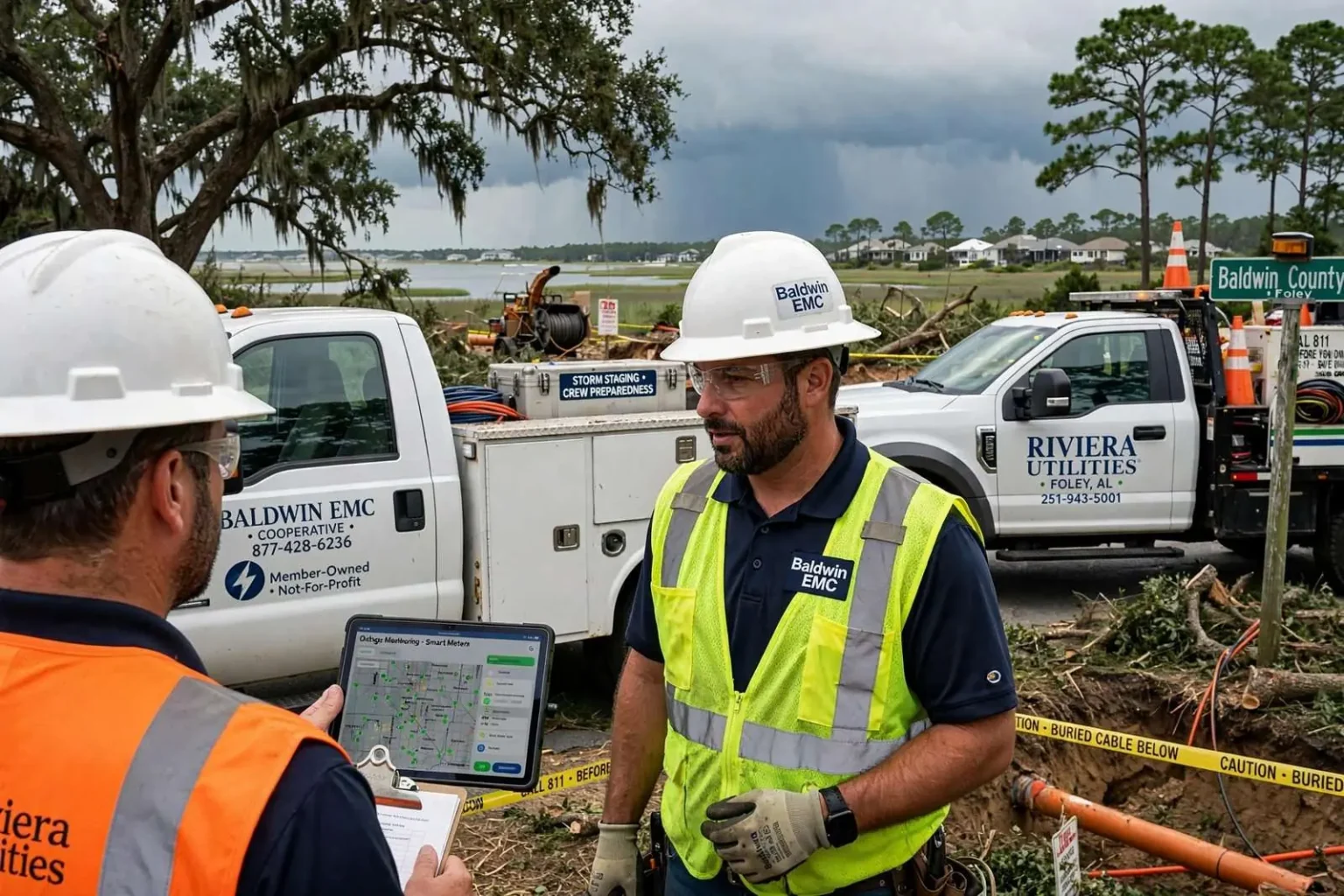
When Tropical Storm Bertha turned toward the coast in July, Riviera Utilities was already in planning mode — meeting with crews and putting an extra standby crew in place before conditions deteriorated. Chief administrative officer James Wallace said preparation scales with the size of the threat.
“We do a lot of preparation ahead of time,” Wallace said. “Getting our crews ready. We also go through our storm response at least once a year to make sure we’re ready.”
Baldwin EMC’s Reliability Investments
Mark Ingram, vice president of corporate services and public relations for Baldwin EMC, said the cooperative is continually working its reliability numbers down.
“We do that a number of ways by investing in infrastructure and then also staging our crews at the appropriate locations to respond to the outages in a timely manner,” Ingram said. “We also have our automatic meters that basically read for us any data and outages that will be helpful in responding to outages and also improving reliability.”
Smart Meters: Knowing Before the Phone Rings
Utilities can now monitor meters around the clock. Riviera Utilities keeps a staffed operations center, and director Zac Barnes said the setup sometimes restores service before a customer even registers that anything went wrong.
“It’s an amazing tool,” Barnes said. “So, in the past we used to have to rely very heavily on customers calling. You had to be home to know your power went out. Now with the smart meters being out there, that meter tells us that your power’s out whether you’re at home or whether you’re on vacation.”
That matters in a county where a large share of housing stock is seasonal or rented, and where an empty beach condo with a failed breaker used to go unreported for days.
Trimming Trees Before the Wind Does
Alongside the technology, Riviera Utilities runs a vegetation management crew that takes a proactive approach to keeping limbs and overgrowth away from power lines. The crew has helped cut outages by more than 50% — a reminder that a substantial share of storm damage is not the storm itself but what the storm throws into the wires.
The Underground Trade-Off
Utility companies across Baldwin County have added thousands of meters a year over the past decade. New developments are being built with underground utilities, and power companies have swapped many overhead runs for buried lines as opportunities arise.
Underground lines survive wind far better. They also come with their own headaches, Ingram said.
“Sometimes with underground, when you have major storms and you have storm surge and you have all that sand that is pushed up, tracking that, finding the transformers, then having to deal with all the salt, air, the water intrusion can take a little bit longer time to repair that damage as well,” Ingram said. “So, there’s advantages and disadvantages to both. Now the cost is much greater for underground than it is for overhead.”
Many municipalities now require underground utilities in new developments. But buried lines introduce a different hazard: the shovel. August carries an annual reminder to call 811 before digging, and Baldwin County utility companies run a public service campaign leading up to Aug. 11 urging residents to locate lines before breaking ground.
When the Plan Goes Live
As the county has grown, utilities have added linemen and kept refining their playbooks.
Keeping the Community Informed
“In the event that we enact our disaster plan, everyone knows exactly what they’re doing,” said Baldwin EMC manager of communications and public relations Kim Frank.
Frank said a strong working relationship between the utility and the local EMA is what ensures customers and county commissioners get reliable information during a mass response — a factor that shapes public patience as much as the repair timeline itself.
“We’re building that relationship and keeping them informed of what’s going on because they’re also a direct connect with the community when it comes to getting our message out,” Frank said. “We prioritize that relationship. It’s critical that we share information.”
Assessing Progress So Far
Tyler said the improvement is measurable.
“They’ve just gotten a lot more effective and a lot more efficient at being able to restore power,” Tyler said. “The repairs are getting better. It’s just the evolution of having been through this a number of times and they’ve gotten quite good at it and they continue to improve. We’re very, very pleased with how our utility companies continue to become more resilient and more responsive to their customers because they know as much as anybody how disruptive power disruptions can be.”
Baldwin County’s Growth and Storm History
Baldwin County has been one of the fastest-growing counties in Alabama over the past two decades, with population gains driven by retirees, remote workers and families relocating from larger metropolitan areas. The growth has placed significant demand on utilities, roads and emergency services in communities from Bay Minette to Gulf Shores.
Hurricane Sally made landfall on the Alabama coast in September 2020 as a Category 2 storm, producing significant wind damage, storm surge and widespread power outages across Baldwin County. The storm served as a real-world test of utility hardening and storm response plans that had been developed and refined since Hurricane Ivan in 2004.
Hurricane Ivan struck the Alabama Gulf Coast in 2004 as a Category 3 storm, producing catastrophic wind damage and some of the most extensive power outages in the region’s history. Parts of Baldwin County went weeks without electricity after Ivan, and the long recovery shaped the way utilities, emergency management agencies and local governments have approached storm preparedness ever since.
The utility companies serving Baldwin County include Alabama Power, which operates across most of the county; Baldwin EMC, a member-owned electric cooperative serving rural and suburban areas; Riviera Utilities, which serves the Foley area; and North Baldwin Utilities, which provides water and sewer service in northern Baldwin County. Each operates its own generation, transmission and distribution infrastructure.
The August 11 date referenced for the 811 call-before-you-dig campaign is the national Safe Digging Day, observed each year to remind homeowners and contractors to call 811 before any excavation project. Underground utility lines, including buried power, gas, water and telecommunications infrastructure, can be damaged easily without the free locating service the 811 number provides.
Underground utility installation has become a standard feature of new residential developments across much of Baldwin County, with municipal ordinances requiring buried lines in many of the larger planned communities. The shift away from overhead lines reflects both aesthetic considerations and the resilience advantages of underground infrastructure in high-wind environments. Existing overhead systems are converted to underground where the cost-benefit case justifies it.
Riviera Utilities, the Foley-based utility serving much of south Baldwin County, has invested in smart-meter technology across its service area. The systems provide real-time information about outages and allow the utility to dispatch crews without waiting for customer reports. The investment has reduced outage response times and improved customer service, particularly during severe weather events.
Baldwin EMC, the electric cooperative serving much of rural and suburban Baldwin County, has invested in vegetation management and grid modernization as part of its reliability strategy. The cooperative’s automatic meter infrastructure provides real-time information about outages and service quality, allowing crews to be dispatched more efficiently. Baldwin EMC has also worked to coordinate its storm response with the Baldwin County Emergency Management Agency and neighboring utilities.