Baldwin County’s Beach Alcohol Restrictions Credited With Calmer Spring Break Season
Gulf Shores and Orange Beach officials say a temporary beach alcohol ban and closer screening by rental owners helped produce a calmer, less crowded spring break season along Baldwin County's coast.
Beach communities across south Baldwin County are reporting a noticeably quieter spring break season this year, and local officials say a temporary alcohol restriction on the sand in Gulf Shores played a significant role in the turnaround.
Unlike the traditional single-week rush that once drew college students and high schoolers to the coast at the same time, spring break along the Alabama Gulf Coast has increasingly stretched across several weeks as different schools stagger their calendars. That shift has made crowd control trickier for local police, who now have to manage a rolling wave of visitors rather than one concentrated surge.
The stretched-out calendar is partly a product of the region’s own success. Baldwin’s beach towns — Gulf Shores, Orange Beach and the Fort Morgan peninsula — draw visitors from across the Southeast, and as enrollments grew at high schools and colleges in Alabama, Georgia, Tennessee, Louisiana and Florida, their spring calendars stopped matching. What had once been a single identifiable week became a six-week season, requiring police staffing plans that covered everything from mid-March college crowds to late-March family travelers, often within the same stretch of sand.
Why Gulf Shores Banned Alcohol on the Sand
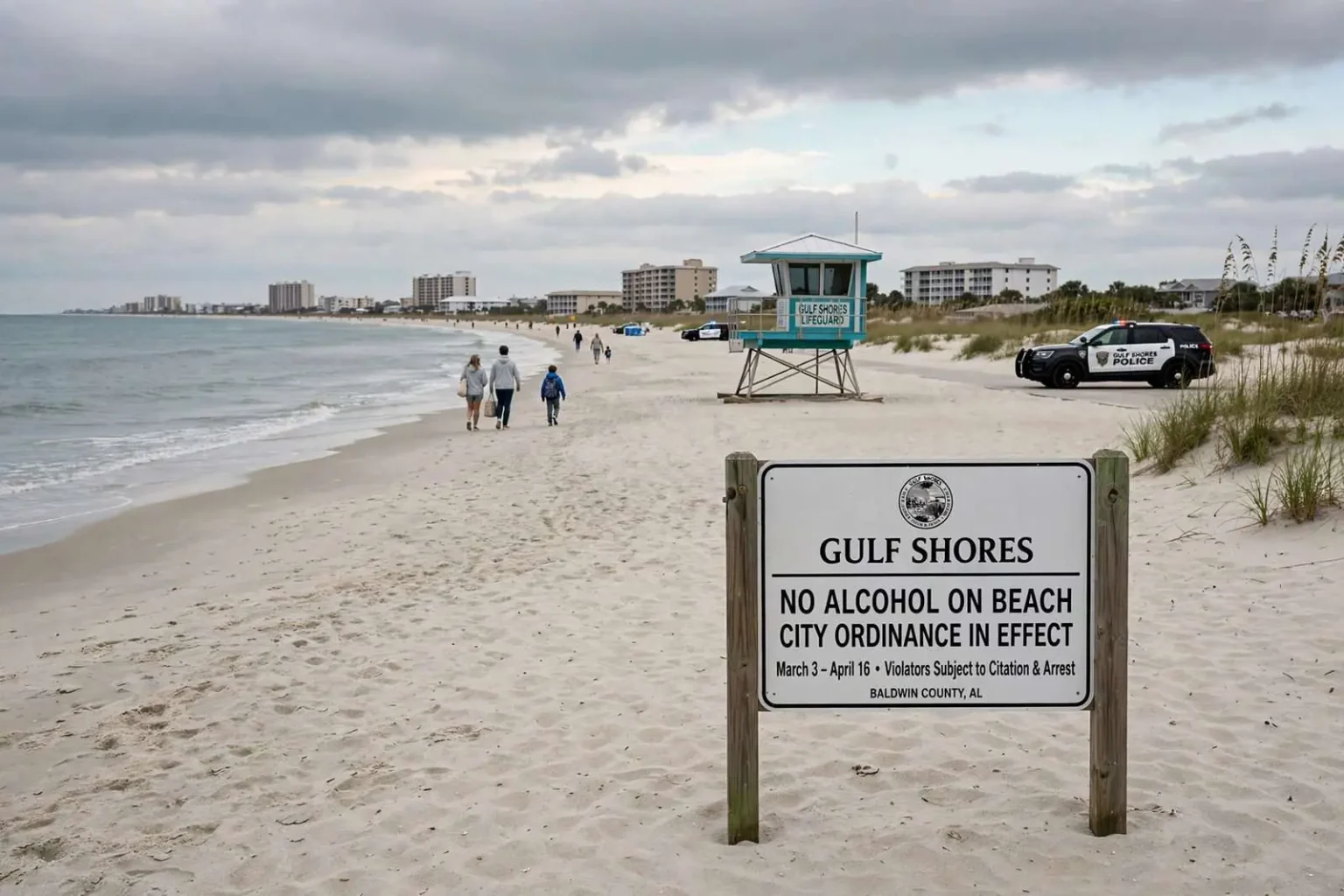
Gulf Shores enacted a ban on alcohol on its public beaches during the peak spring break weeks after the previous year’s crowds grew unruly, with underage drinking and littering along the shoreline prompting a broader crackdown on rowdy behavior. That ban lifted this week, and while officials aren’t encouraging anyone to celebrate its end with a beach party, the numbers gathered during the restricted period made a strong case for keeping the policy in place in future years.
Gulf Shores police recorded 633 arrests between March 3 and April 16 last year, a figure city officials have pointed to as they weighed whether to renew the alcohol ban again this spring. Gulf Shores plans to revisit the need for the restriction annually, but this year’s calmer atmosphere is likely to bolster the case for keeping it.
The arrest total did more than quantify the problem — it reframed it. Six hundred arrests spread across six weeks of the season is a sustained policing operation, and the public-safety costs of an unruly spring break fall on a small city’s year-round budget. Gulf Shores, a city of roughly ten thousand permanent residents that balloons seasonally, had long made tourism its economic engine; the alcohol ban represented the city’s decision that the engine needed rules, even at the risk of losing part of a market segment it had once courted.
Officials Credit the Ban With a Calmer Season
“I think it was a lesser crowd,” said Gulf Shores Police Lt. Bill Cowan. “There were still plenty of people here, but I think the alcohol ban for the weeks of spring break had the effect of letting people know that we’re not going to be the college party town. We’re not interested in being the college party town. I think that helped.”
The concern about Gulf Shores becoming a magnet for hard-partying college crowds grew out of what happened roughly 100 miles east in Panama City Beach, Florida, where authorities cracked down hard enough on spring break excess that many in the tourism industry along Alabama’s Pleasure Island worried the crowds would simply move west.
Panama City Beach had spent years as the undisputed capital of Southern college spring break, building a market around massive beach parties, concert events and national media coverage. When its city government, under pressure from residents and after a series of violent incidents, began aggressively restricting drinking on its sand, the question for every Gulf Coast community east of Pensacola became immediate: where would the crowd go next? Baldwin’s beach towns sat directly in the migration path, and their officials watched the Florida crackdown with a mixture of sympathy and alarm.
When a portion of that crowd did show up on Alabama beaches last year, the underage drinking and trashed beaches that followed led directly to Gulf Shores’ temporary alcohol ban and a wider push to discourage rowdy, unsupervised partying. The city’s action was unusual among Alabama beach towns — Gulf Shores had generally taken a permissive approach to beach drinking in earlier years — and the reversal itself sent a message that the city’s posture had changed permanently, whatever happened in Florida.
Orange Beach’s Different Approach: Private Screening
Orange Beach did not adopt a similar alcohol ban on its beaches, but Mayor Tony Kennon said this year’s spring break was still markedly better behaved than last year’s. “From our perspective it was better than last year,” Kennon said. “We had fewer numbers of unsupervised or unchaperoned spring breakers, which I think is a good thing, or we had a lot more kids who came down here who knew how to behave.”
Kennon credited condominium owners and rental property managers with doing a better job screening who they rent to during the spring break weeks, saying that shift made a real difference on the ground. “Our owners and the folks who rent were very responsible in vetting who was coming,” he said. “They understand how detrimental turning into a no-holds-barred college spring break is to our brand and to our overall business model. So they did a really good job of making sure that these kids were either supervised or they were older and behaved.”
The private-side screening mattered because Orange Beach’s tourism economy differs from Gulf Shores’ in composition. Orange Beach’s market skews toward high-end condominiums, charter-fishing clients and repeat family visitors, and its property owners understood that a single disorderly spring-break week could damage bookings for the rest of the year. Rental platforms, management companies and owner associations tightened their rules — minimum ages, security deposits, occupancy limits, quiet-hours enforcement — in a coordinated effort that no city ordinance could replicate.
A Shooting Near The Hangout Tests the Calm
Cowan noted that a stretch of chilly, rainy weather during the height of the season likely helped keep crowds off the beach as well, regardless of the alcohol restrictions or rental screening efforts, since fewer visitors were inclined to head outdoors in poor conditions.
The weather caveat is a familiar one in tourism statistics along the northern Gulf, where March can swing from summer-like warmth to cold fronts in a matter of days. Officials in both cities acknowledged that a cool, wet season suppresses not only the partying but the foot traffic, the restaurant sales and the rental revenue that spring break otherwise brings — meaning the calmer season came at some cost to the cash registers that depend on the crowds.
Not every night passed without incident. The most serious moment of the spring break period came late on the night of April 1, when gunfire erupted near The Hangout in the public beach area of Gulf Shores. No one was injured in the shooting, and as of Monday, police had a warrant out for a suspect’s arrest.
“Obviously, anytime something like that happens in such a high-profile place, it puts a bad spin on things,” Cowan said. The Hangout, a restaurant and entertainment venue on the public beach at the heart of Gulf Shores’ tourist district, draws crowds of families and young visitors alike, and a shooting within steps of it struck at the image the city had been working to rebuild.
He added that the incident also gave police a chance to demonstrate they take threats to public safety on the beach seriously as they pursue the suspect. “We’re going to find whoever you are and we’re going to put you in jail for behaving like that on our very prime beachfront,” Cowan said. “Our beachfront is special to us, and we’re not going to tolerate that.”
Reviewing the Rules Year to Year
City leaders in both Gulf Shores and Orange Beach say they will continue to evaluate crowd behavior, arrest data and business impact each year before deciding whether beach alcohol restrictions or other spring break measures are needed again.
The year-to-year review formalizes what had previously been an improvised response. Gulf Shores’ ordinance carries an expiration each spring, requiring the council to affirmatively decide whether to renew it — a structure that keeps the burden of proof on the restriction rather than letting it become permanent bureaucracy. Orange Beach’s reliance on private screening operates the same way in practice: rental rules get rewritten every season based on what the previous spring produced. Between the two cities, the Alabama Gulf Coast has settled on a shared doctrine — court the families, manage the students, and refuse, as Cowan put it, to be the college party town.
What the two cities are protecting, in the end, is the same asset from two directions. Gulf Shores’ public beach — the wide, groomed strand at the center of a planned tourist district — is the city’s product, and disorder on it damages a brand the city has spent decades building through festivals, fishing tournaments and national exposure. Orange Beach’s product is quieter: marinas, condominium towers and the repeat customers who return each summer on the strength of a calm, well-run season. Both cities concluded that the spring-break segment, however loud and however lucrative in the short term, threatened more annual revenue than it delivered, and this year’s calmer coast was their evidence.