Baldwin County’s Frog Pond keeps Sunday concerts an intimate, quiet affair
At Cathe Steele's Blue Moon Farm in Baldwin County, the Frog Pond's Sunday Social concert series pairs touring singer-songwriters with a strict no-talking "listening zone," running weekly through April 22.
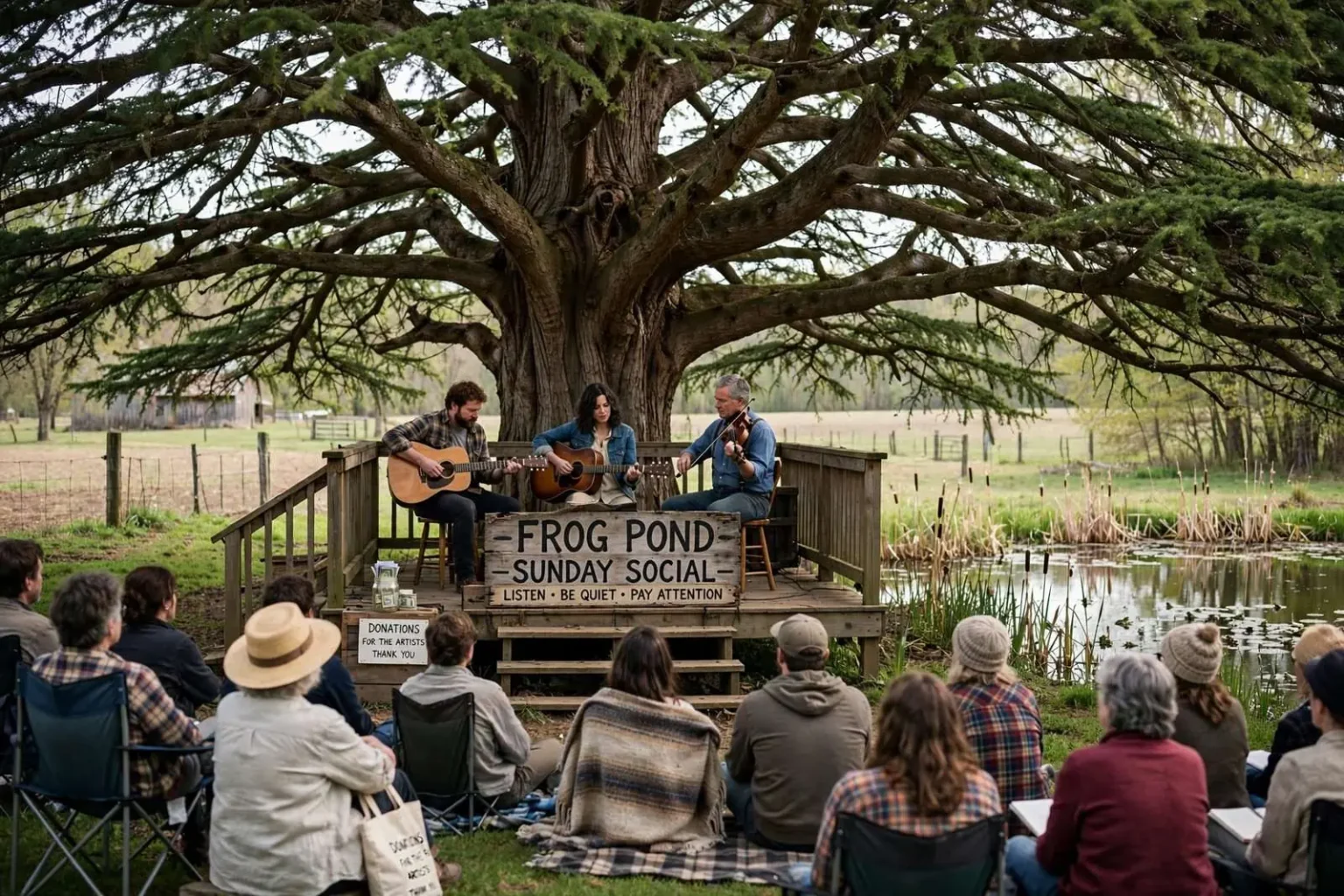
On a quiet stretch of farmland in Baldwin County, a weekly gathering unfolds each spring that has little to do with fame or ticket sales and everything to do with listening. The Frog Pond, a private outdoor concert venue tucked into Cathe Steele’s Blue Moon Farm, is hosting its Sunday Social music series through April 22, drawing together singer-songwriters, longtime music lovers and curious newcomers for an afternoon built around a single, unusual rule: be quiet, and pay attention. Now in its eighth year, the Frog Pond has developed a reputation among touring musicians and serious listeners alike as one of the region’s more distinctive stops. It is not a bar or a festival stage. There is no cover charge in the traditional sense; instead, proceeds collected from attendees go directly to the performers.
The setting is a small outdoor stage that Steele describes as a “front porch,” built beneath a cedar tree believed to be roughly 200 years old. Steele, who is retired, spent years managing entertainment bookings at Pirates Cove in Josephine and helped get the Flora-Bama’s live music program off the ground in its earlier years. When she retired, she said she wanted to keep building spaces where musicians and audiences could connect without the usual noise of a commercial venue. The Frog Pond grew out of that idea. “People are just people here, we don’t care about titles,” Steele said. “In fact, people from different worlds have fallen in love here. People have seen each other after 50 years have gone by. It’s a crazy thing.” The venue’s name comes from the pond on the property, where frogs provide a natural percussion section.
A Listening Room Under the Stars
The Frog Pond is a professional member of Folk Alliance International, an organization that supports folk musicians and the venues that host them, and it has featured some of the country’s touring singer-songwriters on its outdoor stage. Sets typically bring together two to five musicians at a time, many of whom are playing with each other for the first time, trading songs and improvising off one another in front of a small, attentive audience. The format — often called a “songwriter in the round” — places performers in a circle, each taking turns leading a song while the others accompany or harmonize. This structure mirrors the songwriting workshops Steele attended at the Kerrville Folk Festival and the Rocky Mountain Folks Festival, where the emphasis is on craft, vulnerability, and the generosity of listening.
Performers at the Frog Pond have included Grammy-nominated songwriters, Kerrville New Folk winners, and artists from the Nashville, Austin, and Atlanta songwriting communities who route their spring tours through the Gulf Coast. The venue’s reputation in the folk circuit means that booking often happens through word of mouth — a musician plays the Frog Pond, tells their peers about the attentive audience and the cedar-shaded stage, and the calendar fills itself. Steele doesn’t use a booking agent; she manages the schedule herself, communicating directly with artists and their managers.
The Sunday Social Format
The Sunday Social series runs on a donation basis. Attendees bring chairs or blankets, settle in under the cedar or on the grass, and contribute what they can to a collection that goes entirely to the performers. There is no minimum, no ticketing platform, no reserved seating. The model relies on the audience’s sense of reciprocity — and it works. Touring musicians who stop at the Frog Pond often say the per-capita take exceeds what they make at ticketed clubs, because every dollar goes to the art. Steele covers the venue’s modest overhead — insurance, maintenance, portable restrooms — out of pocket, viewing it as a contribution to the cultural fabric rather than a business expense.
This year’s lineup includes a mix of returning favorites and first-time visitors. The series opened with a duo from Nashville who build songs around Appalachian fiddle tunes and modern lyricism. Subsequent Sundays have featured a Gulf Coast blues guitarist who learned his craft in the juke joints of Moss Point, a sibling harmony act from Fairhope whose parents sang in the Medical Center’s church choir, and a songwriter from Austin who toured with a major-label band before returning to the solo circuit. The schedule leaves room for spontaneity — Steele often invites musicians passing through the area to drop in unannounced, creating evenings that feel less programmed than discovered.
Community and Continuity
The Frog Pond’s impact extends beyond the Sunday afternoons themselves. Local musicians credit the venue with raising the bar for original music in the area — young songwriters who attend regularly absorb the craft of touring professionals without leaving the county. The Baldwin County school system’s music teachers have brought students to Sunday Socials as field trips, exposing them to live acoustic performance in a setting that demands respect for the art form. Steele has also hosted songwriting workshops in the farm’s barn, pairing visiting pros with local talent for afternoon sessions on lyric, melody, and the business of independent music.
The venue has become an informal anchor for the Gulf Coast’s singer-songwriter network, a loose affiliation of musicians who travel the circuit from New Orleans to Apalachicola, playing house concerts, listening rooms, and the occasional theater. The Frog Pond sits at the geographic heart of this circuit, and its reputation for attentive audiences and fair pay makes it a reliable stop. Musicians who play there often extend their stays, writing songs on the farm’s porch, swimming in the pond that gives the venue its name, and connecting with other artists in a way that the grind of club touring rarely allows. Several collaborations that began at the Frog Pond have resulted in recorded albums, joint tours, and lasting creative partnerships.
Beyond the music community, the Frog Pond has become a touchstone for the broader Baldwin County cultural landscape. The Fairhope Public Library has partnered with Steele to create a “songwriter collection” of books on craft, biography, and music history. The Eastern Shore Art Center has hosted visual artists who create work inspired by the Sunday Social atmosphere. Even local restaurants and B&Bs have benefited, with out-of-town musicians and audience members booking rooms and tables for the weekend. The economic ripple is modest but real — a reminder that cultural infrastructure, even at this scale, supports the surrounding economy.
The Ecology of a Listening Room
The cedar tree that shades the stage is more than a landmark — it’s an acoustic element. Its dense canopy dampens the high frequencies that can make outdoor sound harsh, while the pond behind the stage acts as a natural reflector, carrying sound toward the audience without electronic enhancement. Steele consulted with a sound engineer from the University of South Alabama’s music department when designing the stage area, but the final arrangement was refined through trial and error over the first few seasons. Musicians regularly comment on the clarity of the sound, the way a fingerpicked guitar or a soft vocal carries to the back row without strain. This acoustic quality, combined with the audience’s self-enforced silence, creates what several performers have called “the best listening room on the Gulf Coast.”
The “be quiet” rule is enforced gently but firmly. Steele and her volunteers make announcements before each set, reminding attendees that talking during songs disrupts the experience for everyone. There are no bouncers, no security staff — just the shared understanding that the music is the point. “It’s not about being strict,” Steele said. “It’s about creating a space where the quiet is as valuable as the sound.” Regular attendees describe the atmosphere as almost sacred, a rare pocket of sustained attention in a culture that fragments it. Musicians who have played venues across the country say the Frog Pond is one of the few places where they can hear themselves think between verses.
Looking Ahead
As the current season approaches its April 22 close, Steele is already thinking about year nine. She hopes to expand the workshop series, partner with the Alabama State Council on the Arts for a grant to improve accessibility, and perhaps record a live compilation album to document the venue’s first decade. But the core will remain the same: a cedar tree, a front porch stage, a circle of musicians, and an audience that knows how to listen. In a region where live music often means amplified covers in crowded bars, the Frog Pond offers a different proposition — that the song matters enough to warrant silence, and that silence, shared, is its own kind of music. The Frog Pond’s model — donor-supported, artist-centered, listener-focused — has drawn attention from cultural organizations across the Southeast. The South Arts federation has cited it as a case study in rural arts sustainability. For Steele, the recognition is nice but secondary. “I just wanted a place where the music comes first,” she said. “Everything else follows from that.”