Baldwin County Schools Stayed Open Amid Flooded Roads in 2007
A 2007 WKRG update reported that Baldwin County schools remained open while flooding disrupted bus travel in Bon Secour and Elberta.
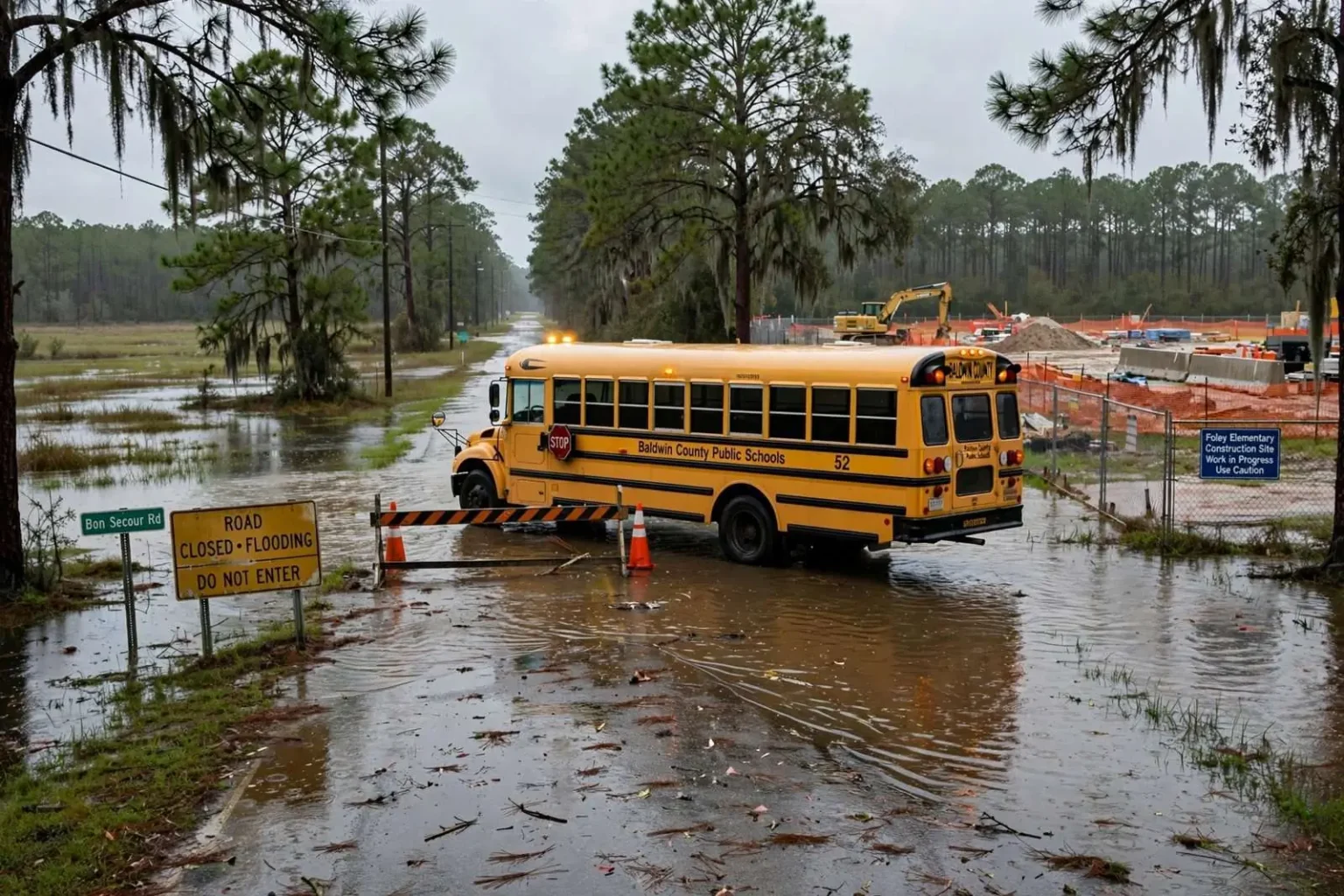
Baldwin County schools remained open in October 2007 as flooding and washed-out roads disrupted some bus routes, according to a local station’s report at the time. The district chose to hold classes while individual routes were reworked around closed and damaged roads, a decision that reflected how widespread the flooding was across southern Baldwin County and how carefully school transportation officials had to weigh safety against keeping the school day intact.
The problems were concentrated in the county’s southern communities, where flat terrain, sandy soils and a network of low-lying roads make flooding a recurring hazard after heavy rain. School-system officials said buses could not travel in the Bon Secour area because several roads there were flooded and closed. Routes that normally threaded through those neighborhoods had to be suspended, altered or served from alternate stops until the water receded.
Washed-out roads near Elberta added to the disruption. When a road surface washes out, the damage is not just an inconvenience for a day; the roadway itself can remain unusable until crews repair it, and school transportation planners must assume the closure could last. The report also noted flooding near the Foley Elementary construction site, where work on the campus was under way and standing water was expected to slow or alter transportation around that part of Foley.
How a rural district absorbs a flood
Baldwin County Public Schools operates one of the largest geographic school systems in Alabama, covering a county that stretches from the Mobile Bay shore across to the Perdido River and from the Gulf-margin communities down south to the piney woods north of Bay Minette. A district of that size depends on an elaborate bus network, with long routes that cross creeks, low bridges and flood-prone stretches of road that city systems rarely encounter.
When heavy rain floods a handful of those roads, the effect ripples through the whole transportation plan. Dispatchers and route supervisors must confirm which roads are closed, decide where a bus can safely turn around, and communicate changes to drivers heading out before dawn. In October 2007, that work was happening community by community, with Bon Secour, Elberta and Foley among the areas most affected.
Keeping schools open during such an event has trade-offs that transportation officials consider quickly. Attendance may drop in the hardest-hit neighborhoods because some students cannot reach alternate stops, but families also count on the routine of the school day, and staff members are positioned to look after children who do arrive. The district’s approach in 2007 was to stay open, adjust the routes that had to change, and get word to parents about what to expect.
The message to parents
Parents were urged to stay with their children until buses arrived because normal pickup times could be affected. That guidance matters more than it might appear. On a flooded morning, a bus running an altered route may reach a stop late, or may skip a stop entirely if the road to it is closed, and a child waiting alone at the curb has no way to know whether the bus is delayed or not coming at all.
Having an adult stay with the child until the bus arrives closes that gap. It is standard advice during weather disruptions, and the 2007 report made a point of passing it along to Baldwin County families. For parents, the practical steps included listening for district announcements, watching for changes at their own stop, and keeping children clear of flooded ditches and roadway edges while they waited.
Standing water carries its own dangers for children on the way to school. Flooded roadbeds can hide washed-out shoulders, and moving water in ditches can be deceptively fast. Local officials have long cautioned that neither children nor adults should walk or drive into water of unknown depth, and a flooded school morning in Bon Secour or Elberta is exactly the situation those warnings anticipate.
Flooding in south Baldwin County
The October 2007 disruption fit a familiar pattern for the lower county. South Baldwin’s communities sit on low coastal-plain ground threaded by creeks that drain toward Mobile Bay, Bon Secour Bay and the Gulf. Intense rain can fill those creeks quickly and push water across roads that look ordinary in dry weather, and the same flat landscape that makes the area productive farmland makes drainage slow once water leaves the channel.
Washed-out roads are a particular hazard in the region’s sandy soils. When a ditch or creek overtops a road, the flow can undermine the pavement or grade and carry the roadbed away, leaving a gap that is invisible under standing water. That is why flooded road closures in Baldwin County tend to last longer than the rain itself, and why the school system could not simply assume that a route open Monday would be open Tuesday.
Communities such as Bon Secour, a historic fishing village near the bay, and Elberta, farther east near the state line, depend on a lattice of county roads for school bus access. A single flooded crossing can force a bus onto a long detour or make a route impractical. In October 2007, several roads in the Bon Secour area were flooded and closed outright, leaving buses no lawful or safe way through.
The Foley Elementary construction site
The report’s mention of flooding near the Foley Elementary construction site pointed to another layer of the story. The school system had construction work under way on the campus, and heavy rain around an active site creates complications well beyond the bus route. Standing water can delay work, complicate deliveries, and turn staging areas into mud, all of which factor into how the surrounding transportation plan is adjusted.
For families in Foley, the concern flagged in the report was straightforward: transportation around the construction area was expected to slow or alter pickups. Construction zones frequently change traffic patterns, and when flooding is added on top, even familiar routes become unpredictable. District officials’ warning that normal times could be affected gave parents in that zone advance notice to plan for delays.
The episode also illustrates how school operations and municipal infrastructure intersect. A construction project, a storm drain network, a county road crew’s repair schedule and a bus route all meet at the same corner. On a flooded October morning in 2007, Baldwin County’s transportation staff were coordinating across all of them at once, community by community.
What the 2007 episode showed
The fact that schools remained open through the disruption says something about the district’s posture toward weather events. Baldwin County schools sit in a hurricane-exposed coastal county, and the system has long experience with closures and evacuations; a rain event that floods some roads but leaves campuses usable falls on the milder end of that spectrum. The district’s choice was to preserve the school day while managing the transportation exceptions.
For the communities involved, the episode was a snapshot of rural coastal life. Bus routes in Bon Secour, Elberta and Foley serve families spread along country roads where a washed-out crossing really can isolate a neighborhood. The system’s ability to communicate which routes were affected, and to ask parents to stay with children at stops, was what made an altered day workable rather than chaotic.
It is also a reminder of how quickly conditions change on the Gulf Coast. October sits in the heart of hurricane season, and the same systems that flood roads in one week can be followed by clear, dry weather the next. The closures and alterations of October 2007 were temporary, but the underlying geography that caused them has not changed.
This article is a historical summary of a 2007 school transportation update reported by a local station. Current school operations, bus routes and road conditions in Baldwin County may differ, and readers should consult the school system and county officials for present-day information.
The morning of a flooded bus schedule
A flooded school morning begins long before sunrise for the people who run it. Transportation staff start checking roads in the dark, often relying on word from drivers who live in the affected communities, county road department notices and their own knowledge of which crossings rise first. Decisions about individual routes have to be finalized before buses roll, because a driver headed to Bon Secour at 5:30 a.m. cannot wait for a daylight confirmation that the water has fallen.
Once buses are out, the plan keeps adapting. A driver who finds water across an unexpected stretch of road radios in, and dispatchers route the bus around the closure if an alternate exists or mark the stop as unservable if none does. Each of those calls changes when children reach school and when they get home, which is why the district’s public guidance centered on delay rather than cancellation.
Afternoon dismissals carry their own version of the same problem. Water that fell overnight may have drained by the final bell, or a road may still be closed, and the district has to re-check every altered route before sending children home. Parents who stayed with their children at morning stops were, in effect, being asked to expect the same uncertainty on the way home.
Why school systems track road closures so closely
Behind the 2007 report is a routine that Baldwin County transportation officials repeat after every significant rain. School systems in flood-prone counties maintain maps of low crossings and known trouble spots, and they coordinate with county engineers who decide when a damaged road is safe for a loaded bus. A road that a passenger car can cautiously splash through may still be off limits for a school bus, both because of the vehicle’s weight and because of the responsibility a driver carries for the children aboard.
That conservative approach is deliberate. The safety record of school transportation rests on drivers refusing marginal situations, and a flooded road is the textbook marginal situation. The cost is inconvenience, as families in Bon Secour, Elberta and Foley experienced in October 2007, but the benefit is that children are never put on a roadbed that may no longer be there.
The episode remains useful history for the county. It shows how a large rural coastal district communicates through disruption, how parents fit into the safety chain, and how the same storm that soaked yards and fields reshaped the morning for thousands of families. It also records the specific local details of October 2007, from the flooded roads of Bon Secour to the construction site at Foley Elementary, that a dry summary of a storm can easily lose.