
Bankhead Tunnel Closing Overnight for Alabama Power Cable Maintenance
Alabama Power is doing cable maintenance inside the Bankhead Tunnel, closing it 9 p.m. to 6 a.m. Monday and Tuesday. Drivers should use the Wallace Tunnel.
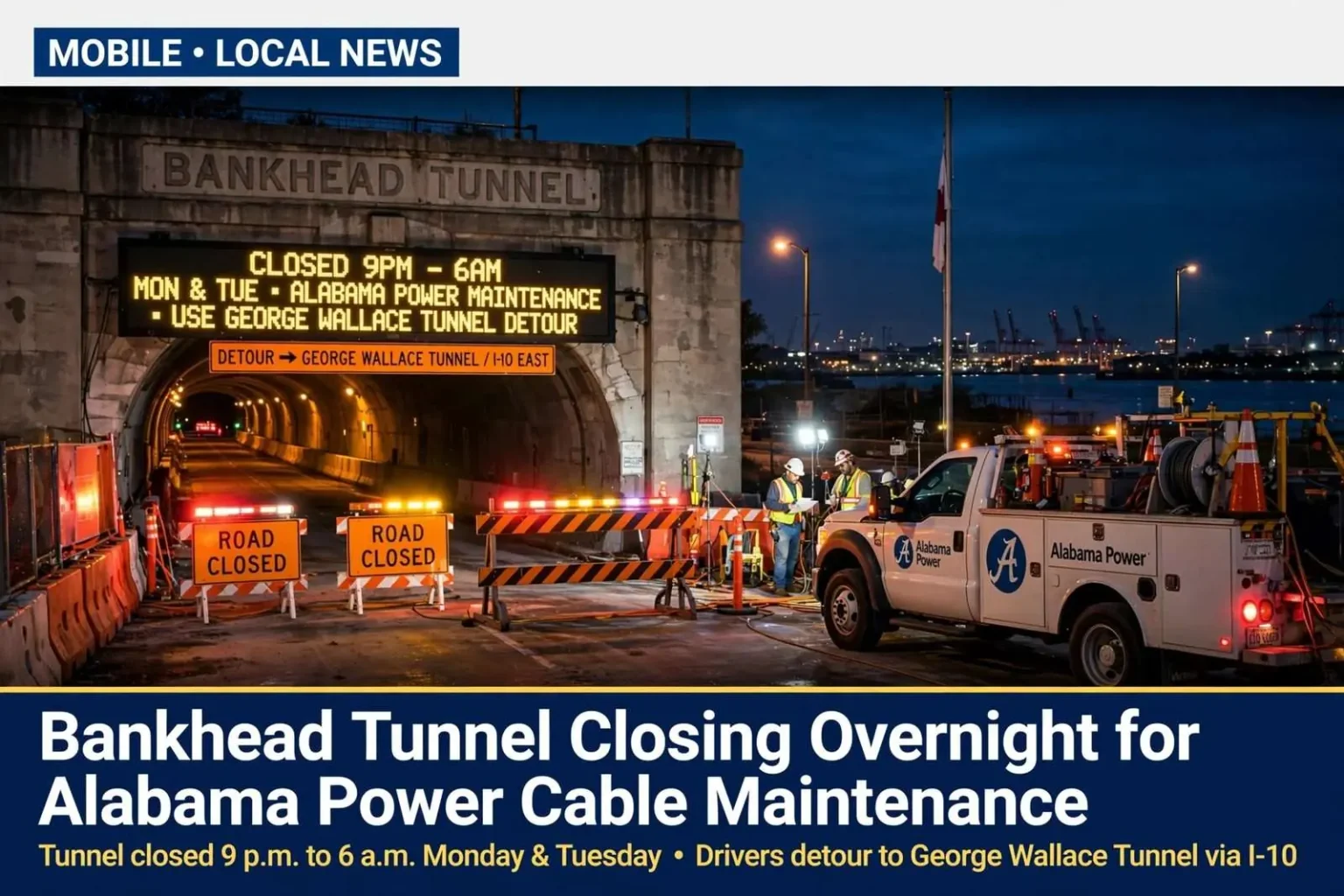
Drivers who rely on the Bankhead Tunnel to get in and out of downtown Mobile will need another route Monday and Tuesday nights. Alabama Power is performing maintenance on electrical cables inside the tunnel, closing it to traffic from 9 p.m. until 6 a.m. both nights.
The utility advised motorists to use the nearby George Wallace Tunnel while the work is underway. The two bores sit side by side beneath the Mobile River, carrying Government Street traffic between downtown and the island that leads across Mobile Bay on U.S. 98 or onto Interstate 10. With the Bankhead closed, every vehicle that would normally use it funnels through the Wallace bore or crosses the river on the city’s bridges, and drivers planning overnight trips should build in a few extra minutes.
Overnight work windows are the standard way to maintain an underwater tunnel. Closing from 9 p.m. to 6 a.m. captures the lowest-traffic hours, letting crews move equipment and cabling through the tube without managing a live roadway overhead. Alabama Power’s electrical cables inside the tunnel serve infrastructure along the crossing, and maintenance on them requires the kind of access that cannot be safely arranged with traffic moving inches away.
For commuters, the practical math is simple: the detour adds distance but not much time outside peak hours. Drivers coming from downtown toward the Eastern Shore can shift to the George Wallace Tunnel on I-10, which carries most of the region’s cross-bay traffic in any case. Anyone crossing between 9 p.m. and 6 a.m. Monday or Tuesday should expect the change and plan accordingly rather than discovering the closed portal at the bottom of Government Street.
Mobile’s Underwater Crossings
The Bankhead Tunnel is the older of the city’s two river crossings. Opened in the early 1940s and named for Alabama’s Sen. John H. Bankhead, it was built as a submerged tube — sections constructed away from the river, sunk into a trench across the Mobile River, and sealed to form a continuous passage beneath the water. Its Government Street alignment ties downtown Mobile directly to Blakeley Island and the routes that continue across Mobile Bay.
The George Wallace Tunnel, which opened in 1973 as part of the Interstate 10 corridor, uses the same basic engineering approach and runs parallel to the older bore. Together the two tunnels are among the most distinctive pieces of infrastructure on the Gulf Coast — roadways that dip beneath a working port river in the heart of a city, carrying everything from school buses to 18-wheelers between downtown and the Eastern Shore.
Because both bores are confined spaces with no shoulder to speak of, any incident inside them is amplified. A stalled car blocks a lane entirely; a fire fills a tube with smoke quickly; a wreck can close the crossing for hours. That is why utility work that requires closing a tunnel is scheduled at night, and why travelers through Mobile have learned to check tunnel status before planning an overnight drive.
A Recent History of Closures
Mobilians have grown accustomed to improvising around Bankhead closures. In July, an overturned 18-wheeler shut both lanes down for nearly four hours, snarling traffic between downtown and the island while crews cleared the wreck from the tube.
Back in April, the tunnel briefly closed after a barrel of weed killer tumbled off a truck and spilled across the lanes, requiring a hazmat response. Chemical spills inside an enclosed roadway are treated with particular caution: ventilation is limited, runoff has nowhere natural to go, and cleanup crews must protect both the workers in the tube and the drainage systems that connect to the river. The April incident was resolved without lasting damage, but it showed how a single unsecured load can shut down a crossing that tens of thousands of drivers count on.
Planned maintenance closures like this week’s are routine. In March 2021, the tunnel closed nightly for a little over a week so crews from Uniti Fiber could perform their own work inside the crossing, stringing and servicing telecommunications cable alongside the other utilities that ride through the bore. The pattern is well established: when a utility needs to open the tunnel’s walls, ceiling, or roadway, the tube closes overnight and reopens each morning for the commute.
The electrical cables Alabama Power is maintaining are part of the bundle of infrastructure that travels through the tunnel. Underwater crossings in Mobile carry more than cars — power feeds, fiber-optic lines, and drainage systems all share the corridor beneath the river, and each utility’s equipment needs periodic inspection and repair. Keeping those systems healthy inside the Bankhead bore protects the services that depend on them, but it periodically costs drivers a few nights of detours.
What Drivers Should Know This Week
The closure runs from 9 p.m. to 6 a.m. Monday and Tuesday nights, with the tunnel scheduled to reopen each morning for daytime traffic. Alabama Power’s work is expected to finish within the two-night window, though utilities typically reserve the ability to extend maintenance if crews uncover a problem that needs more time.
Drivers heading downtown from the Eastern Shore overnight should use the George Wallace Tunnel or one of the river bridges, and those leaving downtown for the bay should do the same. Commercial drivers who normally route through the Bankhead on Government Street will want to confirm their detour clearances; the Wallace bore on I-10 handles standard truck traffic, but surface-street detours through downtown can involve narrower lanes and tighter turns.
Local residents have a practical rule of thumb that has developed through years of closures: if the Bankhead is shut, expect heavier traffic in the Wallace bore and on the Cochrane-Africatown USA Bridge route across the river, and add a few minutes to any trip that crosses the Mobile River after dark. Real-time updates during closures typically come from the city and the utilities involved, and overnight crews post signage at the tunnel approaches well before the 9 p.m. shutdown.
By 6 a.m. Wednesday, the expectation is that Government Street traffic will flow through the Bankhead as usual. The work is one more entry in the tunnel’s long maintenance record — a crossing that has served downtown Mobile since the early 1940s, and one that keeps proving it needs periodic care to keep doing so.
The Bankhead’s role in the city’s daily rhythm makes every closure noticeable. Government Street feeds directly into the tunnel’s west portal, which means the crossing is the default path for downtown workers, port traffic, and anyone connecting between central Mobile and the U.S. 98 route across the bay. When the bore closes, the whole western edge of downtown feels the shift as drivers reroute through the Wallace Tunnel or up and over the river bridges.
Utility work of this kind also illustrates how much hidden infrastructure rides beneath the city. A driver passing through the Bankhead sees a roadway and lights; below and beside the roadway run power feeds, communications cable, and drainage that serve the crossings and the districts at both ends. Maintaining any of it means working in a confined tube under a river, on a schedule that avoids the daylight commute, with crews positioned so they can clear the bore quickly if something changes.
Why Tunnel Maintenance Cannot Wait
Electrical systems inside an underwater tunnel live in one of the harshest environments a utility can face: constant humidity, salt-laden air, vibration from traffic, and limited access for repair equipment. Cables, lighting, ventilation fans, and pumps in these structures require scheduled inspection and replacement, and deferring the work risks failures at far worse moments — a lighting outage in the middle of a rush hour, or a drainage pump down during a Gulf storm.
That is the trade-off communities with underwater tunnels accept. Two nights of detours buy years of reliable service from a crossing that has no easy backup — the George Wallace bore absorbs the load, but it is the only real alternative for vehicles that need to get under, not over, the river corridor. Cities from Mobile to the Chesapeake Bay have all built their maintenance calendars around the same principle: fix the tube when the traffic is asleep.
For Alabama Power, the overnight window also simplifies safety. Crews working on energized cables in a confined space operate under strict clearance and lockout procedures, and having no traffic in the bore removes the most unpredictable variable. The utility’s trucks and equipment can stage at the portals, and the work can proceed at the pace the procedures require rather than the pace traffic allows.
Once the two nights are complete and the tunnel reopens at 6 a.m., drivers should find no visible change — that is the point of maintenance like this. The cables inside the Bankhead Tunnel will be serviced or replaced, the lighting and systems around them will be checked, and the crossing will return to carrying Government Street traffic beneath the Mobile River, as it has for more than eighty years, with the next closure hopefully a long way off.


