
Bankhead Tunnel Opens Its Lanes to Walkers and Cyclists on Saturday Mornings
Mobile's Bankhead Tunnel opens to bicycle and pedestrian traffic on alternating Saturday mornings from 6 to 8, continuing a popular seasonal tradition.
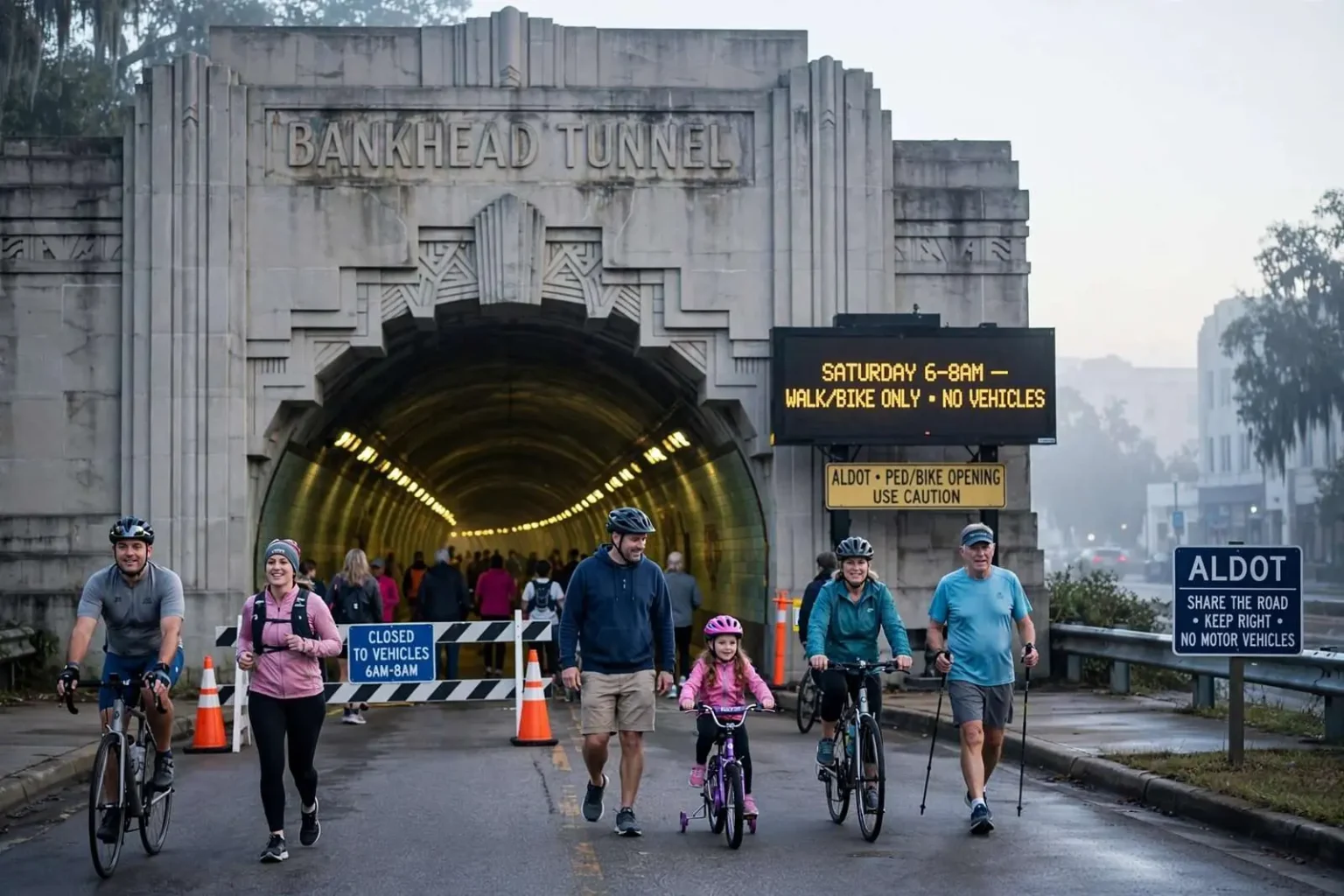
One of Mobile’s most unusual recreational rituals returns this weekend: the Bankhead Tunnel opens to bicycles and foot traffic on Saturday morning, giving walkers and riders a rare chance to travel beneath the Mobile River without a car. For two hours, one of the busiest pieces of pavement in downtown Mobile goes quiet, and the crossing that normally funnels westbound commuters from the old Government Street corridor is handed over, briefly, to people moving at walking and pedaling speed. It is the kind of event that exists nowhere else on the Gulf Coast — a marked route through a highway tunnel that most residents have only ever experienced through a windshield.
The tunnel welcomes non-motorized visitors from 6 to 8 a.m. this Saturday, and the arrangement repeats every other Saturday morning for the next several weeks. The seasonal openings have become an annual tradition in recent years, one that local cyclists and running groups have folded into their regular calendars. Early risers who show up on the first morning tend to include touring riders getting in miles before the heat, joggers looking for a flat, cool stretch of route, and families who want to show children a landmark they usually see only in passing.
The appeal is straightforward. The Bankhead Tunnel is short by highway standards, but it is a genuine river crossing — a dip beneath the Mobile River on a route that otherwise requires a bridge. Walking or riding it puts participants inside the infrastructure rather than on top of it, and the experience is different enough from an ordinary ride that many participants treat it as a small event in its own right rather than simply another training mile logged before breakfast.
How the Saturday openings work
ALDOT, which manages the crossing, notes that times and days are subject to change as the department evaluates public interest and traffic impacts. That flexibility is built into the program by design: the department gauges turnout each cycle and weighs it against the disruption to westbound Government Street traffic, then adjusts the schedule accordingly. Anyone planning to attend on a given weekend is well served to confirm the current schedule before heading out, since a shift in hours or an off-week is possible as the season progresses.
Message boards and additional traffic control devices will be used for safety and information, and cyclists and pedestrians are encouraged to keep speeds reasonable and use extra caution traveling through the tunnel. The message boards warn approaching drivers of the changed use and guide participants at the entrances, where the transition from open street to enclosed tunnel is the most sensitive point of the route. The controlled environment is part of what makes the event work — for those two hours, non-motorized users are the primary traffic, not guests in someone else’s lane.
Even so, participants should arrive prepared. The tunnel is an enclosed space with its own lighting, acoustics, and sightlines, and the courtesy habits that apply on any shared path matter more inside it. Riders coming up behind walkers should announce themselves and pass with room to spare, pedestrians should stay predictable, and everyone should respect the two-hour window — the tunnel returns to vehicle traffic promptly at 8 a.m., and clearing the space on time is what keeps the arrangement welcome with the state agency that donates the pavement twice a month.
A landmark built in the early 1940s
Built in the early 1940s, the Art Deco-era Bankhead Tunnel normally carries Government Street traffic westbound under the Mobile River. It is one of the older pieces of transportation infrastructure on the Alabama coast, a product of the era when cities invested in dramatic public works to modernize their street grids, and its entrance portals still carry the clean geometric detailing that defines the Art Deco style. Approaching it on foot or by bicycle is one of the few ways to actually look at the structure rather than drive through it at speed — the tile, the signage, and the shape of the approach all reward a slower look.
The periodic walk-and-bike mornings let residents experience the landmark’s tiled walls and gentle dip below sea level at a human pace. That dip is the tunnel’s defining engineering feature: the roadway descends below sea level to pass under the river and climbs back out the other side. Inside, the temperature drops a few degrees even on warm mornings, the light changes, and the sound of the city falls away to an echo. For many first-time participants, the most surprising thing is simply how noticeable the grade is — a climb that a car barely registers is a real effort on a bicycle and a distinct tilt underfoot on a walk.
The tunnel also carries decades of accumulated local memory. Generations of Mobilians have commuted through it on the way to downtown jobs, crossed it on the way to the riverfront, and swapped the familiar stories about floodgates and the days the water came close. Opening it to walkers and cyclists taps into that store of local affection; the event draws precisely because the structure is beloved, not merely old, and because it belongs to the city’s daily geography in a way few landmarks do.
A different way to see downtown Mobile
For locals, the Saturday openings double as a fresh route through familiar territory. The Government Street corridor ties the tunnel directly into the fabric of the city — older neighborhoods to the west, the central business district and the riverfront to the east. Participants arriving by bike can build a full loop out of the crossing, pairing the tunnel with the downtown grid or the waterfront paths nearby, while walkers can treat it as a destination in itself and drift toward a downtown coffee shop afterward as the city wakes up around them.
The timing shapes the character of the event. A 6 to 8 a.m. window in the Gulf South summer means cooler air, lighter traffic on surrounding streets, and more comfortable conditions for riders and runners alike. It also means the event belongs to early risers: the crowd skews toward people who are already out training at dawn, along with the curious who make a point of setting an alarm once a season to see the tunnel from the inside at walking speed. Parking and side streets near the portals are quiet at that hour, which makes arriving by car, bike, or on foot equally simple.
Groups have learned to plan around it. Cycling clubs in the Mobile area have used the openings as a meet-up point, and the every-other-Saturday rhythm lets participants build it into a multi-week routine rather than a one-off. The seasonal nature of the program — a run of Saturday mornings rather than a permanent change — keeps interest high, since each opening is a limited opportunity rather than an amenity that will always be there. Missing a cycle means waiting two weeks for the next one, and missing the season means waiting a year.
What walkers and riders should know before going
First-time participants tend to have the same practical questions, and the answers are simple. The route through the tunnel itself is short, so most people will want to pair it with other miles or a longer walk to make the morning worthwhile. The surface is standard roadway pavement, so ordinary road bikes, hybrids, and strollers all handle it without trouble. Lighting inside the tunnel is adequate for the event, but a front light and a rear light are never a bad idea in an enclosed space, and they help riders see and be seen as groups bunch up near the portals.
Pacing deserves a word as well. The department’s advice to keep speeds reasonable is not just boilerplate; the tunnel’s slight grade invites fast descents on the entry side, and visibility around slower users is limited inside the curve of the dip. Riders who want to hammer should save their interval work for the open streets before and after, and treat the crossing itself as the sightseeing portion of the morning. Photographers, meanwhile, will find the tile work and the perspective of the roadway vanishing below sea level among the most photogenic views of Mobile’s built environment anywhere downtown.
Weather is the other variable. Early morning thunderstorms are a feature of Gulf Coast summers, and while the tunnel itself is sheltered, the approaches are not. Participants should watch the forecast, and anyone bringing children should keep the every-other-Saturday cadence in mind when deciding whether to push through marginal conditions or simply wait for the next opening two weeks later. Flexibility cuts both ways: ALDOT can adjust the schedule, and so can attendees.
A small program with an outsized following
Programs like this one cost little and deliver a lot. They turn existing infrastructure into a recreation amenity for a few hours, they introduce residents to a historic structure many take for granted, and they build goodwill between the agency that manages the crossing and the cyclists, runners, and families who use it. In a region where car-free space is scarce, the value of a safe, closed, and genuinely novel route is easy to overstate only in the sense that it could be stated even more strongly.
The annual rhythm also matters for the city’s self-image. Mobile has spent years investing in its riverfront and downtown public spaces, and a tunnel opening that draws residents beneath the river on foot fits that broader story: a working port city that is also finding ways to let people experience its landscape up close. The image of a child on a small bicycle pedaling through a 1940s Art Deco tunnel below sea level is the kind of thing that sticks with a family, and it is the kind of tradition that, once established, residents come to expect and defend.
For now, the practical takeaway is unchanged. The Bankhead Tunnel opens to bicycles and foot traffic from 6 to 8 a.m. this Saturday and on alternating Saturday mornings for the next several weeks, under the management of ALDOT and with schedules subject to adjustment as the department watches interest and traffic impacts. Bring a light, keep speeds reasonable, use extra caution, and enjoy one of the strangest and most charming recreational rituals on the Alabama coast — a walk beneath the Mobile River, at a human pace, before breakfast.