Bankhead Tunnel Reopens After 18-Wheeler Ripped in Half by Low Clearance
The Bankhead Tunnel in Mobile was closed for nearly four hours after an 18-wheeler was ripped in half due to the tunnel's 12-foot clearance height.
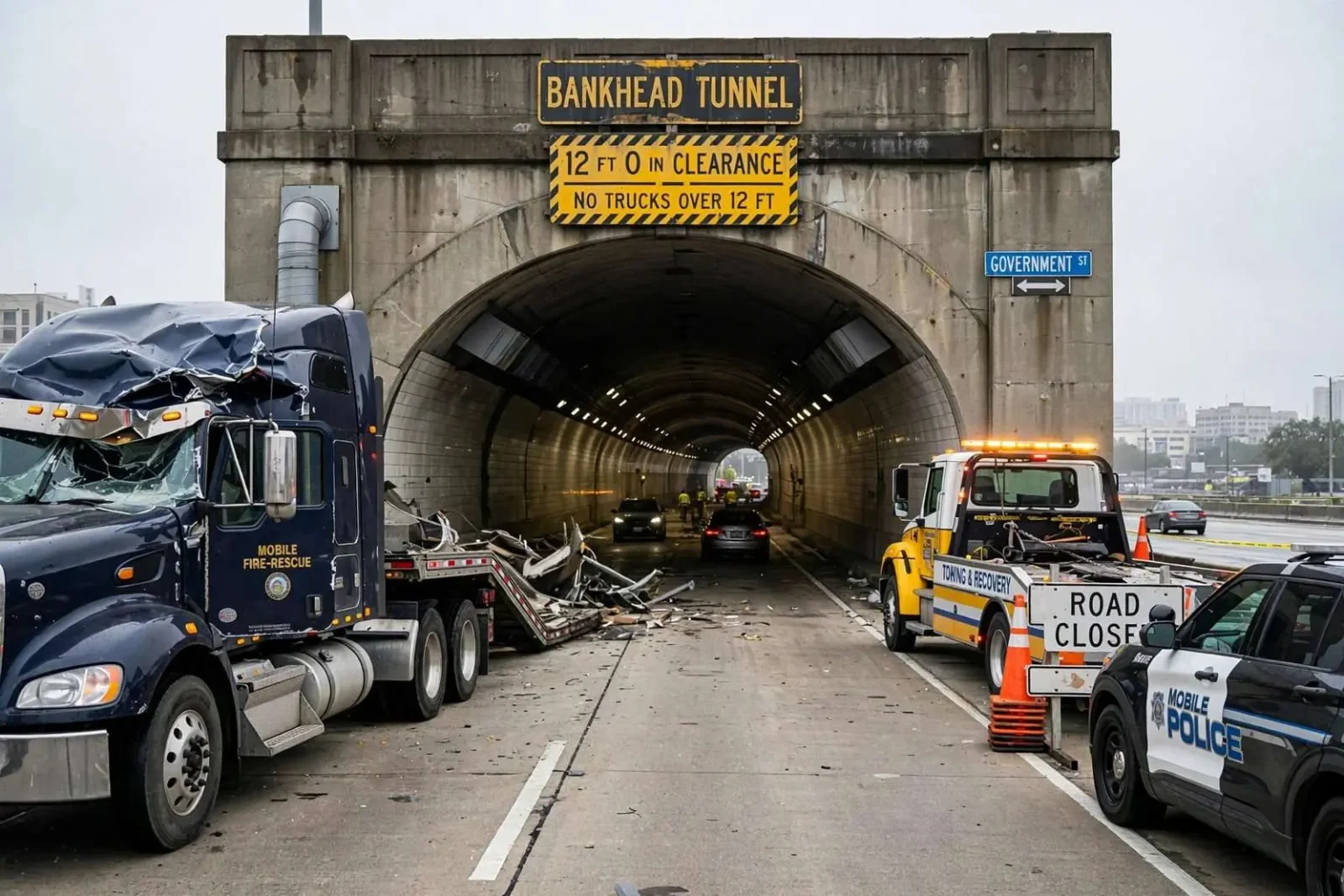
An 18-wheeler was ripped completely in half Wednesday morning when it entered Mobile’s Bankhead Tunnel and struck the low-hanging interior ceiling, shutting down the historic river crossing for nearly four hours. The crash occurred at approximately 6:49 a.m. as the commercial vehicle entered the tunnel, and within minutes both lanes of the two-lane passage beneath the Mobile River were closed while emergency crews and road crews worked the scene.
The Bankhead Tunnel has a posted clearance of 12 feet, while the average height of an 18-wheeler is roughly 13 feet, six inches — more than a full foot taller than the tunnel allows. The mismatch made the outcome almost immediate: the trailer caught the tunnel’s ceiling structure at the entrance, shearing the vehicle apart and scattering debris across the roadway inside the tube. No injuries were reported in connection with the crash, but the damage left the crossing impassable through the height of the morning commute.
Mobile Fire-Rescue responded to the scene and posted an update on Facebook shortly after the incident, telling drivers there was “no foreseeable timeframe for when the scene will be cleared and the tunnel re-opened.” The agency’s message, shared as commuters were beginning to encounter the closure, urged motorists to plan alternate routes while responders evaluated the wreckage and city crews staged equipment to remove it.
A Familiar Hazard for Commercial Drivers
The crash underscored a long-running problem on Mobile’s downtown river crossings, where clearance heights are significantly lower than what interstate-era commercial vehicles typically require. The Bankhead Tunnel’s 12-foot posted limit sits well below the roughly 13-foot, six-inch profile of a standard 18-wheeler, and the approach signage along the downtown streets that feed the tunnel entrance is intended to give over-height drivers a last chance to divert before entering the tube.
Despite those warnings, over-height vehicle strikes remain a recurring hazard at low-clearance crossings across the Gulf Coast, and tunnel strikes are among the most disruptive because there is no way to route traffic around the obstruction once a truck becomes lodged or disabled inside. A single incident closes the entire crossing, since the tunnel carries only one lane of traffic in each direction with no shoulder for a disabled vehicle to pull onto.
The disruption ripples quickly through Mobile’s downtown grid, where the tunnel is one of a limited number of connections between the central business district and the east side of the Mobile River. When it closes, commercial and commuter traffic shifts toward the city’s other crossings, adding volume to approaches that are already busy during the morning rush.
Crews Work the Scene Through the Morning
For nearly four hours, the wrecked trailer sat inside the tunnel while crews dismantled and removed it. Removing a truck that has been torn apart by a ceiling strike is a slow, deliberate process: the wreckage must be cut and dragged clear without damaging the tunnel’s interior surfaces, lighting, or ventilation equipment, and any spilled material has to be cleared before lanes can reopen.
City road crews coordinated the removal while fire and police units managed traffic on the approaches, with “roads closed” signage posted at the tunnel entrances. Drivers who regularly use the crossing — including many who commute between downtown Mobile and the Eastern Shore — were forced onto alternate routes for the better part of the morning.
By 10:22 a.m., the Bankhead Tunnel had reopened to traffic in both directions. Road crews removed the “roads closed” signage from the approaches, and normal traffic flow resumed after the scene was fully cleared — bringing an end to a closure that had lasted from shortly before 7 a.m. until mid-morning.
The reopening came as a relief to downtown businesses and commuters who had spent the morning rerouting, though the four-hour gap illustrated how quickly a single over-height strike can immobilize one of Mobile’s key crossings. Because the tunnel runs beneath the Mobile River rather than over it, there is no detour at the site itself; every displaced vehicle must travel to a different bridge or tunnel entirely.
The Wallace Tunnel Fire Weeks Earlier
Wednesday’s incident was not an isolated disruption for the city’s tunnel system. On June 20, the Wallace Tunnel was shut down after a vehicle fire caused by a crash, creating significant traffic delays across Mobile’s tunnel network. With the Wallace Tunnel out of service that day, pressure shifted to the Bankhead Tunnel and the area’s bridges, stretching travel times for drivers moving between downtown Mobile and the east side of the bay.
Taken together, the two closures highlight how little redundancy the downtown crossings have when one of them goes down. Mobile’s tunnel system is compact by design — the Bankhead Tunnel and the larger Wallace Tunnel both pass beneath the Mobile River within a short distance of each other — so an incident at either structure immediately concentrates traffic on the other, on the Cochrane-Africatown USA Bridge to the north, or on the Interstate 10 crossing farther south.
For commercial drivers, the repeated episodes carry a straightforward lesson that transportation officials have repeated for years: know the height of the vehicle, check the route before relying on navigation software, and heed posted clearance warnings on downtown approaches. Consumer GPS applications do not always distinguish between passenger-car routes and routes that accommodate full-size tractor-trailers, and a wrong turn in downtown Mobile can end against a tunnel ceiling.
What the Bankhead Tunnel Means to Mobile
The Bankhead Tunnel has carried traffic beneath the Mobile River since the early 1940s, making it the older and smaller of the city’s two downtown tunnels. Its Government Street approach runs through the heart of downtown, and its low clearance is a product of its era — built decades before the modern standard for commercial vehicle heights was established.
The larger Wallace Tunnel, opened decades later, handles a heavier share of through traffic today, but the Bankhead Tunnel remains a working piece of the city’s street grid, serving local traffic between downtown and the neighborhoods and industrial areas east of the river. Its closure is felt most sharply by drivers who use it as a daily commuter route and by businesses along the Government Street corridor.
City crews cleared Wednesday’s scene without extending the closure beyond the morning, and the tunnel resumed normal operation by 10:22 a.m. For Mobile drivers, however, the sight of another truck torn open at a tunnel entrance served as one more reminder that the city’s low-clearance crossings will keep demanding attention from every driver who approaches them with a vehicle taller than the sign allows.
How Over-Height Crashes Unfold
Tunnel and bridge strikes follow a pattern that traffic-safety officials know well. A commercial driver unfamiliar with a downtown route follows a navigation prompt onto an approach street, passes clearance signage without stopping, and commits to the entrance before realizing the trailer will not fit. By the time the top of the trailer contacts the structure, there is no room to back up inside a two-lane tube, and the forward motion of the vehicle does the damage.
In Wednesday’s case, the encounter with the ceiling was forceful enough to rip the 18-wheeler completely in half, separating the trailer from the rest of the rig near the tunnel entrance. The severity of the damage is why the closure stretched to nearly four hours — crews were not simply pushing a disabled vehicle out of the way, but dismantling wreckage from a confined, low-ceilinged space.
Incidents like this one also carry costs beyond the delay itself. Tunnel interiors contain lighting, ventilation, signage, and drainage systems that can be damaged in a strike, and any repair work adds to the expense on top of the destroyed trailer and the tow-and-recovery operation. Cleanup inside a tunnel is slower than on an open roadway because equipment access is limited and safety zones are tight.
Alternate Routes During a Closure
When either downtown tunnel closes, Mobile drivers fall back on a small set of alternatives. The other downtown tunnel absorbs some traffic, while the bridges north and south of the central business district carry the rest. During the Wednesday morning closure, the shifts were visible along downtown approaches as drivers used side streets to reach the crossings that remained open.
Commercial traffic faces the same constraint with an added layer: the alternatives must also accommodate the vehicle’s height and weight. That makes pre-trip route planning essential for carriers moving through Mobile, particularly for regional haulers making downtown deliveries rather than staying on the interstate loop.
The Mobile Fire-Rescue notice issued Wednesday morning — that there was “no foreseeable timeframe” for reopening — reflected the genuine uncertainty that dominates the early stages of a tunnel strike. Until crews can get inside, assess the wreckage, and determine what equipment is needed, no one can promise a reopening time. In this case, the estimate settled at roughly four hours from crash to clearance, with the tunnel back in service by 10:22 a.m.
Looking Ahead
Wednesday’s crash closed a chapter that began at 6:49 a.m. with a truck too tall for the passage and ended just after 10 a.m. with traffic flowing again through the Bankhead Tunnel. Between those points, the city got a demonstration of both the vulnerability of its downtown crossings and the speed with which crews can clear a scene when the damage stays within the roadway itself.
For the drivers of Mobile, the practical takeaways are unchanged: watch clearance signage downtown, treat tunnel approaches with caution in any vehicle taller than a standard delivery van, and remember that a few minutes checking a route is cheaper than a trailer. The tunnel system has carried the city’s traffic for generations, and it will keep doing so — for every vehicle that fits.