Barry Moore Proposes Naming New I-10 Mobile Bridge After Donald Trump
U.S. Rep. Barry Moore wants the new $3.2 billion I-10 Mobile River bridge named the 'Gateway to the Gulf of America, the Donald J. Trump Bridge.'
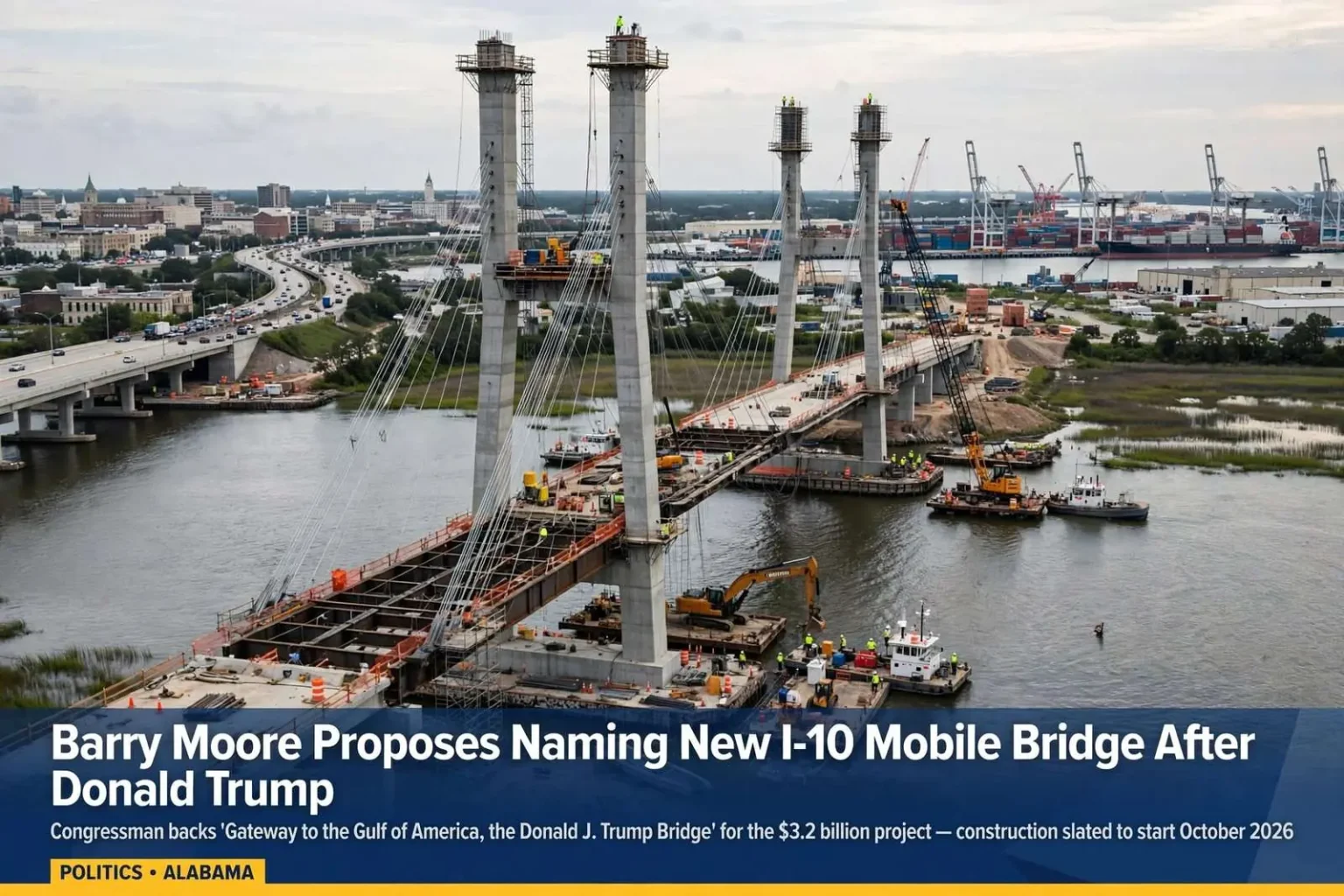
U.S. Rep. Barry Moore (R-Enterprise) wants a new bridge set to be built in Alabama named after the current president of the United States.
The congressman and Republican nominee for the U.S. Senate floated naming the new I-10 Mobile bridge the “Gateway to the Gulf of America, the Donald J. Trump Bridge.” “The new Mobile River Bridge will be a game changer for Mobile, Alabama, and the entire Gulf Coast,” Moore said. “The Gateway to the Gulf of America, the Donald J. Trump Bridge would be a fitting name for a project that reflects Alabama’s growth and our role in America’s future.”
Bridge naming proposals of this kind sit at the intersection of infrastructure politics and political symbolism, and Moore — who represents southeast Alabama in Congress and is campaigning statewide for the Senate seat — has an obvious interest in both. Naming a marquee public works project after a sitting president is a rare gesture, though Alabama has its own tradition of putting political names on its concrete: bridges, tunnels and interstates across the state already carry the names of governors, senators and other figures with claims on Alabama history.
The proposal also arrives while the project itself is still years from completion, which leaves plenty of time for the idea to gain support or fade. Formal bridge naming typically requires action — a resolution, a legislative act or a transportation department decision — and Moore’s comments suggest he intends to push the question through official channels rather than leave it as a suggestion.
A $3.2 billion project
The undertaking is a $3.2 billion infrastructure project in Alabama designed to relieve I-10 congestion. Scheduled for an October 2026 construction start, the project features a new six-lane cable-stayed bridge over the Mobile River, with an opening expected around 2031.
The scale of the undertaking makes it one of the largest transportation projects in Alabama’s history. A cable-stayed bridge — in which the deck is suspended from towers by direct connections to cables — creates the sweeping silhouette that has come to define modern signature bridges, and the six-lane design is intended to handle the freight and commuter volume that today’s I-10 crossing struggles to absorb.
The need is not in dispute among local officials. I-10 through downtown Mobile funnels coast-to-coast truck traffic, Port of Mobile freight and daily commuters across a single confined corridor, and the congestion on the river crossing and the Bankhead Tunnel approach has shaped local driving life for decades. The new crossing is designed to give that corridor genuine capacity for the first time in generations, which is why leaders across party lines have spent years working to get it funded and built.
For travelers who use the corridor regularly, the project’s significance is experienced daily rather than annually. The current route threads interstate traffic through downtown streets and under the river through a tunnel built for a far smaller city, and slowdowns there ripple across the metropolitan area’s entire road network. A new six-lane crossing changes not just how quickly freight moves through Mobile, but how the city’s own waterfront and downtown districts develop around the highway that has divided them — one reason the bridge has been described locally as the most consequential public works project in the city’s modern history.
“President Trump has always had a special connection to Alabama,” Moore continued, “from his early campaign stops here to the strong support he’s received from our state. I’d be proud to see that connection live on through this bridge for generations to come.”
Alabama was indeed among the earliest states to back Trump’s campaigns, delivering him decisive margins in every election cycle since 2016, and the state’s Republican political leadership has aligned itself closely with the president’s agenda. For Moore, tying his name to both the president and the region’s most anticipated infrastructure project in a generation is a natural campaign-season combination — a proposal that costs nothing to announce and connects a local milestone to a national political brand. Moore is the Republican nominee for the U.S. Senate, making the proposal as much a statement about his own positioning as about the bridge itself.
A longtime bridge supporter
Moore has been a longtime supporter of building the bridge. Last year, he backed the Bridge Investment and Modernization Act, which extends and increases funding for bridge infrastructure through 2031.
That legislative work is the substantive side of the congressman’s involvement. Federal bridge funding programs are a critical piece of how projects of this size close their budgets, and legislation that extends and increases that funding through 2031 lines up squarely with the bridge’s construction timeline — a fact Moore’s office can point to when arguing that his support for the project is more than rhetorical. Southeast Alabama’s congressional representatives have generally promoted the I-10 corridor improvements as a regional economic issue, since the freight moving through Mobile reaches every county they represent.
Moore’s district stretches across the Wiregrass and includes communities whose economies are tied to the same Gulf Coast growth the bridge is meant to serve. The Port of Mobile’s expanding cargo operations, the industrial developments along the coast and the region’s logistics corridor all funnel traffic toward the I-10 crossing, which is why officials well outside Mobile’s city limits have historically supported the project. A new crossing, in that framing, is not a Mobile-only amenity but a statewide economic asset — the kind of infrastructure investment that determines where freight, and the jobs that follow it, can move for the next half-century.
The congressman said he has not talked with Trump personally about the idea, but had a conversation with White House staffers and other members of Congress about sponsoring a resolution to name the bridge after the 47th president.
“They are working on it,” he said. “It’s that sort of thing [Trump] will care about. It will make it to his radar screen. It will make it to him. He’ll have an interest in that.”
A congressional resolution is one of several paths a bridge naming can take, and each carries different weight. Resolutions are statements of congressional sentiment rather than binding directives, so the practical naming decision for an Alabama state transportation project would still rest with state authorities. But resolutions matter politically: they create a formal record of support, they generate headlines that keep an idea alive, and they give state officials a sense of whether a naming fight is worth having.
The timing question will shape how the debate plays out. Construction is not scheduled to begin until October 2026, and the bridge is not expected to open until around 2031 — meaning any name attached to the structure today would be carried by a project that residents will watch rise over the Mobile River for the better part of five years. Names have been debated and changed on projects of this size before, and the intervening years give every stakeholder, from city hall to the governor’s office to members of Congress, time to weigh in.
It also means the politics of the naming could look different by the time the ribbon is cut. A structure named for a sitting president would carry that name into whatever political landscape exists in 2031, and history offers examples of presidential bridge names that outlasted the administrations that inspired them as well as examples of names reconsidered. Supporters of Moore’s proposal argue the honor should reflect the current moment; skeptics of naming public works after sitting politicians of any party make the same point in reverse — which is exactly the debate a resolution sponsor invites.
What is not in question is the project’s importance to the region. A $3.2 billion crossing over the Mobile River addresses one of the most persistent infrastructure bottlenecks on the Gulf Coast, and however the structure is ultimately named, the economic case for building it — freight mobility, port access and the daily commute — is the argument that carried it this far. The naming debate, whatever it produces, is a sign of how much the project already looms over the region’s sense of its own future: Alabamians do not generally argue over what to call bridges that never get built.
For Moore, the proposal is a two-front pitch — to Washington, where he is asking colleagues to sponsor a resolution, and to Alabama voters, where he is presenting himself as the congressman who backed the funding and now wants the state’s biggest project to carry the name of the president his party’s base overwhelmingly supports. Whether the “Gateway to the Gulf of America, the Donald J. Trump Bridge” ever appears on state highway maps will be decided by officials who have, so far, said nothing at all — but the conversation Moore wants has now started.