Bay Bites Food Truck Festival Brings Flavors and Funds to Downtown Mobile
The Bay Bites Food Truck Festival in downtown Mobile raised funds for Mobile Bay Keeper while local vendors navigated rising food and fuel costs.
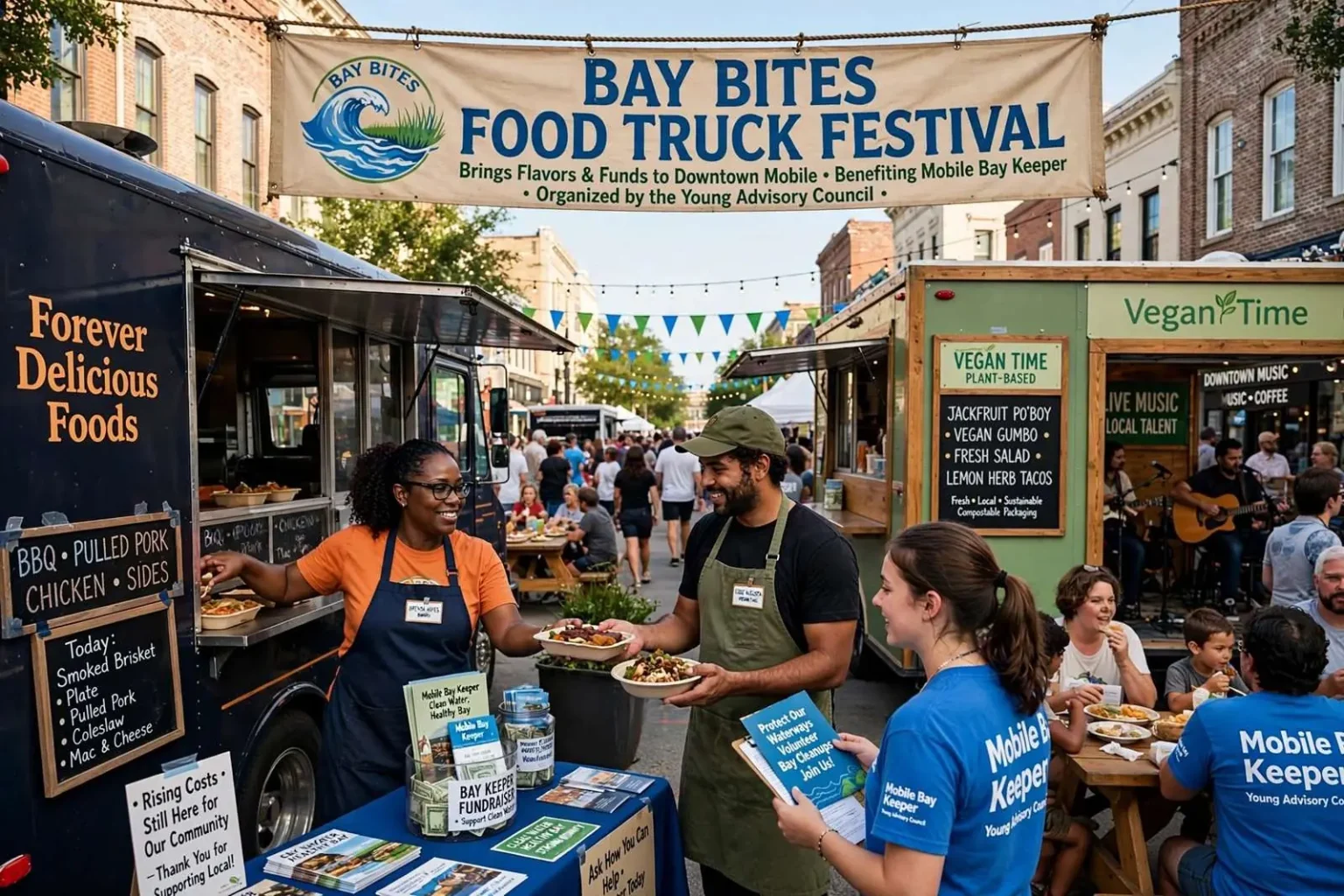
Downtown Mobile was alive with food, music, and community spirit Saturday as the Bay Bites Food Truck Festival, organized by Mobile Bay Keeper’s young advisory council, drew crowds for an afternoon of good eating all in service of a good cause. The festival filled a downtown block with the smells and sounds of the Gulf Coast’s mobile food scene, as lines snaked between trucks and families settled into the afternoon with plates of barbecue, plant-based specials and everything in between. For the crowd, it was a Saturday outing; for the organization behind it, it was one of the most visible fundraisers of the year.
The annual festival brings together local food truck vendors to raise funds for Mobile Bay Keeper, the environmental nonprofit led by executive director Cade Kistler that works to protect and defend local waterways. The young advisory council, a group of young adults who help shape the organization’s mission, organizes the popular event. “It supports our work for clean water,” said Kistler. “Our young advisory council puts this event on to raise funds for Bay Keepers.”
The pairing of food trucks and environmental advocacy is more natural than it might sound. Mobile Bay Keeper’s work centers on the rivers, streams, bays and wetlands that define the region, and few institutions are as dependent on clean water as the restaurants and vendors who feed the city. A festival built around local food gives the organization a crowd that may come for a po’boy and leave with an understanding of what stormwater runoff, polluted tributaries or an oil spill mean for the place they call home.
Vendors Feel the Squeeze of Rising Costs
This year’s festival featured a diverse lineup of local food vendors, including Forever Delicious Foods, owned by Brenda Hayes, and Vegan Time, run by Eddie Augusta. Both vendors drew enthusiastic crowds despite facing the pressure of rising food and fuel costs that have squeezed small food businesses across the Gulf Coast. “With gas, we run off a generator, so that’s affecting us significantly,” said Hayes. “As far as food, because we sell a lot of chicken, a lot of pork, a lot of beef — all of that has gone up tremendously, and then you don’t want to charge too much and then lose your customers.”
The math of a food truck is unforgiving in a way that a brick-and-mortar restaurant never is. Every hour of service burns generator fuel; every new event means another tank of diesel to get there; and ingredients bought in grocery-sized or small-wholesale quantities cost more per pound than the bulk contracts a fixed restaurant can negotiate. When meat prices climb, a truck selling chicken and pork plates feels it immediately, because there is no pantry reserve to soften the blow — tomorrow’s menu depends on today’s purchases at today’s prices.
Augusta, who uses fresh ingredients daily in her plant-based dishes, said she has had to absorb cost increases carefully. “Sometimes I have to go up when prices go up, but I try to keep it down to a minimum and try not to go up too much,” she said. Fresh produce leaves even less room to maneuver than meat and gas, since vegetables and herbs cannot be frozen in bulk or substituted cheaply without changing the dish. Her approach — raising prices in small increments only when necessary — reflects a calculation every vendor on the lot was making: that a dollar menu item priced out of reach costs more in lost regulars than it earns.
Despite the financial headwinds, both vendors pledged to keep showing up at community events like Bay Bites. “I don’t cut back on my food and I’m not cutting back on the quality,” said Hayes. “We are really taking more out of our pockets to make sure our customers stay happy.” That commitment is the unspoken contract of the food truck business — customers follow a truck from event to event precisely because the quality does not waver, and any vendor who cuts corners to protect margins does so at the risk of the entire customer base.
For festival organizers, the vendors’ struggles added weight to the day. Bay Bites exists to raise money for the bay, but it also functions as a marketplace where small local businesses reach hundreds of potential regulars in a single afternoon — a form of exposure that no amount of advertising could buy at the price of a festival booth.
The Bay Bites festival is one of several events held throughout the year to support Mobile Bay Keeper’s mission of safeguarding the region’s waterways and natural resources. The organization’s calendar mixes fundraisers with hands-on work — volunteer cleanups along local tributaries, educational programs, and public campaigns on issues that affect the bay and the rivers that feed it. The young advisory council sits at the center of that outreach, and the festival is its signature project, the one that puts the organization’s name in front of the largest general audience.
Mobile Bay Keeper is part of the Waterkeeper Alliance, the international network of advocacy organizations in which each local group employs a “keeper” who serves as a full-time public advocate for a specific body of water. The Mobile Bay group’s work has ranged from monitoring stormwater and sewage overflows to challenging pollution permits and pushing for enforcement of environmental laws across the coastal counties. Events like Bay Bites fund that monitoring and advocacy, which rarely generates revenue on its own but depends on a community that is paying attention.
Downtown’s Festival Season
The festival’s downtown setting is part of its appeal. Mobile’s central business district has cultivated a full calendar of street festivals, markets and concerts that draw residents back into the city on weekends, and food-centered events have been among the most reliable draws. Bay Bites slots into that scene with a twist: every ticket and every plate purchased carries a message about the water that frames the city’s identity — the bay that gives the city its name, its port and its seafood.
Attendees this year found the usual festival rhythm, with music playing as families moved from truck to truck, but also a snapshot of the region’s evolving food scene. The presence of a plant-based vendor drawing crowds alongside barbecue and traditional Southern plates said something about how Mobile’s tastes have broadened, and the lineup of locally owned trucks gave the afternoon the feel of a fair for the city’s small food entrepreneurs.
For the young advisory council, the event represents months of planning — recruiting vendors, coordinating with the city on street closures and permits, arranging music and logistics — all done by volunteers who fit the work around their day jobs. The payoff is measured in two currencies: the funds raised for clean water programs, and the generation of young Mobilians who come to see environmental advocacy as something done with friends on a Saturday afternoon rather than a cause left to someone else.
By the time the trucks served their last orders and the music wound down, the afternoon had accomplished what the council set out to do — filled downtown with neighbors, put local vendors back to work in a tough season for small food businesses, and turned the simple act of lunch into support for the bay that makes Mobile what it is.
The fundraising model behind events like Bay Bites has become a template for Gulf Coast nonprofits. Rather than galas with ticket prices that exclude much of the community, organizations increasingly build public festivals that raise money while welcoming everyone — families who buy a single plate contribute alongside businesses that sponsor the stage. The approach also fits the subject matter: an environmental group asking the public to care about the bay does better standing in a sunny street full of neighbors than in a hotel ballroom.
The young advisory council members themselves reflect the organization’s long-term bet on Mobile’s future. Council members typically work in professions ranging from law and engineering to education and hospitality, and their involvement gives the nonprofit a pipeline of future board members, donors and advocates. Organizing a festival teaches those volunteers the same skills — budgeting, logistics, negotiation, promotion — that the organization needs in its campaigns, and many councils across the Waterkeeper network have used their young-professional events as the proving ground for the next generation of environmental leadership.
The festival also arrives at a moment when Mobile Bay’s environmental stakes are rising. The bay receives the flow of the Mobile, Tensaw, Spanish and other rivers — the drainage of one of the largest river systems in the United States — and its health is affected by everything from upstream development to coastal storms. Public engagement built on a food festival might look modest against challenges of that scale, but organizers argue it is the foundation: permit fights and cleanup projects succeed when the public understands what is at stake, and understanding begins with an afternoon downtown.
Vendors like Hayes and Augusta, meanwhile, left the festival with more than a day’s receipts. Events like Bay Bites seed the word-of-mouth network that sustains a food truck between bookings, and the contact information collected Saturday — the customers who follow a truck’s schedule online — represents the real profit for a small operator working a charity event. Both vendors said the crowds justified the generator fuel, and both planned to be back.