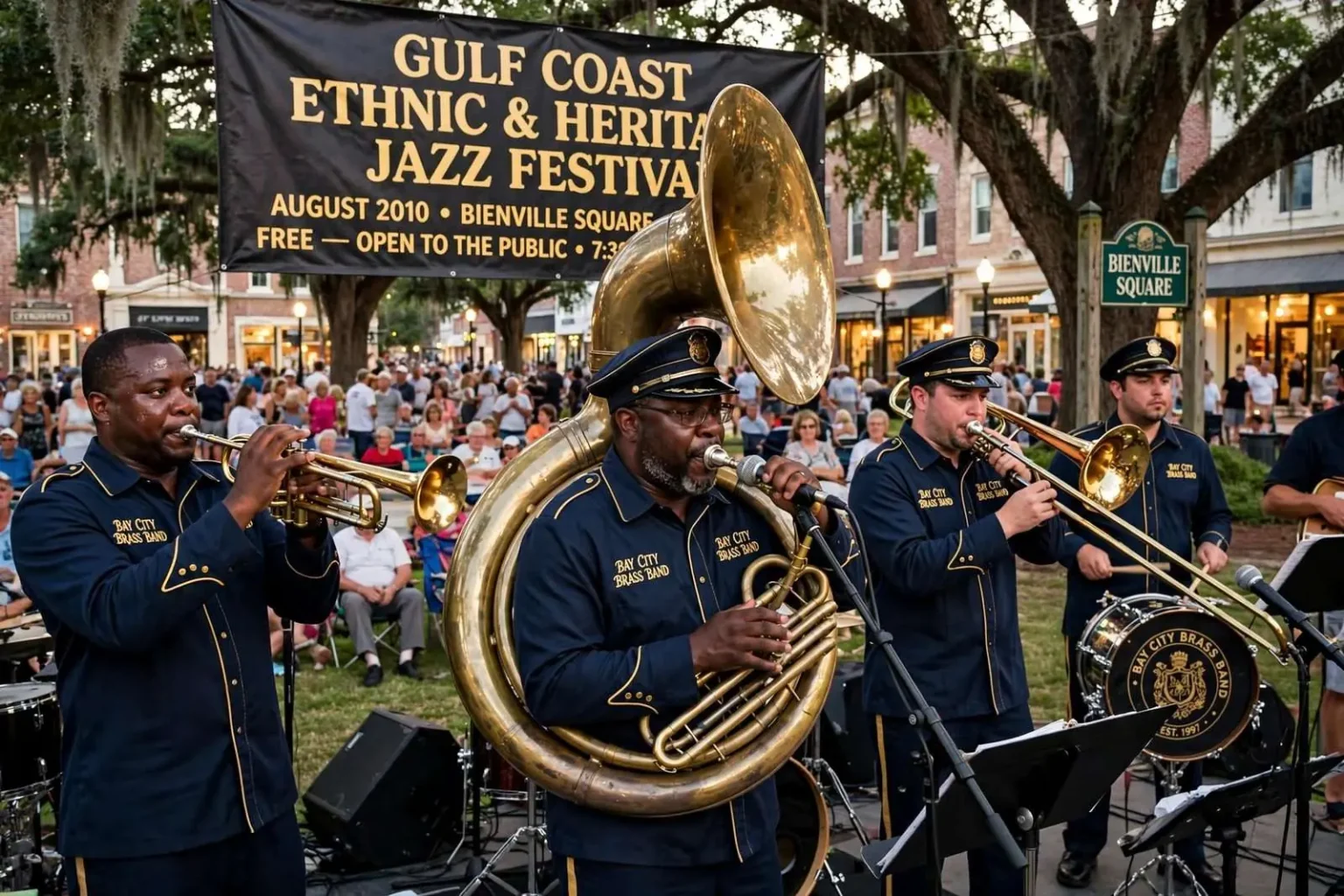
Mobile’s own Bay City Brass Band played the 7:30 p.m. slot in Bienville Square — with 351 Water Street as the rain location — for the Gulf Coast Ethnic & Heritage Jazz Festival in August 2010. The booking put one of the city’s best-known brass bands on one of downtown Mobile’s most familiar stages, in front of the free summer audience the festival draws to the heart of the city every year.
The Gulf Coast Ethnic & Heritage Jazz Festival has long used Bienville Square as its main venue, filling an August evening with music while downtown offices empty out and residents bring folding chairs to the shaded greenspace bounded by Government Street and Dauphin. The festival’s formula is straightforward: local and regional jazz and brass acts, an evening breeze off Mobile Bay a few blocks south, and no ticket between the audience and the stage. A rain location at 351 Water Street — the civic center corridor a short walk from the square — is standard operating procedure for Mobile outdoor events, where an August thunderstorm can end a stage show in minutes.
For the 7:30 slot, festival organizers reached for a band that occupies a particular place in Mobile’s musical hierarchy. Brass bands in this city are not nostalgia acts; they are working units that carry the soundtrack of a Mardi Gras season that predates New Orleans by more than a century, and Bay City Brass Band has spent years at the front of that line.
A band born to bring Mardi Gras music forward
The band was formed in 1997 by tuba player and bandleader Marcus Johnson, who at the time also played in another of Mobile’s brass bands, the Olympia Brass Band. That double affiliation is common in brass band culture, where the pool of players who can hold down a sousaphone or tuba line while marching is small, and it gave Johnson a front-row education in how Mobile’s established bands operated before he built his own.
From the start, Bay City set its sights on pushing Mobile’s Mardi Gras music industry to the forefront and bringing its signature sound to the city full time. That mission statement matters because of what the city’s calendar actually looks like. Mardi Gras in Mobile runs for weeks before Fat Tuesday — parade after parade, ball after ball, from downtown’s parade route through neighborhoods across the city — and every procession and party that wants live brass music needs a band to hire. The groups that dominate those bookings shape what the city’s celebration sounds like, and Johnson’s band set out from its founding to be one of the names at the top of that list.
In the years since, the band became a fixture at semi-pro ballgames, parties, parades, conventions and weddings, where its members supply music made for dancing. That range is the brass band’s business model. A wedding on the Eastern Shore, a convention group at the convention center, a summer ballgame looking for something between innings, a krewe’s parade rollout — all of it calls for the same core skill set: a horn line that can carry a melody, a rhythm section built around the tuba and drums, and a repertoire that moves from traditional second-line numbers to the contemporary songs a crowd wants to dance to.
When major events come to Mobile, Bay City has assumed the role of musical representative for the city’s Mardi Gras tradition. Convention planners, festival bookers, and visiting media looking for an authentic sound of the birthplace of Mardi Gras end up calling bands like Bay City, because the music is the tradition as much as the floats and moon pies are.
Mobile’s brass band lineage
The sound Bay City carries descends from a lineage that runs through the city’s Black neighborhoods over more than a century. Mobile’s Mardi Gras traditions grew up alongside fraternal societies, marching societies, and neighborhood bands that supplied music for parades, funerals, and celebrations, in a pattern that parallels New Orleans but with its own distinct history. The brass band format — horns up front, tuba and drums anchoring the bottom — survived in Mobile even when the number of active bands shrank, kept alive by family connections and players who learned from the generation before them.
By the time Johnson formed Bay City in the late 1990s, Mobile’s Mardi Gras was in one of its periodic growth stretches, with new mystic societies forming and the parade calendar expanding. That growth created demand for live music that a small pool of established bands could not fully cover, and it created the opening that Bay City was built to fill. The band’s founding in 1997 placed it in a generation of groups that took the tradition seriously as a profession — uniforms, bookings, contracts, and a sound polished enough for a convention stage as well as a street.
The tuba, Johnson’s instrument, is the engine of any brass band. In a marching format there are no bass guitars or electric amps, so the sousaphone carries the bassline that everything else hangs on, and it does so while walking a parade route or standing on a festival stage. A bandleader who plays tuba leads from the center of the sound, setting tempos and chord changes from the bottom up, which is one reason tuba players so often end up running brass bands across the Gulf Coast.
August, when Bay City played the jazz festival, is the quiet season in the Mardi Gras calendar — the parades are months away, and the year’s crop of carnival music has not yet started up. That makes summer festivals an important stage for the city’s brass bands, a chance to play for audiences outside the carnival season and to reach residents and visitors who might book the band for a private event later. A 7:30 p.m. festival slot in Bienville Square is a showcase: the whole downtown audience walking past, the music carrying for blocks, and the band free to play its full range rather than the parade repertoire a procession demands.
As the band put it: people come to the birthplace of Mardi Gras wanting to experience those sounds — and Bay City delivers them. Mobile’s claim as the origin point of American Mardi Gras, dating to the city’s earliest colonial years, is a matter of civic pride that local groups promote at every opportunity, and music is one of the most portable pieces of that identity. A brass band that can play the sound of Mardi Gras in August, in a downtown park, gives the city’s history a soundtrack that does not depend on the calendar.
What the festival slot meant
For the Gulf Coast Ethnic & Heritage Jazz Festival, programming a hometown brass band into an evening slot serves the event’s own mission. The festival has always highlighted the Gulf Coast’s Black musical heritage alongside straight-ahead jazz, and brass band music is a living branch of that heritage — street-born, dance-driven, and rooted in the same neighborhoods that produced the region’s jazz and rhythm and blues players. Putting Bay City on the bill connected the festival audience to the music they will actually hear rolling through downtown on parade nights.
For the band, the slot was consistent with the role it had built across its first decade-plus: the group that shows up when the city needs a brass sound for a public occasion. Bands that survive in this business do it through exactly that kind of visibility — a festival crowd in August becomes wedding bookings in October and parade bookings in February — and a 7:30 p.m. set in the square was both a performance and, in the practical economy of Gulf Coast music, an advertisement.
The rain location at 351 Water Street never had to be more than a contingency, but its presence on the bill is a reminder of how Mobile’s downtown event circuit works: Bienville Square and the civic center corridor sit close enough together that an outdoor festival can move indoors on short notice without losing its audience. That geography has made the area the city’s default festival district, hosting everything from Mardi Gras-related events to summer music series, and it is where Bay City and bands like it do a large share of their public performing.
The 2010 festival appearance stands as one stop in a career of them for a band that formed with a specific purpose — to keep Mobile’s Mardi Gras sound working year-round — and spent the years since doing exactly that, one parade, party, ballgame, and festival stage at a time.
Brass band work is also family work in Mobile. Bands recruit nephews and cousins, teach them a horn in the church or the school band room, and bring them along on jobs until they can hold a line on their own. That apprenticeship system is how a tradition survives without a conservatory behind it, and it is why the personnel of a band like Bay City tends to read like a family roster. The bandleader’s job includes training the next tuba player, because the band’s bookings only continue as long as someone can take the chair.
The wider economy around that music is bigger than most residents realize. Between the parades themselves, the season around Mardi Gras supports months of ball entertainment, fraternity and society functions, and the public parties that surround Fat Tuesday, all of which create paying work for horn players in a city with no other industry that does so. A working brass band can measure its year in the carnival calendar: lean summer months filled with festivals and private events, then a winter stretch of parades and balls that can run the music nearly nonstop from January through February.
Bay City’s founding ambition — making the city’s Mardi Gras music a full-time industry — reflected that reality. The players involved were not hobbyists gathering for a season; they were musicians who wanted the tradition to sustain careers, the way it does in cities where brass band music is an established professional circuit. Every booked parade and convention represented a step toward that goal, and the band’s steady presence at the city’s public events over the years showed the approach working.
For audiences in Bienville Square that August night, the set offered a preview of the season to come. The same horn lines that filled the square in summer would be rolling down Government Street and Royal Street by February, attached to floats and followed by crowds. Hearing them in the quiet season, in a park, is one of the ways Mobile keeps its Mardi Gras identity alive between seasons — the music never really stops, it just changes venues, and Bay City Brass Band has spent its career making sure it stays that way.