Bay Minette’s Cane Brew Sweet Tea Now on Store Shelves in 17-Plus States
Bay Minette-based Cane Brew, which packages black tea and pure cane sugar in a single bag, has expanded its sweet tea product into retailers across more than 17 states since its 2023 launch.
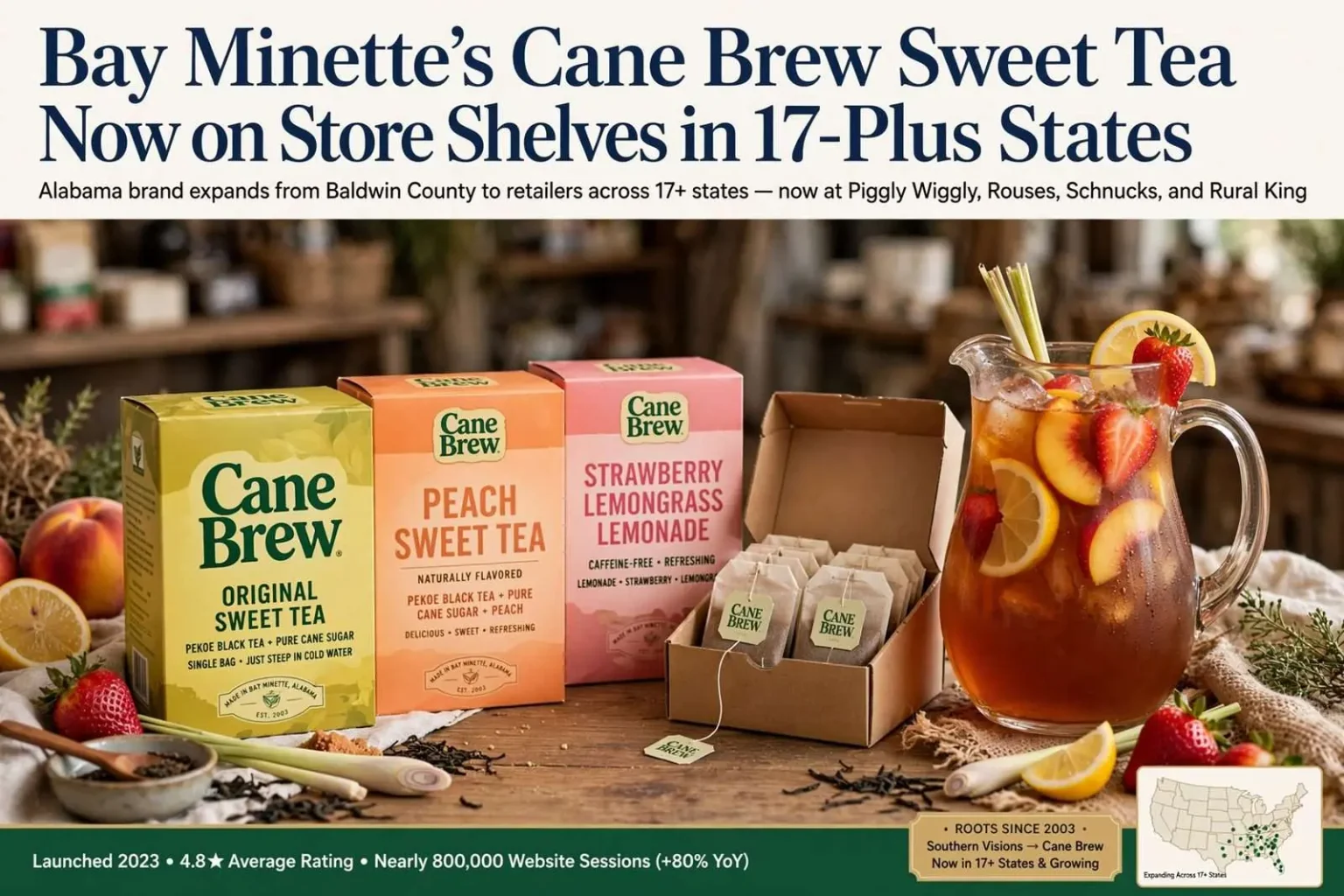
A Bay Minette company that reimagined how Southerners make sweet tea at home is now selling its product well beyond Alabama’s borders. Cane Brew, which launched its consumer sweet tea line in 2023, has expanded into retailers across more than 17 states, according to the company.
The product simplifies a process generations of Southern cooks have followed by hand: boiling water, steeping loose tea and stirring in sugar until it dissolves. Cane Brew combines pekoe black tea and pure cane sugar inside a single tea bag. Home cooks drop the bag into cold water and let it steep anywhere from eight minutes to more than 20, depending on how sweet and strong they want the final pitcher.
Roots Trace Back to 2003
Cane Brew’s story stretches back more than two decades before the retail product hit shelves. The brand grew out of Southern Visions, an Alabama company founded in 2003 by Steve Hicks and Paul Stewart. That company created Sweet Brew, a similar tea-and-sugar-in-one-bag concept built for commercial food-service equipment used in restaurants and other large-scale kitchens.
Paul Stewart’s son, Adam Stewart, later took the concept and adapted it for home kitchens, leading to the launch of Cane Brew as a consumer product in 2023.
From Alabama Shelves to a Multi-State Footprint
Cane Brew is now stocked at a range of grocery chains across the region and beyond. That includes Piggly Wiggly stores in Alabama, Rouses Markets locations throughout the Gulf South, Schnucks stores across the Midwest, and Rural King stores in states throughout much of the country.
The company’s growth isn’t limited to what’s on physical shelves. According to figures provided by Cane Brew, its website logged nearly 800,000 visitor sessions over the past year, an 80% jump from the year before. The company also points to online reviews as a sign of how the product has been received, citing a 4.8-star average rating on its website and saying many customers have described the taste as reminiscent of “grandma’s sweet tea.”
A Growing Product Lineup
What started with a single Original Sweet Tea has grown into a broader lineup. Cane Brew now also offers a Peach Sweet Tea, decaffeinated and unsweetened versions of its tea, and a Strawberry Lemongrass Lemonade.
The company’s expansion reflects a broader trend of small Alabama food and beverage brands finding national retail partners while keeping their headquarters and identity rooted in the state. For Cane Brew, that means a product built on a very Southern tradition is now reaching kitchens and grocery carts in states far from Baldwin County, even as the company continues to call Bay Minette home.
Why sweet tea travels
Sweet tea is more than a beverage in the South; it is a cultural marker, the default drink at gatherings, church suppers and restaurant tables from Virginia to Texas. Cane Brew’s bet is that the ritual — boiling, steeping, sweetening — is beloved but inconvenient, and that a single bag collapsing pekoe tea and pure cane sugar into one step removes the friction without abandoning the taste. The company’s claim that customers describe it as reminiscent of “grandma’s sweet tea” is the central test of that bet: if the convenience version tastes like the homemade one, it earns a permanent spot in the pantry rather than a one-time trial.
The food-service origin story
Cane Brew did not appear from nowhere in 2023. Its roots run through Southern Visions, the Alabama company Steve Hicks and Paul Stewart founded in 2003, which built Sweet Brew for commercial food-service setups — the big brewers and dispensers used in restaurants and institutions. That background matters because it means the consumer product is a adaptation of a proven commercial formula, not a startup’s first experiment. Adam Stewart’s move to shrink that concept into a home tea bag is the pivot that turned a B2B ingredient into a retail shelf item, and it explains why the company could scale distribution quickly once the consumer version launched.
What the retail footprint says
Landing on shelves in more than 17 states through Piggly Wiggly, Rouses, Schnucks and Rural King is a meaningful jump for a Baldwin County company. Those are distinct retail worlds: Piggly Wiggly and Rouses are Southern and Gulf Coast grocers, Schnucks is a Midwestern chain, and Rural King is a farm-and-ranch retailer with stores across much of the country. That mix suggests Cane Brew is chasing both regional familiarity and national reach, and the nearly 800,000 website sessions and 80% year-over-year traffic jump indicate the brand is pulling interest it can convert to shelf space. A 4.8-star average on its own site is a self-reported figure, but it tracks with a product whose entire pitch is tasting like the real thing.
Bay Minette as a small-brand home
Cane Brew’s decision to keep its headquarters in Bay Minette fits a pattern of Alabama food and beverage brands that grow national without leaving the state. Staying put preserves the local identity that is part of the marketing — “a very Southern tradition” made in a small Baldwin County city — while national retail partners handle distribution. For Bay Minette, a company with a multi-state footprint is also a quiet economic win, keeping jobs and a corporate presence in a city better known regionally for its schools and its position on the I-65 corridor than for consumer packaged goods.
The expanding lineup
Starting with a single Original Sweet Tea and growing to Peach, decaf, unsweetened and a Strawberry Lemongrass Lemonade shows the usual retail playbook: establish a hero product, then extend the line to earn more shelf space and more repeat purchases. Flavored and diet variants let the brand reach shoppers who want sweet tea flavor without the sugar or caffeine, and the lemonade broadens it beyond tea entirely. Each new SKU is also a reason for a retailer to keep the brand on the shelf, since a fuller set sells better than a single item. The question for Cane Brew now is whether the line can stay coherent as it widens.
The competitive shelf
Cane Brew enters a crowded field of sweet tea products, from bottled restaurant brands to national grocery lines, so its differentiator is the make-it-at-home format and the cane-sugar recipe. Whether that is enough to hold shelf space against deeper-pocketed competitors will depend on repeat purchase rates, which the company’s own traffic growth suggests are encouraging. The Southern grocery base — Piggly Wiggly and Rouses — gives it a culturally sympathetic launchpad, and the Rural King placement is a canny reach into a rural audience that knows sweet tea well. The next test is whether the flavored and diet extensions pull new buyers without diluting the original’s reputation.
What “17-plus states” really means
The company’s “more than 17 states” figure is a footprint claim, not a saturation claim; a product can be in a handful of stores per state and still span a broad map. The meaningful number for a small brand is velocity — how fast shelves turn — and Cane Brew points to web traffic and reviews as proxies for that. If the online interest converts to reorder volume at Schnucks and Rural King, the footprint will widen on its own; if it does not, the 17-state map could shrink as retailers cut slow sellers. For now, the expansion is a credible indicator of demand, and Bay Minette has a consumer brand with national distribution ambition.
From a bag to a brand
Cane Brew’s trajectory — from a 2003 food-service concept to a 2023 consumer launch to shelves in 17-plus states — is the compressed version of how many regional food brands grow: prove it in commercial kitchens, shrink it for the home, then ride Southern identity into national retail. The risk in that path is losing the story as the brand scales; the opportunity is that “grandma’s sweet tea, made in Bay Minette” is exactly the kind of origin consumers reward with loyalty. If the company keeps the local production and the cane-sugar recipe as it expands, the 17-state map could become a 40-state one without shedding the small-town authenticity that got it on the shelf.
A taste of home, bottled differently
There is a reason sweet tea brands proliferate in the South: nobody thinks the store version beats the one from their own kitchen, so the market is a perpetual search for “close enough.” Cane Brew’s bag format is an attempt to collapse that gap by letting the drinker do the steeping, keeping the fresh-brewed character that bottled teas lose. If it delivers, the product earns a place the bottled brands never quite claim — the one that tastes like it came from the stove. That is a high bar, but it is the only one that matters for a Southern pantry staple, and the company’s growth suggests enough buyers think it clears it.
Why Baldwin County is a fitting home base
Bay Minette sits near the geographic center of Baldwin County, the state’s fastest-growing county and a place where small manufacturers and food producers have found room to grow. A sweet-tea company rooted there can draw on a regional workforce while keeping costs below a big-city base, and the county’s position between Mobile and the beaches puts it within reach of both urban and tourist markets. For Cane Brew, that location is less a constraint than an asset: it can ship north to Schnucks and across the country to Rural King while still calling a small Alabama city home, which is exactly the identity its marketing leans on.