Bayfest 2010 Ticket Sales Jump 50 Percent, Draw Buyers From Overseas
Bayfest organizers say 2010 online ticket sales are up 50 percent, with buyers from 16 states and overseas, possibly tied to oil spill travel delays.
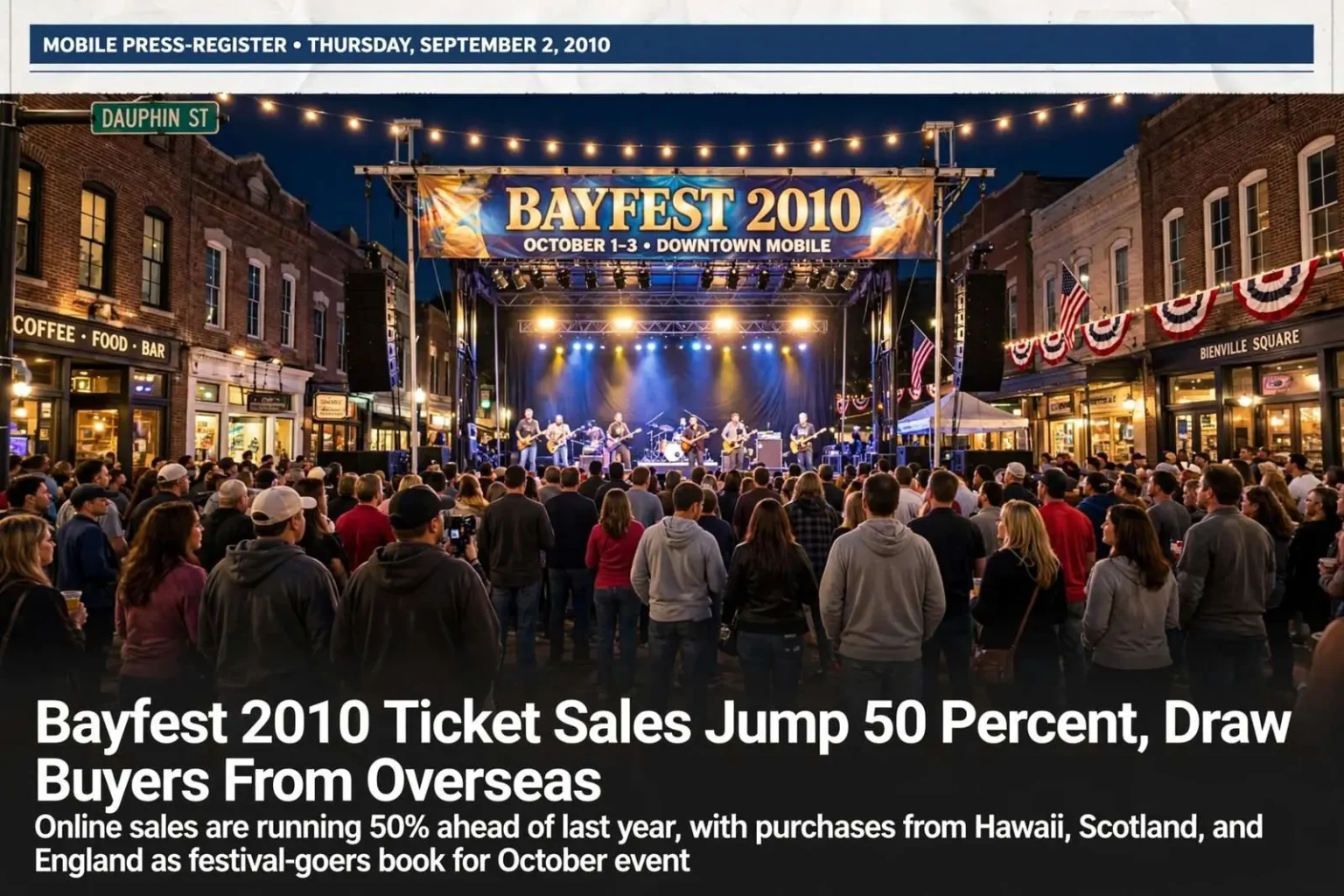
Online ticket sales for this year’s Bayfest are running roughly 50 percent ahead of last year’s pace, and the demand is coming from farther away than festival organizers expected. Buyers have purchased tickets from as far away as Hawaii, Scotland and England, a sign that the downtown Mobile music festival is reaching audiences well beyond the Gulf Coast. Shana Jordan, a spokesperson for Bayfest, said the festival has been surprised and encouraged by the early demand for passes ahead of the October event.
“We have seen an increase in ticket sales online,” Jordan said. “We have had sixteen states, as far away as Hawaii. We’ve had two countries, Scotland and England. We are very excited people come to Bayfest in Mobile, Alabama.”
The surge in advance interest stands out in a year when tourism along the Gulf Coast has been anything but ordinary. Organizers believe part of the jump may be tied to this summer’s Deepwater Horizon oil spill, which kept many regular visitors away from Gulf Coast beaches for much of the season. Bayfest officials say some of those travelers may have simply delayed their coastal Alabama trip until October, opting to combine a visit with the festival instead of a beach trip earlier in the summer.
A Possible Bounce-Back From the Oil Spill
The oil spill hit tourism-dependent businesses across coastal Alabama hard in 2010. Hotels, restaurants, charter fishing operators and beach vendors all reported steep drops in visitors during what is normally the busiest stretch of the year, when families from across the Southeast traditionally fill the condos and rental houses along the Gulf Shores and Orange Beach shoreline. Images of oil and tar along the coast traveled nationally, and even areas that stayed clean felt the pullback as vacationers booked trips elsewhere or canceled them outright.
For communities like Gulf Shores, Orange Beach and Dauphin Island, the lost summer months represented an enormous challenge for businesses that count on a short season to carry them through the rest of the year. Many operators turned to discounts and promotions to lure travelers back as beaches were cleared and reopened, and tourism agencies across the region worked to spread the word that the coast remained open for business. Against that backdrop, any sign of renewed demand is welcome news, and a strong turnout for Bayfest would offer a bright spot for the region’s tourism and hospitality industries heading into the fall.
Festival organizers note that October has always been part of the region’s appeal. The worst of the summer heat has passed, hurricane season’s peak is winding down, and Mobile’s calendar fills with events that draw weekend visitors from across the Gulf Coast. A festival weekend gives travelers a reason to make the trip they may have postponed earlier in the year, and the sales figures suggest that is exactly what some out-of-state buyers are doing.
About This Year’s Festival
Now in its 16th year, Bayfest fills downtown Mobile with multiple stages and a wide mix of musical acts each fall. Since its founding in the mid-1990s, the festival has grown into one of the city’s signature annual events, spreading performances across the downtown district and drawing crowds that fill restaurants, bars and hotels from Dauphin Street to the waterfront. The multi-stage format lets the festival book an unusually broad range of genres in a single weekend, from rock and country to R&B, gospel and local acts that might not otherwise play a stage this size.
This year’s festival runs Friday, Oct. 1 through Sunday, Oct. 3, with a lineup that organizers have been rolling out in stages throughout the summer. The gradual release of acts is a deliberate strategy that keeps attention on the festival across the months leading up to the gates opening, and organizers say the response to this year’s announcements has fed the strong advance sales. Weekend and single-day passes are available through the festival’s website, giving attendees the option of a full three-day experience or a single evening downtown.
What a Strong Festival Means for Downtown Mobile
The significance of a big Bayfest weekend extends well past the festival gates. Downtown Mobile has undergone years of revitalization, and events like Bayfest are a centerpiece of the effort to bring residents and visitors into the historic core after dark. Restaurants and bars along Dauphin Street, Dauphin Street’s stretch of entertainment venues, and businesses near Bienville Square and Cooper Riverside Park all see heavy traffic during the festival, and hotels throughout the downtown area fill with weekend guests who might otherwise pass through on business only.
For local musicians and crew members, the festival also represents some of the most reliable work of the year. Bayfest’s multiple stages require sound engineers, stagehands, security staff and vendors, and the event has long served as a showcase where local bands share a bill with touring national acts. That mix of hometown and national talent is part of what organizers say sets the festival apart from larger events in bigger cities, where local performers rarely get the same exposure.
The early ticket numbers also carry a psychological weight for a region that has spent the summer fighting perceptions as much as actual oil. Tourism officials across coastal Alabama have repeatedly emphasized that media images from the height of the spill did not match the experience of visitors on reopened beaches, and every successful event in the fall calendar helps make that case. A crowd of festivalgoers walking through downtown Mobile in early October, many of them from out of state, is exactly the kind of visible proof the industry hoped to see as the year wound down.
A Festival Built for the Whole Region
Bayfest’s draw has never been limited to the city limits. Each year the festival draws attendees from across south Alabama and northwest Florida, including Pensacola, Biloxi and the New Orleans area, along with families who plan reunions and weekend trips around the event. The proximity of Interstate 10 and the range of lodging options in Mobile make the city a natural gathering point for a regional audience, and organizers have leaned into that role, marketing the festival as a destination weekend rather than a single evening out.
The family-friendly pricing and layout have been part of that approach as well. By offering single-day passes alongside weekend passes, the festival accommodates both the serious music fan who wants all three days and the local resident who can only come downtown for one night. The spread of stages across the downtown district lets attendees build their own experience, moving between acts rather than camping out at a single main stage, and the walkable layout of downtown Mobile makes that kind of movement practical.
Looking Toward October
With the festival roughly a month away, organizers say the focus now shifts from selling tickets to the logistics of staging a three-day event across multiple downtown sites. That work includes coordinating with city public safety officials, arranging transportation and parking plans for the expected crowds, and finishing the stage-by-stage rollout of the performance lineup. The early sales surge gives the organization a stronger starting position than it had last year, but organizers know that weather, competing events and last-minute plans all play a role in final attendance.
For now, though, the numbers point the right direction. A 50 percent jump in online sales, with orders arriving from sixteen states and two countries, suggests that the combination of a well-established festival and a summer of delayed travel plans may be working in Mobile’s favor. When the gates open on the first Friday of October, downtown will get a chance to show the region’s visitors what they waited a season to see.
The Summer That Changed Coastal Alabama’s Calendar
Understanding the 2010 ticket surge requires remembering what the preceding months looked like along the coast. The Deepwater Horizon disaster began in late April, at the very start of the tourism season, and the uncertainty that followed shaped travel decisions for months. Even as cleanup crews worked and testing continued, potential visitors faced a stream of conflicting information about where oil might come ashore and when beaches would be affected. Many simply chose other destinations, and the region’s lodging and restaurant businesses absorbed the difference.
The spill’s effects reached well beyond the beachfront. Fishermen faced closures of harvesting areas, boat captains lost charter bookings, and inland attractions saw softer traffic as the steady flow of beach travelers thinned. For a coastal economy that depends on the rhythm of summer weekends, the uncertainty proved nearly as damaging as the oil itself. Communities organized events and marketing campaigns to reassure travelers, but the recovery was expected to take time and to stretch past the summer season.
That context is why Bayfest’s October date matters so much this year. The festival sits at the point in the calendar where postponed trips can still be made, and where the region has its best chance to recover some of what the summer lost. Organizers’ theory that spill-weary travelers shifted their coastal Alabama plans into the fall fits the pattern the industry has been counting on: visitors still want to come, they simply needed a reason and a season to do it.
Sixteen Years of Building an Audience
The festival’s ability to draw buyers from Hawaii, Scotland and England is also a reflection of sixteen years of steady work. Bayfest has built its reputation one lineup at a time, booking a mix of recognizable national touring acts and the regional performers that Gulf Coast audiences follow. That consistency has created a base of repeat attendees who plan their Octobers around the festival, and word of mouth from those regulars carries further each year, reaching audiences the festival could never reach through advertising alone.
The 16th-year milestone also places Bayfest among the longest-running festivals on the upper Gulf Coast, a span that has outlasted economic downturns, hurricanes and now an oil spill. Events that survive that long tend to become woven into the identity of their host city, and in Mobile the festival’s fall date has become a fixture of the local calendar alongside the city’s other signature traditions. Each edition is both a music event and a measure of how the city’s downtown is doing, and early indicators this year suggest downtown is doing well.
As the festival approaches its opening day, the story of the 2010 edition is already unusual. An event that could have entered the fall with the same cautious expectations facing the rest of the tourism industry instead finds itself ahead of last year’s pace, selling to a wider geographic footprint than ever. Whether the momentum continues through the first weekend of October will say a great deal about how coastal Alabama’s fall season unfolds — and it will give the region a chance to show visitors, some of whom have never been to Mobile before, what they spent the summer missing.