Bayou La Batre Felon Sentenced to Seven Years After Traffic Stop Turned Up Stolen Revolver and Meth
A Bayou La Batre man with three felony convictions got seven years in federal prison after a traffic stop turned up a stolen revolver and methamphetamine.
A Bayou La Batre man has been sentenced to seven years in federal prison after a routine traffic stop in the city revealed a stolen revolver, methamphetamine, and other drugs in his vehicle. The case, prosecuted in federal court, illustrates how a minor traffic violation can unravel into a serious weapons prosecution when the driver is already a convicted felon — and how federal firearms statutes reach everyday streets in the small fishing communities of Alabama’s Gulf Coast.
The sentence also reflects the working relationship between local police departments along the coast and federal prosecutors, who take on firearm cases involving repeat offenders because federal sentencing for those offenses is typically stiffer than what state charges alone would produce. For a city the size of Bayou La Batre, whose police force patrols a compact seafood town on the Mississippi Sound, the partnership means a single alert traffic stop can put a three-time felon behind bars for years.
How the Case Began
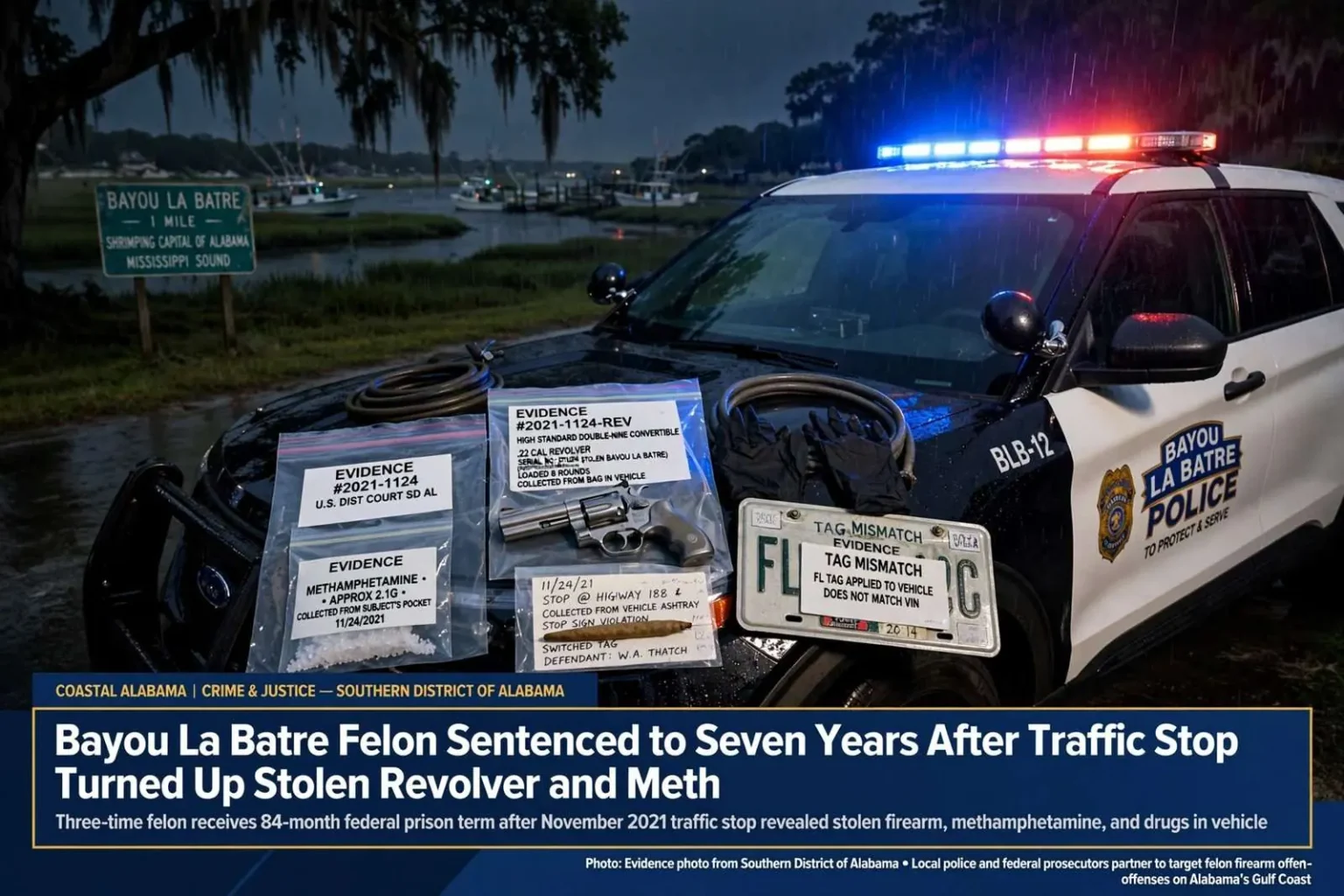
Court records show that on Nov. 24, 2021, a Bayou La Batre police officer pulled over Winston Alexander Thatch for running a stop sign. What began as an ordinary enforcement stop escalated quickly. The officer quickly noticed the car was carrying a switched license tag — a detail that instantly transforms a routine stop, because a switched or improper tag suggests the vehicle may be stolen or the driver may be concealing his identity, and it gives police grounds to investigate further.
A search of the vehicle followed. According to the U.S. Attorney’s Office for the Southern District of Alabama, Thatch had a rubber hose in his lap and methamphetamine in his pocket at the time of the stop. Investigators also found a marijuana blunt in the car’s ashtray and a loaded High Standard Double-Nine Convertible .22-caliber revolver inside a bag. The revolver was loaded with eight rounds of ammunition.
The discovery of a loaded firearm within arm’s reach of a driver under the influence of controlled substances is among the most serious scenarios officers encounter on a traffic stop, and it is precisely the scenario federal firearm statutes are written to address. The presence of methamphetamine alongside the weapon added weight to the government’s interest in the case, reflecting the broader pattern in which drug activity and illegal firearms travel together along the Gulf Coast.
Stolen Gun, Repeat Offender
Federal investigators determined the revolver had been reported stolen out of Bayou La Batre. That finding added a second layer to the offense: the weapon was not only possessed illegally by a felon, but had itself been taken from a victim in the same small community. Stolen firearms circulate quickly in coastal Alabama, often traded or sold within days of being taken, and tracing them back to their origins is a routine part of the federal case-building process.
Thatch later pleaded guilty to being a felon in possession of a firearm. The charge is a federal offense that carries serious consequences precisely because it targets the intersection of criminal history and gun possession. Prosecutors treat convicted felons who rearm themselves as a distinct public safety threat, since prior convictions demonstrate both the willingness and the established pattern to offend again.
Prosecutors noted that Thatch already carried two prior felony convictions from Mobile County — first-degree receiving stolen property and second-degree assault, both entered in November 2019 — making him a three-time convicted felon at sentencing. The closeness in time between the earlier convictions and the 2021 traffic stop was a significant factor in the government’s decision to pursue the case in federal court, and it underscored the warning that repeat offenders face: each new felony conviction compounds the sentence that follows.
In December 2022, a United States District Court judge sentenced Thatch to 84 months — seven years — in federal prison for the firearm offense. The term will be followed by a period of supervised release, the standard structure of federal sentencing in which offenders serve part of their punishment under community supervision after release from custody. Federal sentences are served in full, without parole, which means the seven-year term represents actual time in federal prison.
The case was prosecuted as part of ongoing federal efforts to remove guns from the hands of repeat offenders along the Alabama Gulf Coast. Those efforts pair local police departments with the U.S. Attorney’s Office for the Southern District of Alabama, which covers Mobile and the surrounding counties, and with federal partners including the Bureau of Alcohol, Tobacco, Firearms and Explosives. When a local officer seizes a gun from a person with a felony history, the case can be adopted federally, where sentencing guidelines produce longer terms.
Why Federal Prosecution Matters Locally
For residents of Bayou La Batre and neighboring coastal communities, the practical effect of that strategy is felt in the removal of armed repeat offenders from the streets for extended periods. Small towns have limited police resources, and a single individual cycling repeatedly through arrests can account for a disproportionate share of a department’s calls. Prosecutors say the message they aim to send is that a felon found with a gun in Mobile, Bayou La Batre or any other community in the district faces federal time.
The Southern District of Alabama’s coastline — from Mobile’s port neighborhoods down through the bay communities and the fishing towns of south Mobile County — presents particular challenges for law enforcement. Waterways, a working seafood industry and the steady traffic of Highway 188 and connecting roads move people and goods through the area constantly, and illegal weapons and drugs ride along the same routes. Cases built on traffic stops like Thatch’s are one of the primary tools for interrupting that movement.
Bayou La Batre itself, famous as a shrimping port and immortalized in film for its seafood industry, is a close-knit community where residents are quick to report suspicious activity and officers know the town’s regulars well. That familiarity is what allows an officer to spot something as small as a switched tag in evening traffic — and, in this case, to follow the observation through a search that ended with a stolen gun off the street.
The seven-year sentence closes the case, but officials say the broader effort continues. Every gun recovered from a convicted felon, they note, is a weapon that cannot be used in a future robbery, assault or shooting — and the federal-local partnership that produced this conviction remains a fixture of public safety strategy across coastal Alabama.
Inside a Felon-in-Possession Case
Felon-in-possession prosecutions follow a well-worn path from seizure to sentencing, and the Thatch case shows each step. The gun seizure by a local officer generates a report that is reviewed by federal prosecutors working with ATF agents. Investigators run the weapon’s serial number through national databases to determine where it was stolen or first sold, and they pull the defendant’s criminal history to establish the prior felonies that make possession illegal. If the record supports it, a federal indictment follows and the case moves to the U.S. District Court in Mobile.
Guilty pleas resolve the large majority of these cases, as they did here, sparing the cost of trial but preserving the sentence structure that federal law prescribes. At sentencing, a judge weighs the advisory guidelines alongside the defendant’s history — and a record showing violence, like a second-degree assault conviction, pushes the calculation upward. The 84-month term in this case sits within the range such records typically draw.
Prosecutors and police alike point to a practical reason for taking these cases federally: consistency. State-level outcomes for firearm possession by felons can vary widely with local court caseloads, while federal sentences are structured, substantial and served without parole. The certainty of meaningful prison time, they argue, is itself a deterrent for offenders deciding whether to carry.
The Wider Picture on the Coast
The effort Thatch’s case was part of has run for years across the Southern District of Alabama, producing a steady stream of convictions involving stolen firearms recovered in traffic stops, domestic calls and searches throughout Mobile County and the coastal communities to its south. Law enforcement leaders credit the coordination with taking armed repeat offenders off the street for stretches long enough to change the calculus in the neighborhoods where they operate.
For the community of Bayou La Batre, the case is a reminder that the town’s small police department operates within a much larger enforcement network. A stop sign violation on a November evening in 2021 ended with a stolen revolver documented, a three-time felon sentenced, and one more gun permanently out of circulation on the Alabama coast.
Officials also point residents to the role they play in that system: reporting stolen firearms promptly, documenting serial numbers and passing along information to local police. Stolen-gun cases move only as fast as the reports that start them, and community cooperation in the days after a theft is often what makes a later federal conviction possible.