Bayou La Batre Odor Complaints Spark Fresh Clash Between Residents and Seafood Industry
A long-running dispute over seafood waste odors in Bayou La Batre resurfaced at city hall, with state environmental inspectors visiting a co-op the same day residents and processors clashed publicly.
A long-running dispute over seafood waste odors in Bayou La Batre spilled into city hall again last week, as seafood industry leaders and residents clashed over complaints that have divided the community for months.
Tempers flared after state inspectors returned to the bayou, with processors accusing some residents of threatening an industry that has anchored the city’s economy for generations.
“I’m so disappointed in our town, you know, for some of these people to be causing these problems. You know, this town was built on shipbuilding and seafood, and there is no reason why we should be having to address these issues. Yes, shrimp and crabs smell. Oyster smell. It is inherent to the process, and it is a huge tax base for the city as well as the state,” said Lillie Kraver of Deep Sea Foods. “So if you don’t like it, please leave and leave our industry alone.”
Kraver’s frustration captures the view from the processing side of the dispute. Bayou La Batre has been called the Seafood Capital of Alabama for good reason: its shrimp fleet, oyster houses and crab processors supply markets across the region, and the shipyards along the bayou build and repair the boats that make the whole economy move. Processing shellfish by the tons inevitably means shells, heads and viscera piling up fast, and every coastal town that has ever hosted the industry has grappled with what to do with the byproduct and what it smells like downwind.
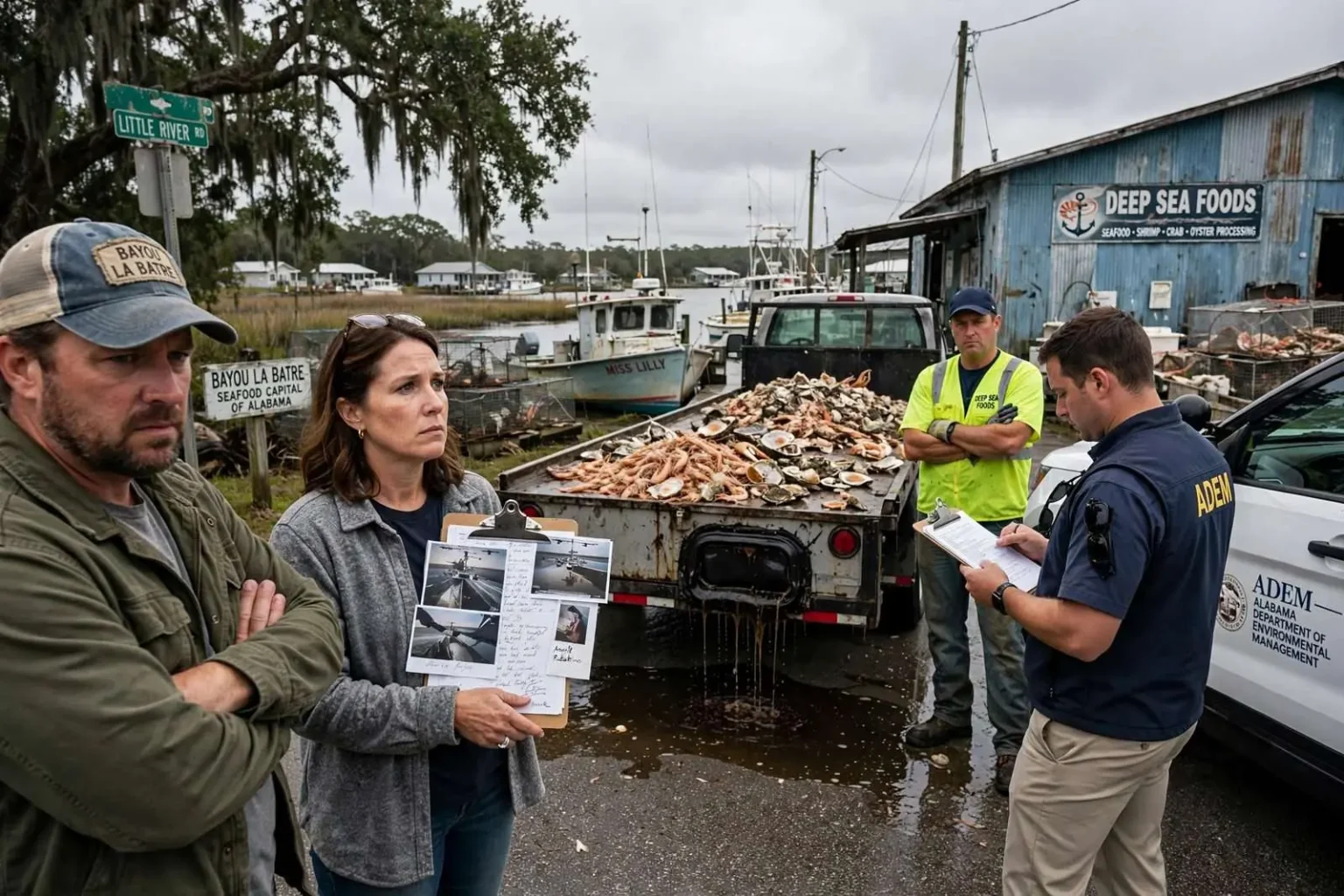
The council meeting happened the same day inspectors with the Alabama Department of Environmental Management visited a co-op where seafood waste is delivered. Video of the visit later circulated on social media. In the footage, the person filming can be heard asking an inspector, “Are they doing anything illegal?” The inspector replies, “We haven’t determined that yet. Our bosses told us to come by and take a look.”
That brief exchange, recorded on a phone and passed around the community within hours, did more to inflame the dispute than any public comment. To residents, it suggested the state was watching but undecided — neither confirming a violation nor clearing the operation. To processors, the sight of inspectors at a working co-op felt like a threat to their livelihood broadcast on video for anyone with a grudge to amplify. In a town of a few thousand people where nearly everyone works on or around the water, a dispute like this is not an abstraction: the complaint file and the payroll list are drawn from the same families.
The residents’ complaint
Angela Rubattino, who says she has filed multiple complaints with ADEM, said she and her husband have documented the issue with photos, videos and drone footage. Rubattino said the concern began when they noticed strong odors coming from a neighboring property, where seafood waste is reportedly used as fertilizer and compost, and later traced the smell back to the co-op. She disputes claims that she is trying to shut down the seafood industry, saying her concerns center on how the waste is transported and stored.
“That’s me just trying to get y’all to do what you’re supposed to do. You’re supposed to cover it. You’re not supposed to drip. There’s an ordinance. There’s something already in place. That’s not me trying to change any laws or ordinances or anything,” Rubattino said.
Her argument, on its face, sidesteps the fight the processors expect. She is not asking Bayou La Batre to stop processing shrimp; she is asking that waste leaving a co-op be hauled in sealed, covered trailers rather than the open arrangements that let liquid drip down the road, and that storage at the receiving property meet standards the town already has on its books. The drone footage and photo documentation are the modern version of a neighbor’s complaint file — the same grievance families along the bayou have raised for decades, now recorded well enough to stand up in a council chamber or a state file.
Mayor Henry Barnes said the issue has come up at nearly every council meeting over the past few months. He said the processors and those receiving the waste are following the rules, and that some changes have already been made to address the complaints.
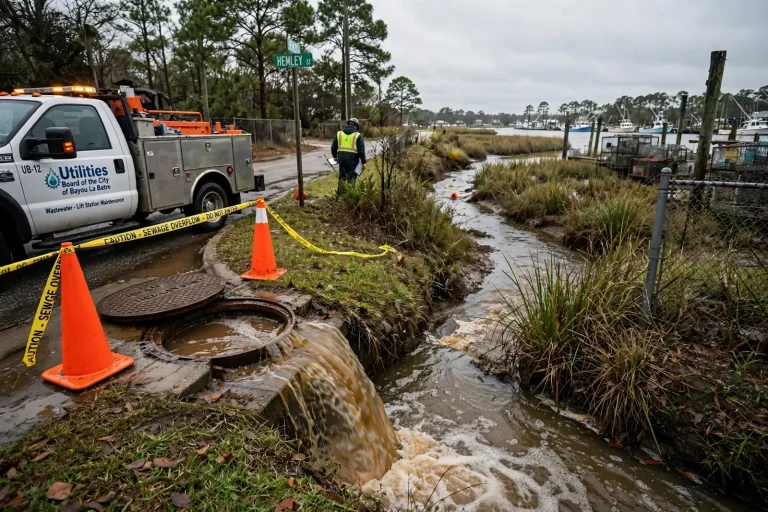
“To put new seals, new gaskets on the back of them trailers that they haul this stuff in, and go down University Road instead of going down Little River Road, and they’ve been doing that,” Barnes said.
The mayor’s account amounts to a practical, unglamorous resolution path: new gaskets so trailers stop dripping, and a hauling route that keeps the waste trucks away from the residential stretch along Little River Road. Neither change required a new law. Both required the town to use the leverage it already had — and both are the sort of quiet fixes that never appear in a state enforcement file, which is part of why the dispute has continued to simmer at city hall even after the changes were made.
ADEM closes its investigation
The Alabama Department of Environmental Management has since wrapped up its investigation into one specific complaint, concluding that Alabama has no enforceable odor standards and that the composting operation in question does not require a state solid waste permit.
The complaint, filed July 23, alleged that Pro-Mulching, operated by Thomas Steele, was dumping seafood waste directly onto the ground, producing strong odors that affected nearby residences and created airborne particulates. ADEM’s Air Division reviewed the complaint on July 24 and classified it as “non-actionable,” noting in its findings that “Alabama, like most other states, has no quantifiable odor limitations due to the subjective nature of odors.”
The Air Division’s reasoning reflects a genuine regulatory dilemma rather than simple indifference. Regulators can measure particulates, ammonia concentrations and emissions from a smokestack, but the everyday nuisance smells of a working waterfront resist quantification: one person’s unbearable stench is another’s smell of making a living. Most states have concluded that putting a numeric ceiling on odor would invite endless litigation over measurements no two noses agree on, and so they leave the issue to local zoning, local ordinances and nuisance law — exactly the gap the Bayou La Batre dispute now illustrates.
ADEM’s Land Division inspected the site on July 30 and concluded that composting non-hazardous solid waste for on-site use does not require a permit. According to the agency’s reasoning, individuals who compost materials and use the resulting product on their own property are not subject to state permitting requirements.
The on-site-use exemption is a standard feature of solid waste law across the country. The logic is straightforward: material that a landowner composts and spreads on his own fields never enters the commercial waste stream, so the state’s disposal regulations — written for landfills and permitted processors — do not attach. Seafood waste, rich in nitrogen and minerals, is a traditional soil amendment in coastal communities, and a mulching operation that takes deliveries of shells and trimmings and turns them into compost used on the same property can sit outside the state’s permitting system entirely, no matter how many loads arrive or how strongly the neighbors object.
Steele has maintained that he is recycling seafood waste into fertilizer rather than disposing of it as waste, and contends his operation complies with applicable regulations. The complaint file contains no documented violations or enforcement actions against the property.
That distinction — recycling versus disposal — is the legal fulcrum on which the whole complaint turned. If the material is a product in the making, not a waste awaiting disposal, then the state’s solid waste rules and their permitting triggers simply do not apply to it. Steele’s position, now backed by the agency’s own conclusions, leaves his operation on firm regulatory ground even as the smell that draws the complaints continues to arrive with each delivery.
What residents are left with
The outcome leaves residents who have raised the odor issue at council meetings for months without a clear regulatory remedy at the state level, underscoring a gap that local officials, including Mayor Barnes, have acknowledged: without enforceable odor standards, the city and state have limited tools available beyond voluntary changes by processors, such as the new trailer seals and rerouted hauling routes cited above.
That is the uncomfortable arithmetic of the case. The state will not measure the smell, and the state will not require a permit for on-site composting. What remains is the town’s own ordinance — the one Rubattino cited from the council floor — and the willingness of the industry to keep cooperating. Barnes’ report that processors have installed new gaskets and shifted their routes off Little River Road is the strongest evidence the pressure is working, even without a citation on file anywhere.
The dispute is unlikely to disappear, because the forces that produced it are permanent features of the town. Bayou La Batre’s working waterfront sits close to its residential streets — closer than anyone would zone it today — and the fleet and processing houses that define the town also generate the shells, trimmings and effluent that define the complaints. As long as the seafood economy anchors the city, somebody will truck the waste somewhere, and somebody will live near where it goes.
What the episode has clarified is where the levers are. The state’s answer is no; the town’s ordinances are yes; and the practical fixes — covered loads, sealed gaskets, routes that spare the residential roads — are happening at the council table, one month and one complaint at a time. Residents like Rubattino have shown that documentation, persistence and a standing spot on the council agenda can move an industry that state regulators have declined to touch. Processors like Kraver have shown they will defend the industry that built the town every time it is challenged. The resolution, when it comes, will be local — worked out between the people who smell the bayou and the people who work it, in the same small room where both sides go to be heard.