
Bayou La Batre Utility Board Weighs Ending Maintenance Agreement, Leaving Residents Facing Thousands in Repairs
Bayou La Batre's utility board is weighing whether to discontinue a $8.50/month sewer maintenance plan, potentially shifting repair costs onto residents.
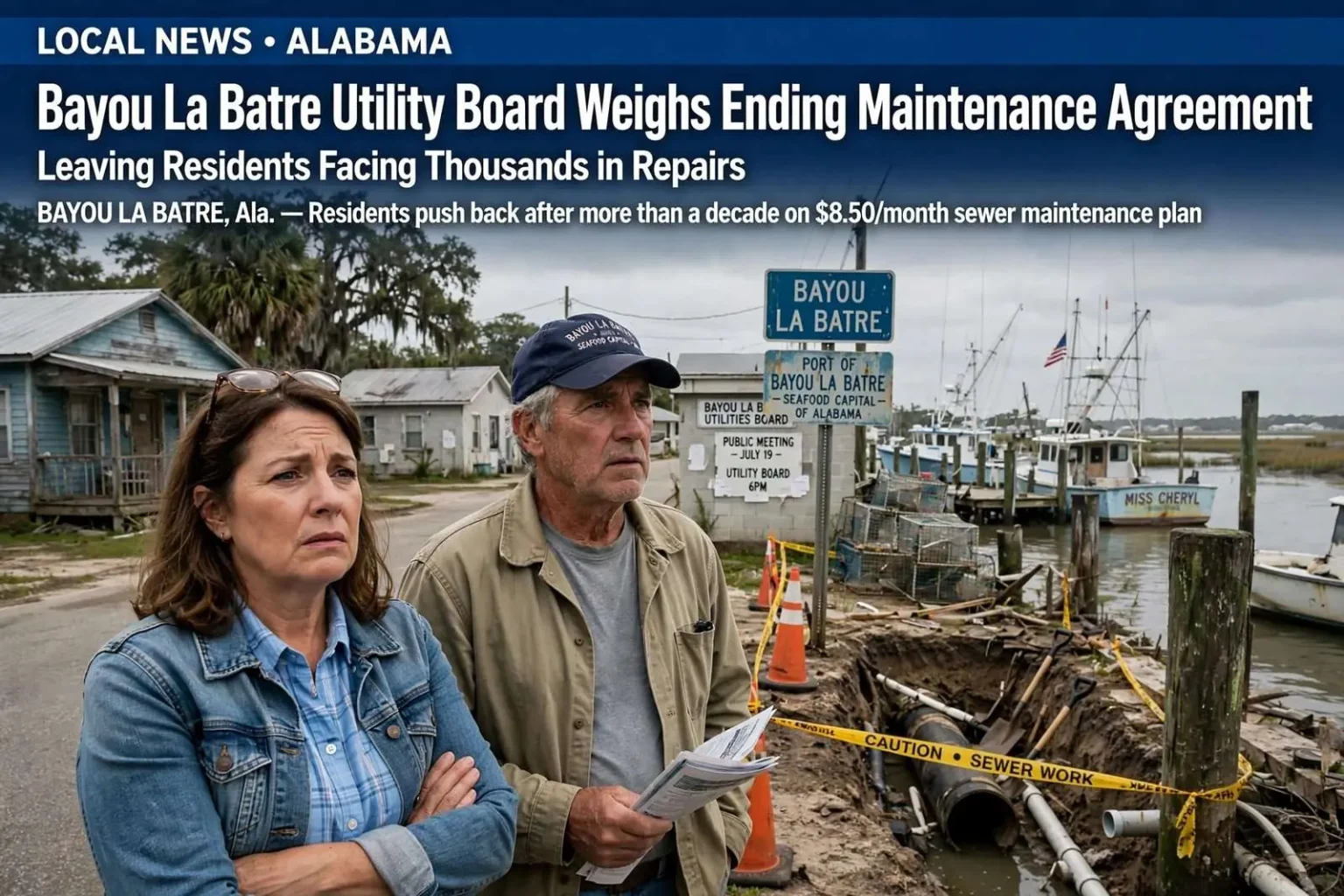
BAYOU LA BATRE, Ala. — Dozens of Bayou La Batre residents pushed back this week after the city’s utility board signaled it may discontinue a long-standing maintenance agreement, a move that would shift thousands of dollars in sewer-pipe repair costs onto homeowners who had been paying $8.50 a month for more than a decade.
The dispute touches a small group of customers, but it goes to a question that matters far beyond the city limits of this working waterfront town: what happens when the promise that persuaded a community to modernize its infrastructure becomes too expensive for a small utility to keep? For the households involved, the answer could mean repair bills reaching into the thousands of dollars — costs they agreed to help avoid more than ten years ago.
Agreement grew out of post-Katrina rebuild
The affordable maintenance plan was established in the years after Hurricane Katrina as an incentive to persuade Bayou La Batre households still on private septic tanks to hook up to the central sewer system. In exchange for the monthly payment, the utility board maintained the lateral sewer pipes running from each customer’s home to the larger city infrastructure.
The arrangement made sense in the aftermath of the storm. Hurricane Katrina struck Bayou La Batre directly in August 2005, destroying much of its seafood fleet, processing plants and waterfront housing, and the town became one of the most recognizable images of the storm’s toll on the Alabama Gulf Coast. Federal recovery money poured into the community in the years that followed, funding rebuilding projects that included upgrading and extending public infrastructure. Getting the remaining homes off aging septic tanks and onto the central system was a public health priority — septic failures in a low-lying coastal town create contamination risks that storm flooding can spread across entire neighborhoods.
For homeowners, the deal was straightforward. They paid a modest monthly fee — $8.50 — and in return the utility board took responsibility for the lateral lines, the pipes that carry wastewater from a house to the main line in the street. Laterals are the segment of a sewer system that most frequently fails and the most expensive for an individual homeowner to fix, since repair often requires excavation in the yard, driveway or foundation line. A repair that might cost several thousand dollars out of pocket became, in effect, an insured risk covered by the monthly payment.
Jay Ross, a representative for the Bayou La Batre Utilities Board, said the agreement was created specifically for people coming off septic tanks. “By hooking up to the sewer system, the utility board would maintain the pipes in the infrastructure in the ground from their house to work and to the sewer system,” he said.
Rising costs, limited manpower cited
Ross listed several pressures behind the board’s review: increased maintenance costs, difficulty hiring qualified people, and a small overall enrollment of fewer than a hundred households. “Based on increased costs, lack of manpower, trying to find adequate train people to run the utility board properly,” Ross said.
The pressures he described are not unique to Bayou La Batre. Small municipal utilities across rural Alabama have struggled in recent years with the same combination of rising material costs, aging underground systems and a shrinking pool of certified operators willing to work for small-town wages. State environmental officials have repeatedly flagged small systems as the ones most at risk of falling behind on maintenance, and industry groups have warned that without consolidation or outside support, many small boards will face hard choices between raising rates and cutting services.
In Bayou La Batre’s case, the arithmetic is unforgiving. A maintenance commitment spread across fewer than one hundred customers leaves little cushion when a single lateral failure can require heavy equipment and days of labor. The board’s monthly revenue from the program — a few hundred dollars a month in total — has not kept pace with the real cost of keeping crews, equipment and materials available to respond.
Residents vow to fight
Among those in the audience Tuesday was Shelia Dismuke, a current participant in the plan. “There was a small group of people around 100 who were given this option and they’ve paid their money all these years, and now the utility board feels like we’ve had it long enough and they can’t continue this agreement at this rate of pay and they don’t have the manpower,” Dismuke said.
Dismuke said the affected residents were prepared to seek legal counsel if the board voted to end the program. “If they decide this is something they don’t want to continue doing then the group will decide if then the group said they are willing to go forward with legal counsel,” she said.
Her argument, and that of the other participants, is a matter of fairness as much as finance: they chose to hook up to the central system — giving up their septic tanks — in reliance on the utility’s promise to maintain the laterals. If the board withdraws that maintenance now, the customers say, they are left holding a liability they never agreed to carry, with no easy way to return to their previous arrangement.
The practical stakes are significant. A failed lateral can force a household to stop using its plumbing until the line is repaired, and contractor estimates for excavation and replacement on a typical residential lot routinely run into the thousands of dollars. For a town of roughly 2,000 people where many households work in the seafood industry or hold modest fixed incomes, an unplanned bill of that size is not an inconvenience — it is a crisis.
As of the July 19 meeting, the utility board had not yet made a formal decision. Residents who attended said they left with the impression that the board was leaning toward ending the program, but with no vote taken, the outcome remains open. Participants in the plan said they intend to attend future meetings in numbers and, if necessary, pursue their legal option.
A small town with big infrastructure stakes
Bayou La Batre, a small seafood town on the western shore of Mobile County with a population of roughly 2,000, has long relied on its centralized sewer system as a critical piece of local infrastructure, particularly given the community’s vulnerability to coastal flooding. The town sits at the edge of Portersville Bay, its harbor packed with shrimp boats and oyster vessels, and much of its land area lies barely above the tide line. Storm surge from tropical systems regularly pushes water into streets and yards, which is precisely why an engineered sewer system — and functioning lateral lines — matter more here than in an inland town of the same size.
The community’s economy deepens the stakes. Bayou La Batre has long called itself the seafood capital of Alabama, and its processing houses, boatyards and docks depend on homes and businesses that can operate every day. A sanitation failure in one neighborhood is not only a private hardship; it can ripple into public health orders, lost workdays and a town’s hard-won reputation for cleanliness in the handling of seafood products.
What residents are watching for now is whether the board pursues an alternative before dissolving the agreement. Options that small utilities elsewhere have considered include gradually phasing in higher rates for program participants, applying for state or federal infrastructure grants to cover lateral repairs, contracting maintenance work to a neighboring system, or selling the lateral-maintenance obligation to a regional utility with more capacity. None of those paths would be quick, and all would likely require outside help, but participants say they want to see the board demonstrate that ending the promise was a last resort rather than a first choice.
What comes next
The board’s next meetings will determine the program’s fate. Participants are urging anyone enrolled in the plan to attend, keep copies of their payment records, and document any past conversations with utility staff about what the monthly fee covered — material they say would matter if the dispute ends up before a court. A written record of what customers were promised, and for how long, would be central to any legal argument that the board cannot simply walk away from the arrangement.
The conflict also serves as a cautionary example for other small Alabama communities. Incentive agreements like Bayou La Batre’s are common tools for persuading residents to join central water and sewer systems, particularly in towns rebuilt after disasters with federal money. But the agreements are only as durable as the finances behind them. When a utility signs a maintenance promise calculated on one set of costs, and those costs rise for a decade while enrollment stays flat, the gap eventually comes due — the only question is who pays it.
For now, the roughly one hundred households in the plan are waiting. They have paid $8.50 a month for more than ten years for a service the board may soon decline to provide, and they are organizing to make sure that if the promise is broken, the decision does not happen quietly. The utility board, for its part, must weigh its legal exposure, its manpower reality and its relationship with the residents it serves. The next vote in Bayou La Batre will be watched closely — by the families whose basements and yards depend on buried pipes, and by small utilities across the region facing the same squeeze.
Anyone with questions about the program’s status can contact the Bayou La Batre Utilities Board directly, and residents are encouraged to raise concerns at a public meeting rather than waiting for a final notice in the mail. In a town where everyone knows everyone, the dispute has already become the main topic of conversation — at the docks, the processing plants and the church suppers — and whatever the board decides, it will be deciding with the whole community watching.


