BBB warns Gulf Coast homeowners about storm-chaser scams after Sally
The Better Business Bureau is urging Gulf Coast homeowners to avoid storm-chaser contractors and verify licensing after Hurricane Sally.
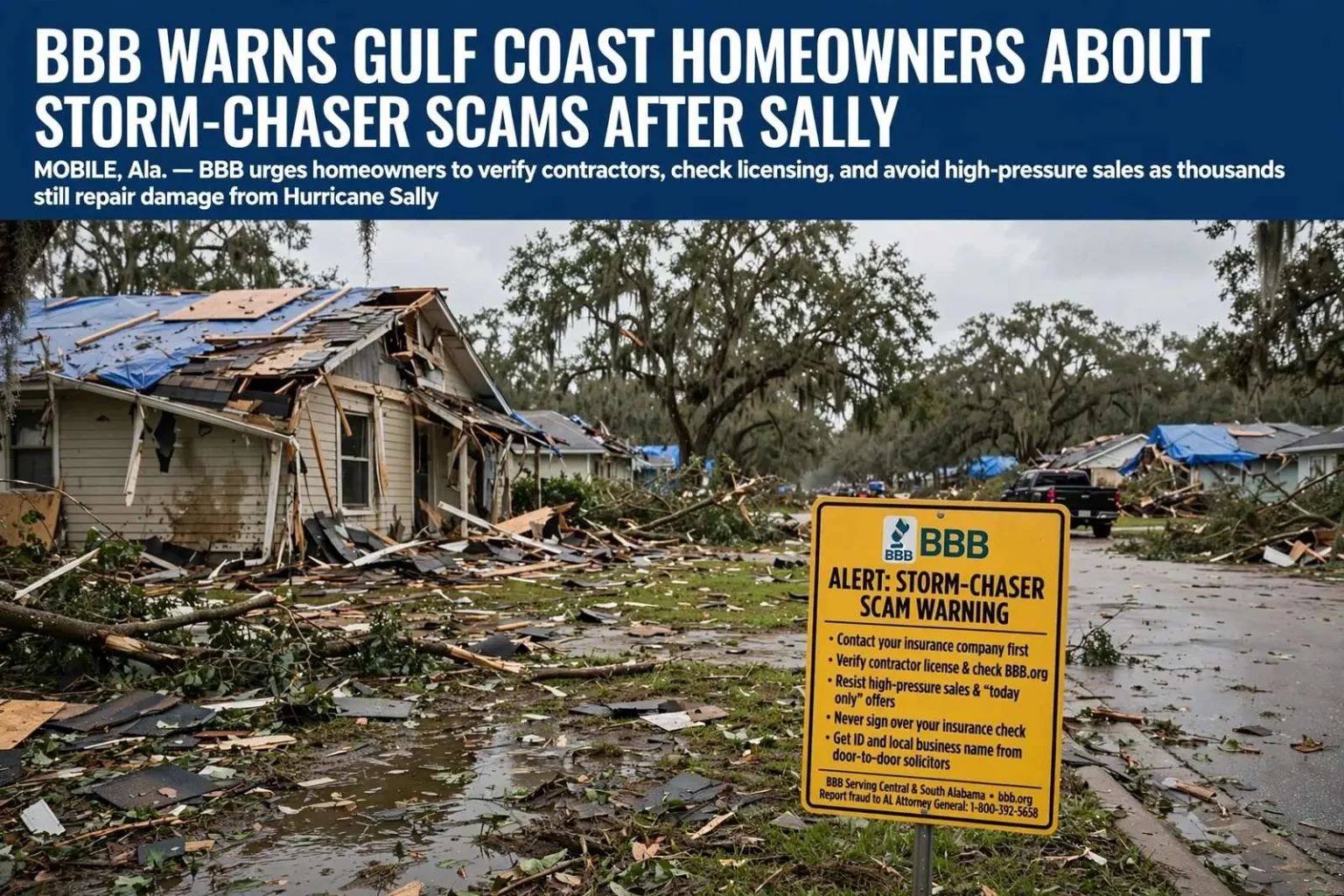
MOBILE, Ala. — As Gulf Coast residents recover from Hurricane Sally, the Better Business Bureau is warning homeowners to beware of “storm chasers” and out-of-town contractors who show up soliciting repair work. Monde Donaldson with the BBB Serving Central and South Alabama said most contractors are honest, but some storm chasers lack proper licensing for the area, offer quick fixes or make promises they cannot keep.
The warning arrives at the moment of maximum vulnerability for storm victims. Weeks after Sally’s landfall, thousands of homes across Baldwin County and the Mobile area still bear damaged roofs, fallen trees and water-stained interiors, and homeowners who have never hired a roofer in their lives are suddenly asked to make consequential decisions under pressure. Storm chasers know this — and some follow hurricanes across the Southeast precisely because distressed, insured homeowners are easier marks than ordinary customers. The pattern repeats after every Gulf storm: trucks with out-of-state plates, door-knockers offering free inspections and “today only” pricing, and paperwork designed to move fast and answer few questions.
The BBB offered several tips for storm victims: contact your insurance company first and save all receipts; research contractors on BBB.org and check state licensing; resist high-pressure sales; ask door-to-door solicitors for identification and a local business name; never sign over insurance checks to a contractor; and be wary of allowing strangers to inspect hard-to-see areas such as attics and crawl spaces. Each of those rules addresses a documented scam technique, and together they form a checklist homeowners can actually follow while repairs pile up around them.
Why the Tips Matter
Contacting your insurance company first protects both the claim and the budget. Insurers want to inspect damage before repairs begin, and policies generally require policyholders to mitigate further damage — tarping a roof, boarding a window — without completing permanent work that has not been approved. Saving every receipt, from hotel bills to lumber purchases, preserves the documentation adjusters need, and it becomes essential evidence if a dispute develops later. Homeowners who let a contractor drive the process from the first hour often discover that their claim has been shaped by someone whose interest is the contract value, not the coverage.
Checking licensing separates legitimate operators from the rest. Alabama requires general contractors to be licensed for projects above a modest threshold, and roofing work in particular falls under state regulation; Mississippi and Florida, Sally’s other affected markets, maintain their own licensing boards with online lookups anyone can use in minutes. A contractor who cannot or will not produce a license number is telling you something. Research on BBB.org adds another layer: a business profile shows how long a company has operated, its complaint history and how it responded when things went wrong — records a door-knocker with a phone number and a magnet sign simply cannot match.
The warning about high-pressure sales addresses the most reliable tell of a scam. Reputable local contractors have backlogs after a hurricane and no need to force a signature before the insurance check clears; the demand for their work outlasts any “today only” discount. Offers that expire tonight, discounts for letting the contractor “handle the insurance company,” and pressure to sign an assignment-of-benefits form on the hood of a truck are all red flags that the BBB sees repeated across storm-damaged regions year after year. A legitimate business will give a homeowner a written estimate and happily wait for the family to compare it.
The Checks and the Checks You Shouldn’t Sign
Asking door-to-door solicitors for identification and a local business name is simple but effective. Cities and counties across Baldwin County and the Mobile area require peddler and contractor permits, and legitimate canvassers after a storm carry identification from a real, locally registered company. The BBB advises homeowners to take the information down and verify it independently — call the company’s listed office, look up its address — rather than relying on a card handed over at the door. Scam operators count on residents being too polite, too tired or too overwhelmed to make the call.
Never signing over insurance checks to a contractor is the tip that saves the most money. A homeowner who endorses a settlement check and hands it to a contractor has surrendered all leverage; if the work stalls, is abandoned or is performed shoddily, the money is already gone. The safer practice is payment tied to progress — a modest deposit at most, then payments as phases of work are completed and inspected. Homeowners should also be skeptical of any contractor who asks them to sign forms they don’t fully understand, particularly documents that assign insurance benefits directly to the contractor or authorize the contractor to negotiate with the insurer.
The caution about strangers inspecting attics and crawl spaces sounds minor until homeowners consider what those spaces are. An inspector who has never been inside a home can claim to find damage a homeowner cannot see — hidden water stains, lifted shingles, structural issues — and manufacture a repair bill out of thin air. Legitimate adjusters and contractors expect homeowners to photograph whatever they find, share the findings with the insurance company and welcome a second opinion. The BBB urges residents to be present during any inspection, ask questions and refuse entry to anyone who arrived uninvited.
A Warning for Honest Contractors, Too
The bureau also cautioned legitimate local contractors about scam artists who offer to pay to use an established business’s name and reputation to collect insurance money, then disappear. The scheme puts a local firm’s good name on work performed by people it never vetted — jobs that go unfinished, claims that inflate real damage, customers who call the legitimate company demanding answers for work it never supervised. The reputable contractor discovers the damage only after the complaints arrive, and unwinding the mess can cost far more than the fee the impostors paid.
The warning reflects how sophisticated storm-fraud operations have become along the Gulf Coast. The BBB Serving Central and South Alabama, which covers the Mobile area, Baldwin County and regions beyond, has tracked these patterns through decades of hurricanes — Frederic, Ivan, Katrina and now Sally — and the bureau’s investigators note that each storm brings new variations on the same core schemes: inflated damage claims, phantom repairs and borrowed reputations. Donaldson’s message to homeowners cuts through the noise with a simple principle: take your time, verify everything and remember that the insurance company, the licensing board and the BBB all exist precisely to be checked before a contract is signed.
For residents weighing their next steps, the BBB’s advice pairs with guidance state officials repeat after every major storm: report suspected fraud to the Alabama Attorney General’s consumer protection division, keep copies of all contracts and payments, and consult your insurance adjuster before accepting any settlement on repair work. Recovery from Sally will take months, and the contractors who serve the Gulf Coast honestly will still be in business when the storm chasers’ trucks have moved on to the next headline.
Local officials add one more layer of protection: the Better Business Bureau’s Storm resource pages, which compile accredited contractors, complaint data and scam alerts specific to the affected region. Homeowners who use the site can check a company’s accreditation status, read customer reviews submitted through the BBB and file a complaint if a transaction goes wrong — a paper trail that helps both the victim and the next family the bureau warns.
The BBB reminds residents that a little patience is the cheapest insurance of all. A roof that sits under a tarp for two more weeks is inconvenient; a repair paid twice — once to a storm chaser and once to a legitimate contractor who has to fix the damage — is a disaster. Sally’s cleanup will employ hundreds of honest contractors across the Gulf Coast, and homeowners who verify before they sign will get their money’s worth from every one of them.
History explains why the Gulf Coast takes these warnings seriously. After Hurricane Ivan in 2004 and again after Katrina, consumer agencies documented waves of contractor fraud across Baldwin and Mobile counties — repair companies that collected deposits and vanished, roofers whose new shingles failed the first hard rain, and homeowners whose insurers denied claims for work performed without required permits and inspections. The cases that reached prosecutors often involved victims who had signed quickly, paid upfront or handed over insurance proceeds, none of which they would have done with a contractor they had verified first.
State licensing boards also urge homeowners to take the extra step of confirming that a contractor’s license is active and appropriate for the scope of work — roofing, electrical, plumbing and general contracting each carry separate requirements in Alabama. Homeowners can verify a license, check whether complaints or disciplinary actions exist, and confirm the contractor carries the workers’ compensation and liability coverage that protects them if a worker is injured on their property. Hiring an unlicensed worker is not just risky; it can leave the homeowner legally responsible for on-the-job injuries and without recourse when the work fails.