Beach Brain Camp Turns the Gulf Shores Shoreline Into a Classroom
Fifth and sixth graders from Gulf Shores Elementary School spent their June mornings in class and their afternoons on the sand, learning math and science alongside University of South Alabama marine science majors training to teach.
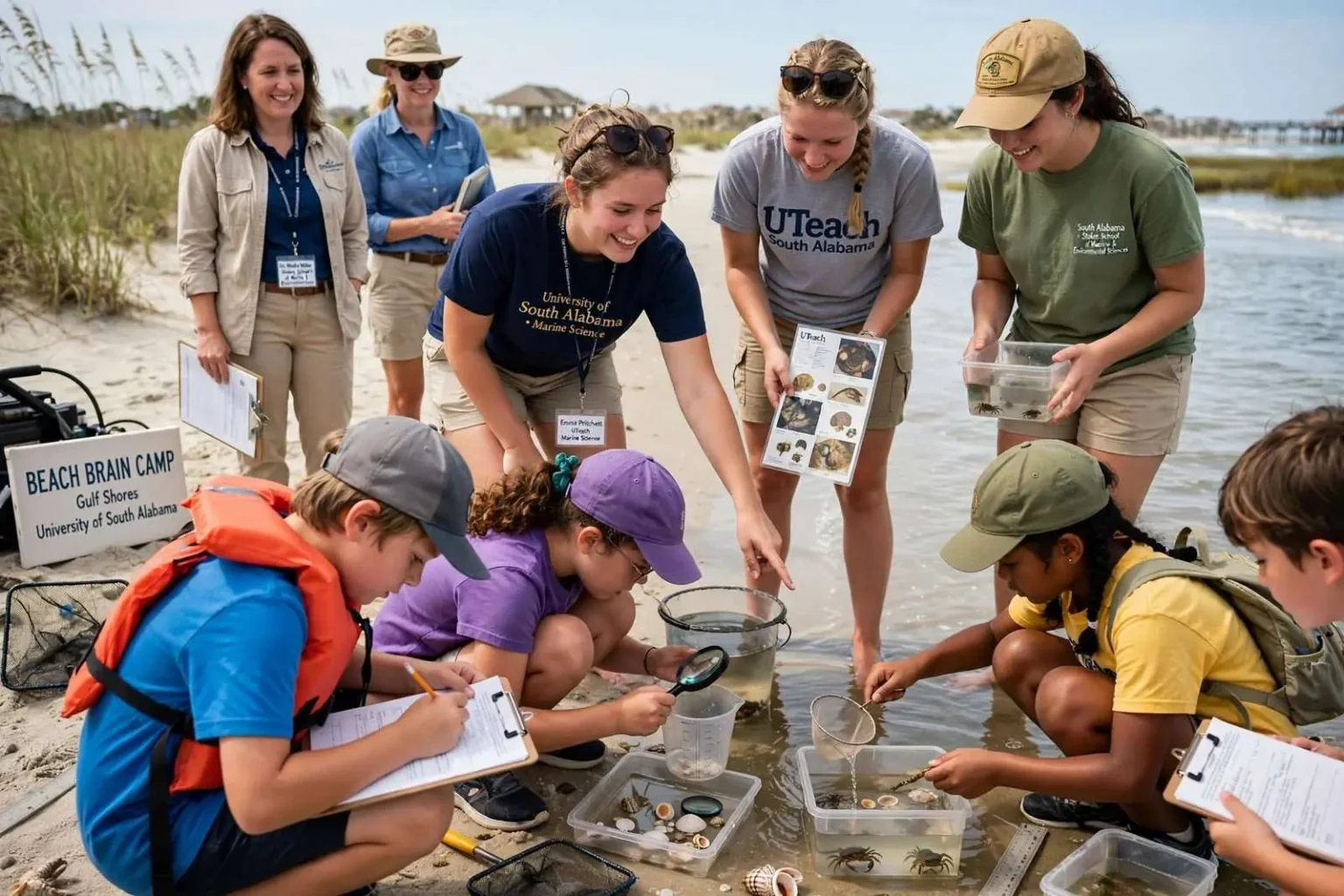
GULF SHORES — For two parts of a June day, fifth and sixth graders here got two very different versions of the same lesson. In the morning they sat in a classroom at Gulf Shores Elementary School. In the afternoon they walked out to the water and did it again with sand under their feet.
The Beach Brain camp paired elementary students with University of South Alabama undergraduates who are studying marine science and training, simultaneously, to teach it. The result was a summer day camp in which math and science lessons written on a whiteboard in the morning got tested against the actual shoreline a few hours later.
Mornings in the Classroom, Afternoons on the Sand
Campers spent their mornings at Gulf Shores Elementary, where teacher candidates from the University of South Alabama’s College of Education and Professional Studies led math and science lessons.
In the afternoons the group moved to the beach. Sessions were held at several Gulf Shores locations, including Lake Shelby, the pier and the pavilion area — a set of sites that between them cover freshwater, the Gulf shoreline and the built structures where people actually interact with the coast.
That progression is a familiar one in science education, and it is not accidental. A concept introduced abstractly and then encountered physically tends to stick differently than one that stays on paper. Measurement, estimation, scale, data collection, classification, habitat and human impact are all ideas that can be taught at a desk but that behave differently when the material under study is moving, wet and full of living things.
Who Led the Beach Sessions
The afternoon sessions were led by three University of South Alabama marine sciences majors who are also earning a minor through the UTeach program: Emma Pritchett, Addison Cannedy and Lexi Young.
The College of Education and Professional Studies invited Dr. Molly Miller and Dr. Amy Sprinkle, assistant professors at the Stokes School of Marine and Environmental Sciences, to assist with the afternoon portion of the camp. Miller and Sprinkle worked directly with the three undergraduates to design the structured beach-based activities, and provided on-site feedback and instructional assistance while the sessions were running.
That arrangement — faculty scientists coaching student scientists who are teaching children — is unusual enough to be worth naming. It puts a content expert and a pedagogy structure in the same place at the same time, which is precisely the combination that is hardest to arrange in ordinary teacher preparation.
Drawing on the scientific knowledge they had built through their marine science coursework and their UTeach teaching experience, the three undergraduates guided the fifth and sixth graders through hands-on activities that connected classroom concepts directly to the local environment.
What UTeach Is
UTeach is a nationally replicated model for preparing STEM teachers. Its core idea is that students majoring in a science, mathematics or engineering field can earn teaching credentials alongside their degree rather than instead of it, and that they should get in front of real students early and often rather than only in a final semester of student teaching.
The model was developed at the University of Texas at Austin and has since been adopted at dozens of universities around the country, including the University of South Alabama, where it operates as a minor available to STEM majors.
The problem it was built to address is a persistent one. School districts across the country, and particularly in rural and coastal areas, have difficulty filling secondary math and science positions, in part because graduates with those degrees have well-paid alternatives outside education. Programs that let a marine biology major discover a taste for teaching before graduation are one of the few interventions that reliably move that number.
A Senior Finds Her Career Path
For Emma Pritchett, a senior marine sciences major, the camp settled a question about what she wants to do after graduation.
“The Beach Brain summer camp was a highlight of my entire undergraduate career at South!” Pritchett said. She said the experience reassured her that outdoor science outreach and education is the career path she intends to pursue.
“My time at Beach Brain gave me many opportunities to expand my knowledge of people and their place in the environment,” she explained. “I got to communicate ideas across a range of individuals, like professors, high school students and elementary students.”
That last detail describes a skill that scientists are rarely trained for explicitly. Explaining the same idea to a faculty member, a teenager and a fifth grader in the course of a single afternoon requires shifting vocabulary, pacing and framing three times without changing the underlying content — the working definition of science communication.
Pritchett said the most rewarding part was watching the students take on difficult questions and realize they can have a positive effect on the environment around them.
“Beach Brain solidified my goals and my confidence that people need learning and need inquiry; they need hands-on instruction and need to think bigger,” she said.
Two Sets of Students at Once
The camp’s structure meant that two groups were learning simultaneously, and the second group was made up of adults.
The undergraduates leading beach sessions were getting supervised practice in a setting that no methods course can simulate: outdoors, in wind and sun, with a group of 10- and 11-year-olds and no classroom walls to contain them. Meanwhile, other preservice teachers within the College of Education and Professional Studies gained first-hand experience teaching science in an authentic outdoor setting.
Outdoor instruction is genuinely harder than classroom instruction. Attention is more difficult to hold, materials blow away, weather changes plans, and the environment itself constantly supplies interruptions that are simultaneously distractions and teachable moments. Teachers who have done it under supervision, with feedback available in real time, arrive in their first jobs with a capacity that most new hires do not have.
Why the Location Matters
Gulf Shores sits on Alabama’s narrow strip of Gulf coastline in southern Baldwin County, where a barrier landscape of beach, dune, freshwater lake and back-bay marsh is compressed into a few miles.
Lake Shelby, one of the camp’s sites, is a freshwater lake that lies close to the Gulf beach, which makes it a useful place to show students how sharply an ecosystem can change over a short distance. The pier and pavilion area put the same students in front of the built shoreline — the structures, access points and human traffic that shape how a coastal community actually uses its beach.
For children who live in Gulf Shores, this is not a field trip to an exotic location. It is their own town, examined with different tools. That distinction is the point of place-based education: students who study the systems in their own backyard tend to retain both the science and a sense of responsibility for the place.
The Partnership Behind It
Beach Brain drew on three separate parts of the University of South Alabama — the College of Education and Professional Studies, the UTeach program and the Stokes School of Marine and Environmental Sciences — alongside a Baldwin County elementary school.
Collaborations of that shape are easier to describe than to execute. They require a school willing to open its building in the summer, faculty from two different colleges willing to coordinate schedules, and undergraduates prepared to plan and deliver instruction rather than observe it.
What the arrangement produced, by the account of the people involved, was a camp where the children got science taught by people who study it and the college students got teaching practice supervised by people who do it — on the beach they all share.