
Beekeeper clears buzzing swarm at Mobile middle school
A beekeeper with the Environmental Studies Center safely removed a swarm of bees that turned up outside a classroom at a Mobile middle school.
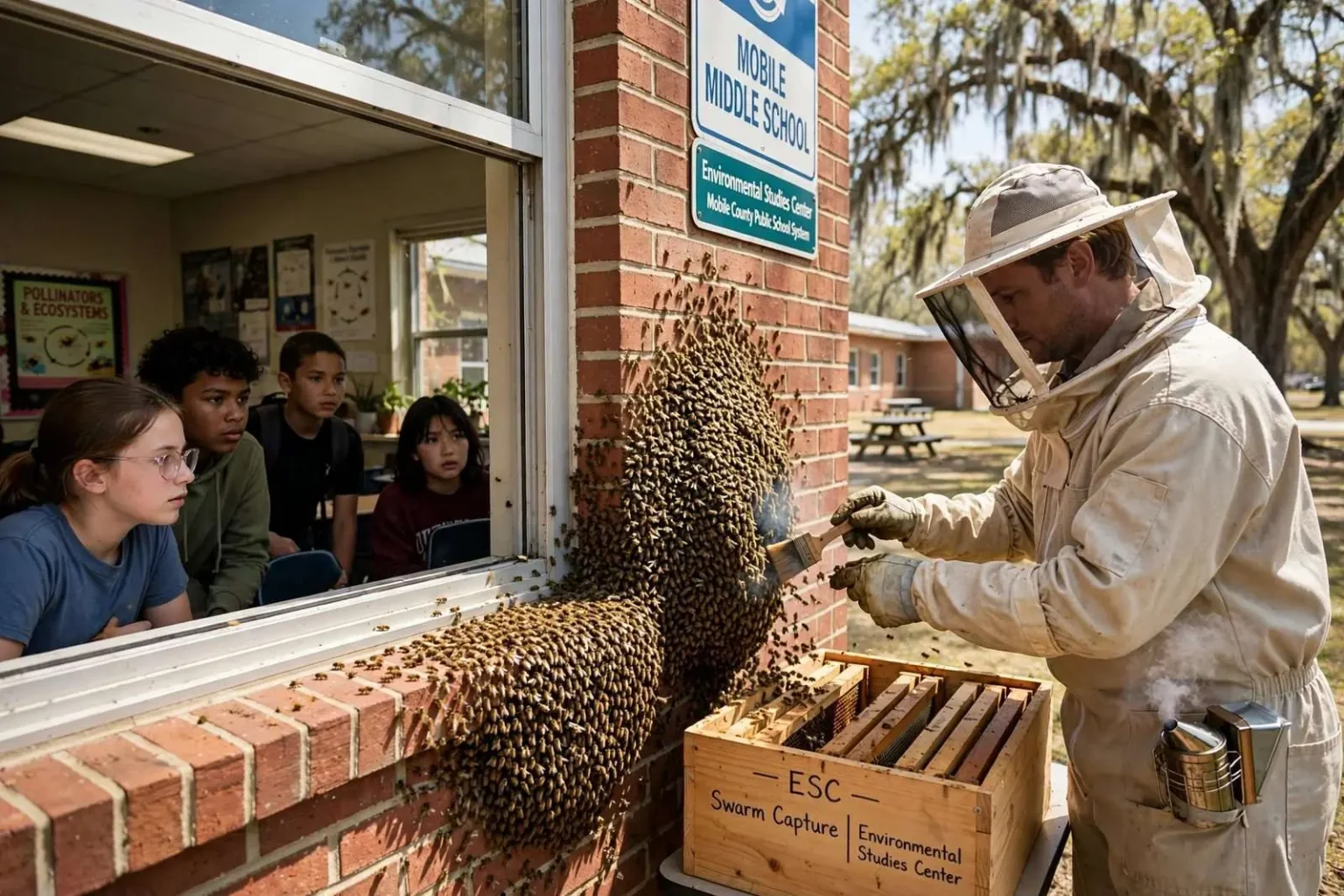
There was a buzz at a Mobile middle school this week after a swarm of bees turned up outside a classroom window. The peaceful pollinators were simply looking for a new home, and the Environmental Studies Center stepped in to help. The center’s beekeeper arrived quickly and safely removed the swarm. Photos of the removal were shared on the Environmental Studies Center’s social media.
The episode offered a small lesson in how beekeepers handle the harmless seasonal swarms that show up around the Gulf Coast each spring — and in why the right response to a swarm is a phone call to someone who keeps bees, not a can of insecticide.
What happened at the school
The swarm appeared outside a classroom window during the school week, an unusual sight that quickly drew attention from students and staff. School officials contacted the Environmental Studies Center, an outdoor education facility that serves Mobile County public school students, and the center’s beekeeper responded. The removal was completed quickly and safely, with the bees collected rather than destroyed, and the center later shared photographs of the operation on its social media accounts.
For the students who watched, the incident became an unplanned science lesson. A swarm clinging to a window frame or a tree limb is one of the most misunderstood sights in the insect world, routinely mistaken for danger when it is in fact the moment honey bees are at their most docile.
Why bees swarm in spring
Swarming is how honey bee colonies reproduce. When a hive grows crowded in the warmth of spring, the old queen leaves with roughly half the worker bees, and the mass of insects clusters nearby — on a tree limb, a fence, or in this case near a school building — while scouts search for a permanent cavity to move into. The cluster can contain thousands of bees hanging in a living bunch, often the size of a football or larger, and it may stay put for hours or a few days.
Contrary to appearances, a swarm in this state is usually calm. The bees have no hive, no honey stores and no brood to defend, and they gorge on honey before leaving home, which makes them less inclined to sting. Swarms around the Gulf Coast typically appear from late winter through spring, when colonies are strongest, which is why Mobile-area residents see them clustered on mailboxes, playground equipment and tree branches each year.
The Environmental Studies Center’s role
The Environmental Studies Center, operated within the Mobile County Public School System, gives students across the county hands-on exposure to the natural world — trails, wetlands, animal ambassadors and seasonal programs that connect classroom science to the local environment. Keeping bees and beekeeping expertise on hand fits that mission. When a swarm shows up at a school, the center can dispatch someone who knows how to collect it without harming the colony or frightening the students watching from a safe distance.
Collecting a swarm is a practiced skill. Beekeepers either clip the branch and lower the cluster gently into a ventilated box, or scoop the mass by hand into the container, taking care to get the queen inside; the rest of the bees follow her scent. Once collected, the swarm can be installed in an empty hive and grow into a productive colony — turning a potential nuisance at a middle school into a working educational asset.
What residents should do about a swarm
The school episode illustrates the advice beekeepers give every spring: if a swarm lands in your yard, leave it alone and call a local beekeeper or beekeeping association. Swarms usually move on within a day or two on their own, and spraying them kills pollinators that were never a threat and leaves behind a nest of dying bees. Local beekeeping clubs keep swarm-capture lists precisely so the public has somewhere to call.
South Alabama’s long growing season makes its pollinators especially valuable. Bees working pecan groves, citrus trees, vegetable gardens and wildflowers across Mobile and Baldwin counties support both backyard food production and commercial agriculture. Each swarm safely relocated — like the one outside a Mobile middle school classroom this week — preserves a colony that would otherwise be lost.
Swarm season on the Gulf Coast
The Gulf Coast’s climate makes it productive beekeeping country, and also productive swarming country. Mild winters mean colonies build population early, and by the time spring flowering peaks, hives are full and ready to split. Beekeepers in south Alabama manage this by inspecting hives for crowding, adding boxes for expansion, and splitting strong colonies before the bees split themselves — but even well-managed apiaries throw the occasional swarm, and feral colonies in trees and walls swarm constantly.
That is why Mobile-area neighborhoods see clusters of bees in March, April and May on everything from live oak limbs to gas grills. The clusters look alarming and photograph dramatically, but they are transitional: the bees are homeless, not hostile, and they will depart for a hollow tree or an attic gap if no one intervenes. Intervention by a beekeeper simply redirects the colony somewhere useful instead of somewhere that ends with an exterminator.
Bees and schools as teaching partners
The appearance of a swarm at a middle school was, in a sense, the Environmental Studies Center’s mission arriving uninvited. Few classroom demonstrations can match thousands of live bees hanging in a cluster ten feet from a window, and the center’s response showed students how knowledge replaces fear. A beekeeper who approaches calmly, works without a defensive suit in some cases, and handles a fist-sized mass of insects gently teaches a lesson about expertise and about the animal itself.
Sharing the photos afterward extended the lesson beyond the students who saw it happen. Social media posts of swarm captures routinely draw comments ranging from alarm to fascination, and each one is a chance to explain the difference between a swarm and a hive, between honey bees and wasps, and between a threat and a resource. The center’s posts turned one school’s unusual Tuesday into a public service announcement about pollinators.
Why pollinators need the help
Honey bees face well-documented pressures from habitat loss, pesticides, parasites and disease, and feral colonies — the descendants of escaped managed hives — have declined sharply from their historical numbers. Every swarm that is captured rather than killed represents a genetic lineage that has survived on its own in the local environment, which beekeepers prize for hardiness. In a region with year-round forage like south Alabama, a captured swarm can become a productive hive within a season.
The school episode ended the way swarm stories should: bees removed safely, students given a memorable science lesson, and a colony given a second chance in managed care. It also left behind a practical takeaway for every school and household on the Gulf Coast — when the buzz arrives in spring, the answer is a beekeeper’s phone number, not fear.
Inside a swarm capture
A swarm capture that goes smoothly takes less time than most people expect. The beekeeper arrives, assesses the cluster’s location and the risk of it moving somewhere inaccessible, and works from the bottom of the mass, since disturbing a swarm causes it to tighten and hum louder before it settles. The bees are shaken or scooped into a box fitted with frames, and once the queen is inside, the behavior of the cluster changes visibly: workers begin fanning at the entrance, releasing the scent that tells the rest of the colony where home now is.
Timing matters because a swarm that settles somewhere protected — inside a wall, under a shed floor, in a utility box — becomes an established colony rather than a temporary cluster, and removing an established colony from a structure is far harder than capturing a swarm. That is the practical reason to call quickly, and it applied at the school as much as it does at a private home: a swarm outside a classroom window today could be a colony inside the wall next week.
The middle of the food chain
The bees that gathered outside the Mobile classroom are part of an ecological and agricultural chain that runs through the region’s food supply. Watermelons, cucumbers, squash, blueberries and many other Gulf Coast crops depend on insect pollination, and beekeepers transport hives across the region each season to provide that service. Urban and suburban swarms, collected and managed, replenish the pool of colonies available for that work.
South Alabama’s feral bees also occupy an ecological niche among native pollinators — the bumble bees, carpenter bees and hundreds of native bee species that share the work. Honey bees are not a replacement for native pollinators, but a healthy population of managed hives supports the overall pollination web that gardens, orchards and wild plants all draw on. Capturing a swarm keeps one more contributor in that web.
A small incident with a clear message
No one was hurt, no bees were killed, and a middle school got an unexpected visit from one of the Gulf Coast’s most valuable insects — handled by the people whose job is turning encounters with nature into education. The Environmental Studies Center’s quick response and its photographs of the removal turned a moment of potential panic into a demonstration of how things should be done.
The story that reaches beyond the school is the one about swarming itself: a natural, peaceful, seasonal event that Gulf Coast residents will see again every spring, on porches and playgrounds and parking lots, wherever bees go looking for a new home. The right answer never changes — give them space, make the call, and let someone who keeps bees take it from there.


