
Before the Jaguars: The Forgotten First Football Team at South Alabama
Decades before the Jaguars went varsity, South Alabama students fielded their own club football team in the 1980s until a clash with the university shut it.
When Mississippi State walked out of Ladd-Peebles Stadium with a 35-7 win over South Alabama in September 2014, many Jaguars fans still counted the night as a milestone. A program barely seven years old as a varsity operation had just hosted an SEC charter member, filling a stadium that had anchored Mobile football for generations. The score mattered less than the setting: a young university sharing a field with the conference that defines college football in the Deep South.
What most of the crowd did not know was that intercollegiate football at the Mobile university had actually been attempted three decades earlier — by students, with no university support, and it ended in a standoff with the school’s legendary longtime president. The story survives in the memories of the men who played, in a handful of local accounts, and in the institutional memory of a campus that once decided football was not worth the trouble.
To understand how a club team came to exist at all, it helps to remember what the University of South Alabama was in the early 1980s. The school was still young, created in the early 1960s out of a struggle for independence from the University of Alabama system, and it had spent its first two decades pouring its energy and money into classrooms, clinics and buildings along University Boulevard. Athletics existed, but football — the expensive, consuming sport that dominates college life across Alabama — did not. For students who had grown up on Friday nights and Iron Bowls, the absence was conspicuous.
A Club Team Is Born
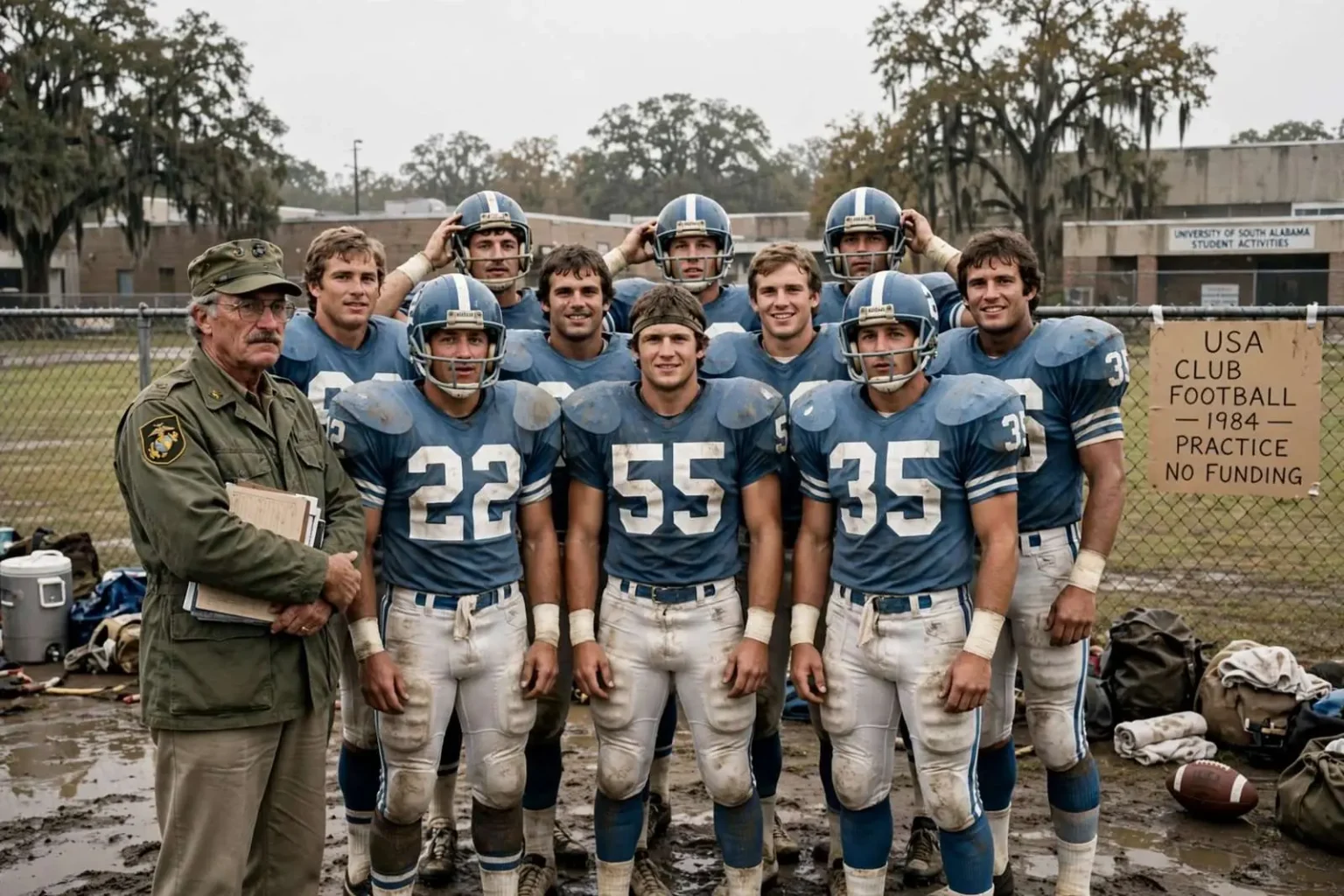
In the early 1980s, a group of South Alabama students chartered a club football team through the office of student activities, aiming to play full-contact games against club squads from other schools. Club sports occupied a middle ground in campus athletics: recognized by the university, funded modestly through student channels, but ineligible for the NCAA, without scholarships, and dependent entirely on the commitment of the students who organized them. It was the only realistic vehicle for football on a campus whose administration wanted nothing to do with the varsity version.
The students recruited a volunteer coach in Bob Windish, a World War II Marine veteran with decades of amateur and pro coaching experience who handled playbooks, depth charts and scheduling from a practice field between the track and Old Shell Road. Windish brought a seriousness to the enterprise that the players remembered decades later — real installations, real meetings, the discipline of a man who had been around the game in nearly every form it takes.
The roster was a throwback to the sport’s earliest college teams — students first, athletes second. Some had played high school football in Mobile or Baldwin County; others had not put on pads since junior high. They paid their own way in practice, shared equipment, and organized around classes and jobs. What they lacked in depth they made up for in the sheer novelty of what they were attempting: football at a university that had, to that point, firmly declined to have any.
First Games
The squad played its first game late in 1983 against the club team at then-Mobile College, the small Baptist-affiliated school across the city now known as the University of Mobile. It was a natural first opponent — close enough to travel, similarly sized, and similarly dependent on students rather than scholarships. The game gave the club a foundation to build on, and the players began planning something more ambitious for the following year.
That plan became a three-game 1984 season: twice against Mobile College and once against Marion Military Institute’s junior college team, one of the nation’s top five programs at that level. Marion, in the Black Belt town of the same name, had been playing organized military-style football since the nineteenth century and drew from a pipeline of talent that no collection of students could reasonably match. Scheduling the Indians was an act of optimism as much as ambition.
According to accounts from former club players, the 1984 opener featured a broken leg, a downpour and a narrow loss decided by a missed field goal. It was, by the standards the club would later set, almost a triumph. The players came away from it believing they could compete, and the season’s remaining games carried the energy of a group that thought it was building something permanent.
The trip to Marion, Alabama, went worse. Facing a roster loaded with players whose grades had sidelined them at bigger schools, the club team was overwhelmed in a cold rain while a small tornado touched down in neighboring Hale County. The afternoon compressed everything that could go wrong into a single game — the talent gap, the weather, the travel, and the sense of being a long way from home in every respect. It remained, for the men who made the trip, the definitive lesson in the difference between club football and the organized kind.
The following year brought new leadership under Jim Carter, a former semi-pro player, who enlisted Leroy Cook — the two-time Alabama All-American later drafted by the Dallas Cowboys — and other local football veterans as volunteers. Cook was a genuine celebrity in the state, a defensive star whose college career had made him one of the most respected players ever to come through Tuscaloosa. His willingness to give his afternoons to an unsanctioned club team said something about how seriously Mobile took the experiment.
A Local Story, Briefly
The club raised thousands of dollars through a roadside collection at Michael Boulevard and Azalea Road, drew television coverage of its practices and briefly became a local story. Motorists who slowed at the intersections of a working-class stretch of west Mobile were funding a football program, dollar by dollar, that the university itself declined to fund. The cameras and the collections gave the players a fleeting sense that the campus and the city were watching something that might grow.
Then the university pushed back. Former members say student activities suddenly imposed new compliance demands despite years of unchanged charters, barred the team from school practice facilities, froze the club’s on-campus bank account and summoned officers to a meeting where they were told to cease activities. The bureaucracy that had cheerfully chartered the team now dismantled it piece by piece — the field, the money, the recognition, each withdrawn in turn. To the players, the message was unmistakable: this was not paperwork. It was policy.
Shutdown at the Top
Former players traced the resistance to President Frederick P. Whiddon, who according to their recollections had long quashed attempts to bring football to South Alabama dating to his clashes with the University of Alabama before he founded the school. Whiddon had spent his career guarding the institution’s independence and its finances with a ferocity that became legend in higher education circles, and football — costly, consuming, and in his judgment destabilizing — had no place in his plan. Every prior push for the sport had died at his door, and the club team died there too.
In a tense confrontation in Whiddon’s office, the president declared that neither the students nor the trustees ran the university — he did. It was a statement that shocked the young officers in the room and confirmed what the shutdown had already suggested. Whatever the charter documents said about student organizations, the power to keep football off the campus rested in exactly one place.
The club played on briefly as an independent semi-pro outfit before dissolving after the 1985 season. Windish was inducted into the American Football Association Hall of Fame in 1987, a postscript that recognized the caliber of the coach the students had somehow attracted. Founding club vice president Phil Williams graduated from South Alabama and later became an Alabama state senator, carrying the memory of the standoff into the Statehouse. Whiddon led the university until trustees forced his retirement in 1998, ending a tenure that spanned virtually the entire life of the institution.
From Club to Varsity
Once Whiddon was gone, the school moved quickly: a new, better-organized club team launched that year, playing college squads as far away as Texas and the Carolinas. The new club operated in a different climate entirely — encouraged rather than tolerated, with the administration’s blessing where the old one had faced active resistance. The travel schedule alone showed how much the landscape had changed; the original club had never gotten the chance to test itself beyond a handful of nearby opponents.
In 2007 the university announced a varsity football program, and the Jaguars’ rise — from club experiment to hosting SEC opponents at Ladd-Peebles — became one of the fastest in modern college football. Ladd-Peebles itself was a fitting stage, a stadium that had hosted Mobile’s greatest football traditions for decades and that gave the new program an instant sense of scale. What had been denied in the 1980s as too risky and too expensive became, within a decade of the announcement, one of the most talked-about startups in the sport.
When Mississippi State arrived in September 2014, the scoreboard read 35-7 and the fans went home on the wrong end of it. The milestone held anyway. A program barely seven years old as a varsity operation had shared a field with an SEC charter member, in a city whose older football loyalties run deep and unforgiving.
The longer history is the part worth carrying out of the stadium that night. Intercollegiate football at South Alabama was not born with the varsity announcement of 2007. It was attempted in the early 1980s by students who chartered a team, recruited a Marine veteran to coach it, played through downpours and a tornado’s aftermath, raised money on street corners, and were shut down by a president who told them plainly that neither they nor the trustees ran the university. The students of the early 1980s, it turns out, got there first — and the varsity era that followed stands, in part, on what they proved was possible.
What the Episode Left Behind
For those who played, the club era remained a defining experience — proof that a group of students with a volunteer coach and a borrowed field could make real football happen in a city that loves the game. For the university, it became part of the origin story told when the Jaguars finally took the field: an anecdote about persistence, eventually vindicated. And for Mobile, it was one more chapter in the long, sometimes strange relationship between a young university and the sport that the rest of Alabama had never once doubted.