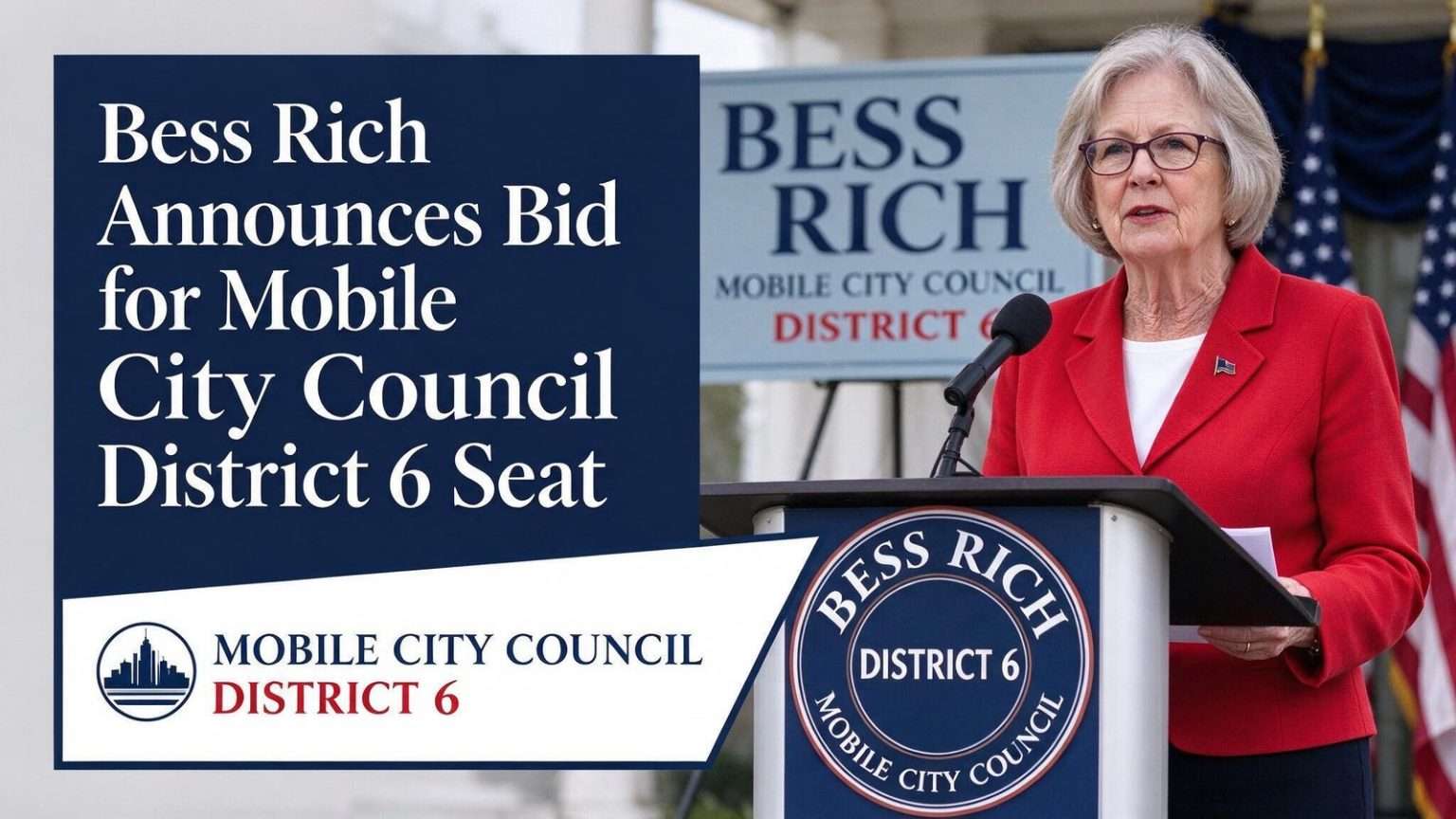
Former Mobile City Council member Bess Rich has announced she is running to reclaim the District 6 seat, campaigning on a platform of fiscal restraint and transparent city government. The entry of a familiar name instantly reshapes a race that opened up only weeks ago, and it gives west Mobile voters a candidate whose record in the chamber can be examined vote by vote. Rich framed her return as a continuation of the watchdog role she played during two previous terms.
Rich made her announcement in late August, shortly after Connie Hudson — who succeeded Rich as the District 6 representative nine years earlier — won election to the Mobile County Commission, leaving the council seat open. The timing puts Rich into the contest at its earliest stage, before other candidates have fully organized. Hudson’s move to county government created the vacancy that now draws Rich back into city politics.
A Familiar Face for the District
Rich served two terms on the Mobile City Council, where she built a reputation for pressing city leaders to prioritize essential services over new spending and for pushing to open up city government to public scrutiny. District 6 takes in much of west Mobile, including established residential neighborhoods, and its council seat has historically gone to candidates who campaign on services and infrastructure rather than large-scale development projects. Rich’s two terms made her one of the chamber’s most consistent votes for holding the line on spending.
Among the changes she championed was the televising of city council meetings, along with regular community meetings and a district office she funded herself to keep in closer contact with constituents. Before broadcast coverage, council actions could pass with little public awareness, and Rich argued that residents deserved to watch the debates that ended in their tax bills. Paying for her own district office was a signature move, keeping a staffed point of contact between elections at no cost to the city budget.
“In the current economic climate it is important for the residents of District 6 to have a conservative voice that will speak the truth and put their needs first,” Rich said in announcing her campaign. “I will continue the conservative voice of our district, pressing for a prioritization of spending on essential city services while reminding our city leaders that we can’t fix a spending problem with a tax increase.”
The message aligns with the themes she carried throughout her earlier tenure on the council. Rich repeatedly warned during budget seasons that recurring spending commitments made in good years become layoff threats in lean ones. Her campaign language suggests she sees the same dynamic returning as the city weighs new priorities against its existing obligations.
Her advocacy for open records and open meetings placed her alongside a broader movement in Alabama municipal government during that era, when councils across the state faced pressure to make proceedings accessible without requiring a trip to the clerk’s office. Rich’s argument was straightforward: decisions made in public can be corrected in public, while decisions made behind closed doors compound quietly until the cost is fixed. The longevity of the practices she forced shows how quickly reform becomes orthodoxy once it is in place.
Rich said she initially faced resistance from colleagues and constituents when she pushed for more open government practices, but that many of those changes are now taken for granted at City Hall. Practices that once drew pushback, from televised proceedings to routine public comment, are now standard features of Mobile’s council government. She has pointed to that arc as evidence that the pressure she applied outlasted the resistance it met.
Background in City and Regional Boards
Following the 2005 city election, Mayor Sam Jones appointed Rich to his transition team, a sign of her working relationships across the political spectrum. Transition appointments typically signal that an incoming administration values an outgoing critic’s institutional knowledge, and Rich’s service on the panel showed that her reputation for independence had not cost her a seat at the table. The role gave her a behind-the-scenes look at the departments she would later question in budget hearings.
She also spent seven years on the Mobile Area Water and Sewer System board, including a term as its chair. MAWSS is the public utility responsible for water and sewer service across much of the Mobile area, a system whose capital projects and rate decisions affect nearly every household in the city. Chairing that board placed Rich at the center of debates over infrastructure spending and ratepayer costs, experience she can draw on when city budgets intersect with utility operations.
Utility governance experience is not a common credential in city council races, and it gives Rich a technical grounding in topics that surface regularly in council business. Drainage problems, sewer capacity and water line replacement are recurring issues in west Mobile neighborhoods, and candidates who can speak to the systems behind those services often have an advantage with voters who have lived through infrastructure headaches.
Her tenure on the water board also coincided with years of major capital work across the system, when aging lines, treatment capacity and storm-related repairs demanded steady investment. Board members in that period had to balance the pressure to keep rates affordable against the reality that deferred maintenance eventually costs more than scheduled replacement. Rich’s emphasis on separating essential spending from discretionary projects traces directly to that experience.
The Campaign Ahead
Rich said she intends to work with Council President Reggie Copeland if elected and pledged to treat the seat as a full-time commitment, telling voters to expect direct access to her if they have concerns about city services. The pledge returns to the model of her earlier terms, when the self-funded district office functioned as a year-round constituent service operation. Treating the post as full-time work distinguishes her from candidates who would balance the seat with outside careers.
The District 6 council race will be decided in Mobile’s municipal elections. Mobile elects its seven council members citywide on the ballot but by district in representation, with each member answering to a distinct geographic slice of the city. The municipal contest will sit atop a ballot that also includes the mayor’s race, and turnout in district races typically rises when a competitive mayoral campaign drives voters to the polls.
West Mobile’s District 6 has been one of the city’s most reliably engaged districts in council elections, in part because its neighborhoods generate a steady stream of service questions, from road resurfacing to drainage maintenance after heavy Gulf Coast rains. Candidates who can document responsiveness on those day-to-day issues tend to build durable support across multiple election cycles.
Rich’s re-entry also creates a test of how voters weigh incumbency records over time. She left the seat nine years ago when Hudson succeeded her, and a generation of newer residents has moved into west Mobile since. Her campaign will need to introduce her record to voters who were not in the district, or not in the city, during her two terms.
For City Hall watchers, the most immediate question is what Rich’s candidacy does to the field. Well-known candidates tend to narrow the pool of potential entrants, since primary challengers must weigh name recognition and fundraising against a figure with an existing base in the district. Other candidates still have room to file, and municipal races in Mobile have a history of producing crowded fields when an open seat is at stake.
What She Says She Will Focus On
Based on her announcement, Rich’s platform will center on the same pillars as her earlier service: spending discipline, transparency and responsiveness to constituent concerns. Her quotation framing taxes and spending as the district’s core concern signals that budget votes will be the centerpiece of her campaign argument. The emphasis on speaking “truth” to city leadership positions her once again as an independent voice rather than a bloc vote on the council.
Her record on transparency offers concrete examples for that argument. Televised council meetings changed how residents could hold members accountable, and the community meeting schedule she kept brought council business out of Government Plaza and into neighborhood venues. Those practices, once contested, became institutional expectations for the district’s representation.
The seven years on the MAWSS board, including the chair’s term, round out a public service resume that spans city and regional bodies. Voters weighing her candidacy will look at that full arc, from council watchdog to utility chairman to transition adviser, in deciding whether her return would repeat the earlier model or bring a different approach to a changed city government.
Political observers in Mobile will also watch how the campaign frames Rich’s relationship to the current council leadership. Her stated intent to work with Council President Reggie Copeland signals cooperation on the chamber’s day-to-day business rather than a return built on confrontation. The balance she strikes between independence and collaboration will likely become a recurring theme as the election approaches.
Mobile’s municipal elections will settle the question. Until then, District 6 voters can expect a campaign fought largely on territory Rich knows well: budgets, utility rates, neighborhood services and the question of who is watching the store at City Hall.
Rich’s announcement completes the circle of a Mobile political story that began when she first left the council: a seat opened by Hudson’s county commission win, now sought by the woman Hudson replaced. The election will determine whether the district returns to its previous representation or chart a new course, and the campaign begins with Rich holding the advantage of a record voters can examine in full.