Better Business Bureau Issues Medicare and Affordable Care Act Scam Alert for Seniors
The Better Business Bureau warns Mobile-area seniors about Medicare open enrollment scams seeking personal information through unsolicited phone calls.
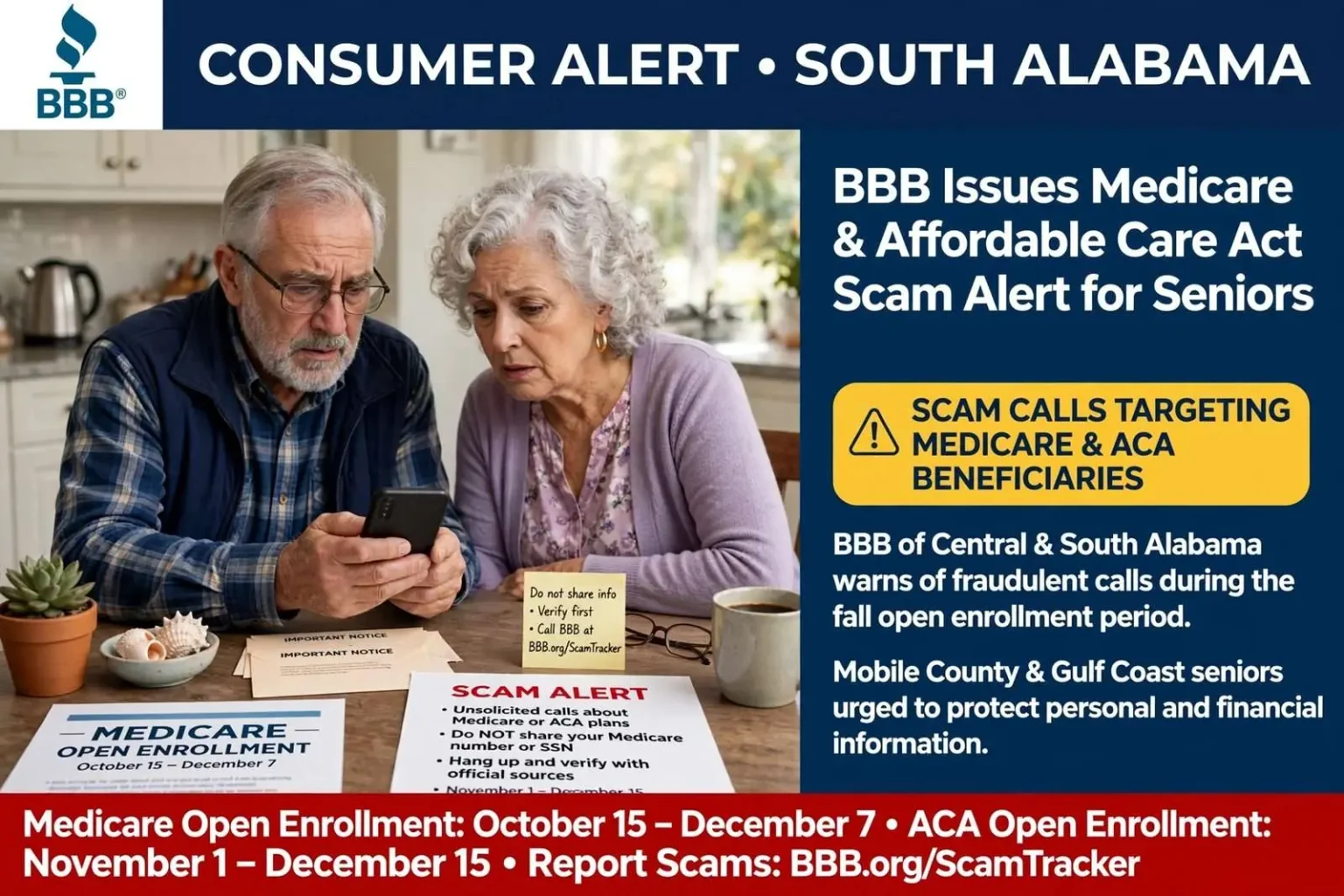
The Better Business Bureau is warning senior residents across Mobile County and South Alabama to stay alert as the annual health insurance open enrollment window approaches, a stretch of the calendar that has historically drawn out scammers hunting for personal and financial information from older consumers. The advisory comes from the BBB office serving Central and South Alabama, which said it is fielding reports of fraudulent phone calls aimed at Medicare beneficiaries and consumers covered through Affordable Care Act plans.
Monde Donaldson with the BBB of Central and South Alabama said the agency’s reporting channels have logged contacts from area residents describing callers who pose as benefits specialists and push hard for sensitive details. The timing is no accident. Each fall, as legitimate enrollment periods open and insurance advertising fills television and radio across the Gulf Coast, imposters blend into the noise, counting on the sheer volume of official-sounding outreach to make their pitches seem routine.
The enrollment calendar matters for anyone trying to sort real opportunities from fake ones. Medicare open enrollment runs October 15 through December 7 this year, the window when beneficiaries may switch Medicare Advantage or prescription drug plans or return to original Medicare. Affordable Care Act enrollment runs November 1 through December 15, when consumers shopping the federal marketplace can select coverage for the coming year. Outside those windows, unsolicited calls announcing new benefits, cheaper plans or urgent deadlines should be treated with deep suspicion.
The “Benefits Advocate” Pitch
In one approach reported through BBB.org/ScamTracker, callers claim to represent a “healthcare benefits advocate” or a similar title, offering to enroll the recipient in a cheaper Medicare plan that supposedly comes with all the same services and coverage. The pitch is built to sound like a windfall: the same doctors, the same benefits, a lower monthly cost. What the caller actually wants is the consumer’s Medicare identification number and other personal data, which can then be used for identity theft.
Once a fraudster holds a Medicare number, the damage can extend well past a single phone call. The identifier can be used to bill for services and equipment the patient never received, to open fraudulent accounts, or to anchor larger identity theft schemes that take months to unwind. Because the number is tied directly to federal benefits, victims often do not discover the misuse until claims begin appearing on their statements or their legitimate coverage runs into problems.
The BBB of Central and South Alabama serves a broad territory that includes Mobile, Baldwin and surrounding counties, and its investigators say the rhythm of these scams tracks closely with the official enrollment calendar. When enrollment opens, the calls surge. When it closes, the pitches shift to other pretexts. That predictability is a warning in itself: any caller who initiates contact about Medicare or marketplace plans during enrollment season, without the consumer having requested information first, deserves heightened scrutiny.
The Fear Tactic: “Your Coverage Will Be Discontinued”
In a second tactic, a caller attempts to frighten the target into disclosing personal information by falsely claiming that Medicare coverage will be discontinued unless the recipient re-enrolls immediately. The supposed advisor then offers to “fix” the problem for anyone willing to provide sensitive personal details over the phone. The pressure is the point. Urgency short-circuits the caution that most consumers would otherwise apply, and older adults who worry about losing access to doctors or prescriptions are especially vulnerable to that kind of manufactured crisis.
The reality is that Medicare does not work this way. Coverage is not canceled over the phone by a stranger, re-enrollment is never required through an inbound caller, and legitimate government representatives do not demand Social Security numbers or insurance details in an unexpected call. Consumers who are unsure about their status can hang up and verify directly by contacting Medicare or reviewing their records through official channels before sharing anything.
A third scheme has also surfaced in ScamTracker reports: unsolicited calls pushing free back or knee braces. The BBB described that arrangement as direct Medicare fraud. In these operations, the caller offers durable medical equipment at no cost, then bills Medicare using the beneficiary’s information, often for equipment that is never delivered or that was never medically necessary. The consumer may believe they received a harmless freebie while fraudulent claims accumulate under their name.
Why Older Consumers Are Targeted
South Alabama’s large retiree population makes the region a recurring target for health insurance fraud. Medicare beneficiaries are reached through public enrollment data, phone lists and robo-dialing campaigns that can touch thousands of numbers in an afternoon. Scammers favor health insurance schemes in particular because the subject matter feels familiar and urgent to older adults, because the terminology is confusing enough to discourage questions, and because a successful pull of a Medicare number or Social Security number is immediately valuable on fraud markets.
Identity theft built on medical identifiers carries consequences that differ from ordinary credit fraud. Fraudulent claims can corrupt a victim’s medical records, complicate future treatment, and exhaust benefit limits before the patient has used them. Correcting the record typically requires coordination between the beneficiary, the insurance plan and federal investigators, a process that can drag on long after the initial scam call is forgotten.
Federal investigators have repeatedly warned that equipment scams often pair with genetic testing, cancer screening and other “free” medical offers, all built on the same formula: a no-cost item in exchange for a Medicare number. Each variant leaves the same fingerprint on a beneficiary’s account, a trail of claims the consumer never knowingly approved.
Advocates for seniors note that shame and embarrassment keep many victims from reporting these calls, which in turn lets the operations continue unchecked. BBB officials encourage residents to treat every unsolicited health insurance call as a potential scam, to warn older relatives and neighbors about the seasonal pattern, and to remember that a legitimate plan will still be available after the consumer takes time to verify who is asking for information and why.
Legitimate Channels Only
Government officials have consistently emphasized that Medicare and marketplace plans and benefits are obtained only through verified government channels at Medicare.gov and Healthcare.gov, and that unsolicited calls and texts about Medicare or ACA plans are not legitimate enrollment campaigns. Federal rules bar cold calls selling Medicare plans unless the consumer has given permission to be contacted, and marketplace coverage is purchased through the federal website or licensed assisters rather than arranged over an inbound phone call. Any caller who claims otherwise is announcing themselves as a fraudster.
Enrollment help for seniors who genuinely need it is available without risking personal data. Beneficiaries can review plans on Medicare.gov, call the program directly, or work with State Health Insurance Assistance Program counselors who provide free, unbiased guidance. In Alabama, the Senior Medicare Patrol program also helps beneficiaries recognize and report health care fraud, and county health and aging agencies across the region can point residents toward these services.
BBB Advice for Residents
The BBB recommends that consumers never provide their Medicare ID number, Social Security number or insurance details over the phone to unsolicited callers, and that they immediately report questionable calls to the BBB Scam Tracker. The tracker is a free, crowdsourced database at BBB.org/ScamTracker that maps scam reports by location and type, allowing consumers to see what schemes are circulating in their own communities and giving investigators a running picture of what fraudsters are attempting across the region.
Reporting matters even when no information was surrendered. A pattern of calls into Mobile County and South Alabama can prompt warnings, media outreach and coordination with other agencies, cutting down the pool of available targets. Consumers who did share information should act quickly, contacting their bank, their insurance plan and the Social Security Administration as appropriate, and placing fraud alerts on their credit files.
Simple habits go a long way during enrollment season. Let unknown numbers go to voicemail. Never trust caller ID, which scammers routinely spoof to display government or insurance company names. Hang up on anyone who threatens loss of coverage or demands an immediate decision. Ask questions a legitimate representative would welcome, such as the name of the company and a callback number, then verify independently. Discuss any plan change with family members or a trusted advisor before enrolling.
With Medicare open enrollment running through December 7 and ACA enrollment through December 15, the BBB expects the calls to continue for weeks. Officials stress that the message is not to avoid the enrollment process itself, which offers real opportunities to compare coverage and costs, but to initiate every contact personally. Consumers who reach out through official channels control the conversation; consumers who answer the phone do not. For Mobile County seniors and their families, that distinction is the strongest defense against the season’s most persistent scams.