Bienville Books on Dauphin Street Marks a Decade Serving Downtown Mobile Readers
Bienville Books on Dauphin Street in downtown Mobile marked 10 years in 2012, with owner Russ Adams reflecting on storms and the BP spill.
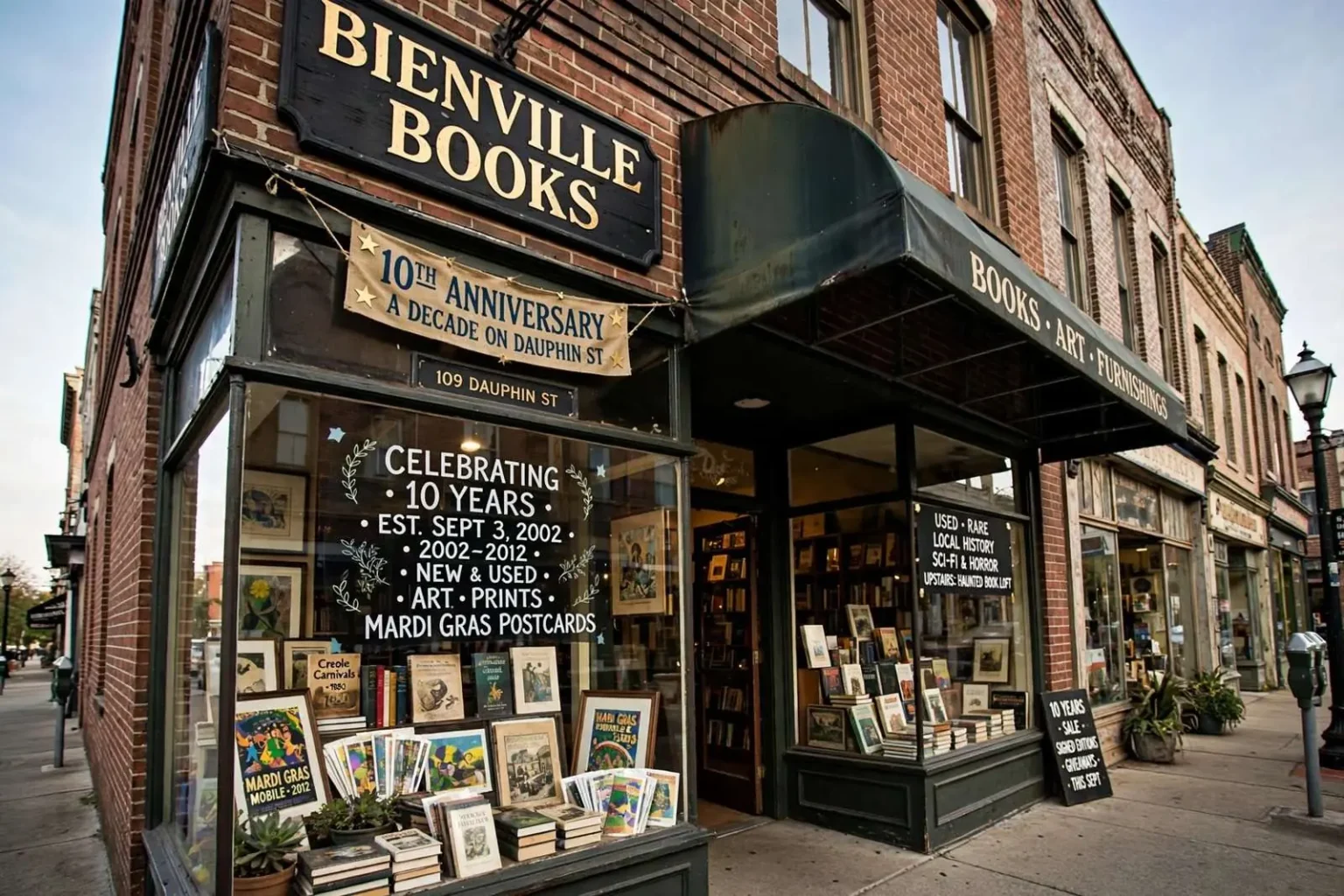
Bienville Books celebrated 10 years on Dauphin Street in downtown Mobile in 2012, a milestone for an independent shop that opened Sept. 3, 2002, when the surrounding blocks still held many vacant storefronts. Owner Russ Adams said he hoped a bookstore would help “seed” the area and draw more businesses downtown.
Ten years on, the store had done exactly what Adams hoped — and it had become one of the anchors of a downtown revival that few observers would have predicted on the day it opened. In the early 2000s, Dauphin Street’s commercial blocks were a patchwork of empty buildings, marginal bars and businesses hanging on from an earlier era. A bookstore was an act of faith: independent bookstores everywhere were struggling against chains and online sellers, and downtown Mobile was not yet a place shoppers went on purpose.
The shop at 109 Dauphin Street sells new and used books, art and furnishings, and its walls display prints, original paintings and posters for locals and out-of-town visitors alike. The mix is deliberate. A used-book inventory gives browsers a reason to dig through the shelves the way they would in a flea market, while new titles, art and furnishings give the store a retail energy that pure used shops lack — and give tourists something distinctly Mobile to carry home.
In a 2012 interview marking the anniversary, Adams reflected on a turbulent decade that included three hurricanes and the 2010 BP oil spill’s blow to area tourism. The Gulf Coast that the store grew up in was battered repeatedly during its first decade: major hurricanes struck the region in 2004 and 2005, scattering residents, shuttering businesses and bending the local economy for months at a time, and the oil spill that followed in 2010 sent another shock through a tourism economy still recovering from the storms.
Surviving storms and the spill
Adams said the store actually saw business rise during the oil spill as spill-related personnel filled downtown hotels and offices, then slid once they left in the fall. The pattern was one downtown merchants across the city noticed: the spill response brought an influx of cleanup crews, contractors, scientists and media, all of whom needed meals, coffee, entertainment and something to read during long deployments. When the response wound down, the spending left with it, and stores that had adjusted to the temporary boom felt the drop.
A later round of oil-spill relief funding helped keep the doors open. Compensation programs funded by BP reached businesses across the Gulf Coast, and for many downtown Mobile merchants the payments bridged the gap between the spill-era boom and a return to normal customer traffic. For a bookstore — a business built on thin margins in the best of times — that bridge was the difference between riding out the decade and closing it.
He has also leaned on the internet, selling through biblio.com and at one point moving a Warhol-inscribed book for $39,000. Online marketplaces for used and rare books let independent shops reach collectors worldwide, and Mobile’s deep history produces exactly the kind of material that collectors hunt: old Mardi Gras memorabilia, regional histories, and signed volumes connected to the city’s long literary and artistic traditions. A single rare sale can equal months of ordinary receipts, which is why dealers like Adams spend as much time evaluating estates and acquisitions as they do stocking current titles.
The store reprinted a scarce copy of T. C. deLeon’s 1890 booklet “Creole Carnivals,” scanning and restoring its pages, and wholesales Mardi Gras and local-scene postcards to other shops in town. The deLeon booklet is a prized piece of Mobile Carnival history — a contemporary account of the city’s celebrations from the 19th century — and bringing it back into print put a scarce piece of local heritage back in circulation for readers who would never have handled an 1890 original.
The Haunted Book Loft and the buildings
Upstairs, the Haunted Book Loft was renovated in 2008 to host the Southeast Independent Booksellers Association conference. Adams named it to honor the Haunted Book Shop, a beloved downtown store that closed in 1991, and to showcase one of the Southeast’s strongest collections of horror and science-fiction and fantasy titles. The naming was both a tribute and a claim of lineage — a way of saying that the new bookstore saw itself as part of a tradition of downtown Mobile bookselling rather than a break from it.
Genre sections like horror and science fiction have long been among the most collectible parts of the used-book trade, and a deep, well-organized selection draws dedicated collectors from across the region. Hosting the regional booksellers’ association conference put the loft in front of the people who run independent stores across the Southeast, and it gave Mobile’s small bookselling scene a moment on the industry’s map.
Adams’ father, N. Q. Adams, was a co-owner of the building when the bookstore began; today Adams owns the buildings at 105, 107, 109 and 111 Dauphin Street, which together house five businesses. He described the property as “a life support system for the bookstore.” The arrangement is a survival strategy as much as a real estate play: rents from other tenants cushion the bookstore through slow seasons, while the bookstore — a destination business that draws foot traffic — helps keep the surrounding storefronts rented. The two sides of the operation prop each other up.
Owning a row of buildings on a street that was half-vacant in 2002 also made Adams a stakeholder in the district’s recovery in a way that few merchants were. The condition of his neighbors’ properties affected his investment, and the steady reopening of storefronts along the block over the decade traced the same upward line as his own business.
On downtown and the road ahead
Asked how the area had changed since 2002, Adams pointed to the restoration of the Battle House and nearby RSA-built properties and a big jump in tourist traffic, with roughly half his business now coming from out-of-towners. The Battle House, the city’s historic downtown hotel, reopened after an elaborate restoration as the centerpiece of a broader redevelopment wave that also brought new residential and commercial space to the blocks around it. That wave changed the arithmetic for every downtown retailer: where Adams once depended on a small base of local regulars, he now serves visitors walking the district between hotels, restaurants and museums.
He said he would like to see more retail return downtown and a city system that prods owners of vacant properties to fix them up or sell. His observation reflected a common frustration among downtown advocates: while restaurants and bars multiplied quickly, retail — the shops that give a district daytime traffic and everyday utility — lagged behind, and vacant upper floors and storefronts remained scattered through the district, owned by parties with no urgency to act.
For aspiring business owners, his advice was to do the research and keep enough reserves for slow periods, and to remember that the used-book trade tends to be more profitable than new. New books carry thin wholesale margins and competing online prices; used books arrive cheaply, sell at healthy markups and cannot be undercut by a website discounting a brand-new title. It is a lesson independent bookshops across the country have absorbed, and it shaped the inventory mix that made Bienville Books work.
He said he is not alarmed by e-readers, noting most of his stock is unavailable electronically, and that anything getting people to read is a good thing. For a shop built on out-of-print titles, regional history and collectible editions, the e-book threat barely reaches the shelves — there is no electronic version of a 19th-century Mobile booklet or a signed first edition.
Looking ahead, the shop was weighing a sale tied to its 10th-anniversary celebration and planned to bring back signed books and advance reading copies from a regional book fair to give away in early September. A decade after opening on a street of vacant storefronts, the store planned its second decade the way it survived its first — as part bookstore, part landmark, and part believer in downtown Mobile.
The anniversary celebration itself reflected the store’s character. Rather than a simple discount weekend, Adams and his staff built the observance around books themselves — signed editions brought back from a regional book fair, advance reading copies that collectors and curious readers alike prize, and giveaways scheduled through early September to keep visitors returning through the month. Anniversaries in the bookselling trade double as marketing: each customer drawn in for a freebie walks past shelves of inventory, and the regulars who come to celebrate often leave with a stack of finds.
Independent bookstores like Bienville Books occupy a role in their communities that the sales figures never quite capture. They host the quiet encounters that big-box retail cannot stage: the parent hunting a favorite childhood title, the college student discovering a used copy annotated by a stranger, the researcher who finds exactly the out-of-print local history the library never owned. In a downtown, a bookstore adds something harder to quantify — a reason to linger, a storefront that signals the district is worth walking.
Adams’ decade also tracks the broader story of Mobile’s center city. When the store opened in 2002, investing in Dauphin Street required optimism bordering on stubbornness; by 2012, the blocks around it held a restored flagship hotel, new apartments and offices, a livelier nightlife strip and a tourist trade that half his receipts depended on. The bookstore did not cause all of that, but it was part of the chain of small commitments — shop by shop, building by building — that made the district believable again.
The anniversary year found the store in familiar form: new titles at the front, used shelves deep in the back, art on the walls, the Haunted Book Loft overhead, and the owner still evangelizing for the street that adopted him. Whatever a sale or second decade brings, the milestone marked in 2012 was clear — the seed Adams said he hoped to plant on Dauphin Street had taken root.