Bienville Square Renovation Project Gets Underway in Downtown Mobile
Mobile has closed Bienville Square for a $3.2 million renovation covering lighting, walkways, landscaping and the Ketchum Fountain, set to finish in early.
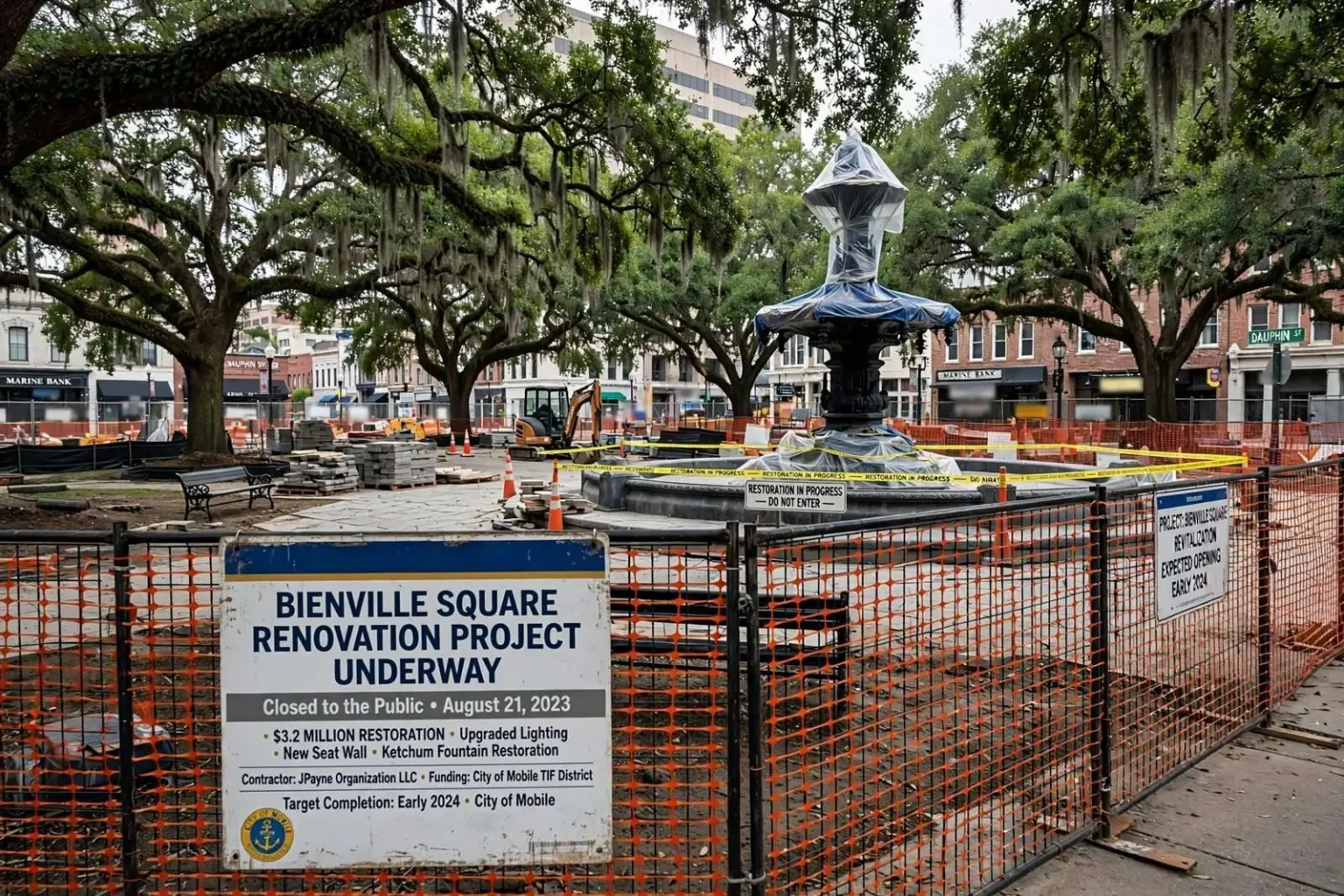
MOBILE, Ala. — Downtown Mobile’s Bienville Square has closed to the public as the city launches a $3.2 million renovation of one of its oldest and most recognizable parks, a project that will touch nearly every part of the historic green space before it reopens.
Contractors began erecting perimeter fencing on Monday, Aug. 21, a process expected to take about three days, and the square will remain off-limits for the duration of construction. The fencing marks the formal start of work that city officials have described as the most comprehensive overhaul the park has received in decades.
According to city officials, the work will touch nearly every part of the park’s interior. Plans call for upgraded lighting, rebuilt walkways, bluestone pavers, refreshed landscaping, and a new seat wall. The restoration of the historic Ketchum Fountain at the park’s center is among the most anticipated elements of the project, returning the Victorian-era centerpiece to prominence at the heart of the square.
A park at the center of downtown
Bienville Square occupies a full block along Dauphin Street in the heart of Mobile’s central business district, a tree-shaded green that has anchored the city’s downtown since the 19th century. Named for Jean-Baptiste Le Moyne, Sieur de Bienville, the French colonial founder of Mobile, the square has served generations as a lunch spot for downtown workers, a staging ground for civic gatherings, and a landmark that orients visitors to the historic core.
Its location places it along the corridor that carries Mardi Gras parades and downtown foot traffic, close to the office towers, restaurants, and churches that define the historic district. Through decades of change around it — the rise of suburban retail, the return of downtown residential living, and the steady growth of the medical and technology sectors — the square has remained the symbolic front yard of the city center.
City officials and downtown advocates have long argued that the condition of Bienville Square matters well beyond its boundaries. Parks of this kind set the tone for investment around them, and a renovated square with active programming is expected to reinforce the momentum that downtown Mobile has built with residential conversions and new businesses in recent years.
What the renovation includes
The $3.2 million scope reads like a checklist of what makes an urban park function. Upgraded lighting will extend safe, usable hours into the evening and support the events that fill the square throughout the year. Rebuilt walkways and bluestone pavers will repair decades of wear and give the park a cohesive, period-appropriate surface that handles both daily foot traffic and special-event crowds.
Refreshed landscaping will replace aging plant material and restore the canopy and beds that give the square its character, while the new seat wall adds flexible, durable seating along the park’s edges. Together, the elements aim at the same goal: making the square comfortable and inviting from morning coffee hours through evening events.
The Ketchum Fountain restoration stands apart as the project’s signature piece. The cast-iron fountain, a Victorian-era gift that has watched over the square for well over a century, has long been one of downtown Mobile’s most photographed landmarks. Its careful rehabilitation will preserve a tangible link to the city’s 19th-century history while returning working fountains and their soothing presence to the park’s center.
Funded through the TIF district
The project is being paid for through Mobile’s Tax Increment Financing District, with the JPayne Organization LLC serving as the contractor leading the work for the city. TIF financing captures the growth in property tax revenue within a defined district and reinvests it in improvements inside that same district, a mechanism that has funded streetscapes, infrastructure, and public-space projects across downtown Mobile.
The logic is straightforward: improvements that make the district more attractive raise property values, and the incremental tax revenue created by that growth pays for the improvements themselves. Downtown advocates have pointed to Bienville Square as exactly the kind of project TIF districts were designed for — a public amenity whose restoration benefits every property around it and strengthens the tax base that funds the work.
Completion is targeted for early 2024, giving the project roughly a year and a half from the August start of fencing to the planned reopening. Construction timelines for park renovations of this scale depend on weather, material lead times — bluestone and custom fountain components among them — and the sequencing required to demolish, rebuild, and replant a working public space.
The mayor’s case for the project
Mayor Sandy Stimpson called Bienville Square “one of the primary gathering spaces” in Mobile’s historic downtown, saying residents and downtown stakeholders will be pleased with the results once the project wraps up.
The remark captures the administration’s broader approach to public spaces during its tenure, which has included park improvements and quality-of-life investments pitched as foundations for downtown’s resurgence. Stimpson’s administration has consistently framed parks as economic development — assets that draw residents, workers, and visitors into the city center and justify private investment nearby.
For the stakeholders who use the square daily — office workers on lunch breaks, residents of downtown’s growing residential stock, parishioners at nearby churches, and the crowds that gather for events — the promise is a park that matches the energy of the neighborhood that has grown up around it.
History beneath the live oaks
Bienville Square’s story runs deep in Mobile’s civic history. The city acquired the land in the 19th century, and the square evolved from open common into a formal park as downtown Mobile matured around it. The Ketchum Fountain arrived as a gift in the 1890s, donated in memory of a prominent local physician, and the square became a regular site for public addresses, celebrations, and gatherings of every description.
Over the 20th century the square hosted political rallies, Christmas celebrations, and the everyday rhythms of a working downtown — a place where generations of Mobilians took lunch on benches beneath the oaks. Renovation efforts over the decades have repeatedly returned to the same themes the current project addresses: aging infrastructure, worn paths, and the need to keep a historic space functional for modern use.
The current renovation is the most ambitious answer yet to those challenges, and the city has emphasized that the design respects the square’s historic character even as it upgrades nearly every physical element inside the fence line.
What the closure means downtown
The loss of the square during construction will be felt most directly by the daily users who make it part of their routine, and by the event organizers who have traditionally staged programming on its lawns. Downtown stakeholders have urged patience with the fencing and construction activity, noting that the temporary disruption is the price of a park that will serve the city for the next generation.
Nearby businesses will watch the project with interest as well. Foot traffic patterns shift when a central park closes, and downtown merchants have an obvious stake in how quickly and cleanly the work proceeds. The city’s targeting of an early-2024 completion sets clear expectations for everyone planning around the square.
Construction in a historic district brings its own considerations, from protecting the mature oaks that define the square to coordinating with the surrounding streets during staging. The three-day fencing operation that began the project was the first visible step of a long logistical effort that will unfold behind the barriers for months.
Bienville Square in the city’s calendar
The square has long functioned as one of downtown Mobile’s principal venues for public life. Civic celebrations, memorial observances, rallies, and festivals have all claimed its grounds, and its position along the parade corridor puts it at the center of the city’s signature cultural season. The renovated version — with better lighting, more seating, and improved surfaces — is designed to host that calendar more comfortably and more often.
Parks professionals note that renovated urban squares tend to see a compounding return: better spaces attract more programming, more programming draws more people, and more people build the public support that keeps the space maintained. That cycle is the bet the city is making with its $3.2 million, and the early returns will be measured in how quickly the reopened square returns to daily use.
What comes next
With fencing in place and contractors mobilized, work on the interior proceeds toward the early 2024 target. Residents can expect periodic updates from the city as milestones pass — demolition and site preparation first, followed by the walkway and paver work, landscaping, lighting installation, and the fountain restoration that anchors the project.
When the barriers come down, Mobile will get back its historic square with a new foundation beneath its old bones: rebuilt paths under century-old trees, a restored Victorian fountain at the center, and a park equipped for the gatherings that have always defined it. City officials are betting that the first visit back will confirm the mayor’s promise — that residents and downtown stakeholders will be pleased with the results.
Until then, downtown Mobile will carry on around a fenced, quiet square, with the live oaks rising above the construction barriers and the promise of a renewed landmark waiting on the other side.