Birmingham’s Will Stewart Brings Alt-Country Debut “County Seat” to Callaghan’s
Birmingham singer-songwriter Will Stewart plays Callaghan's Irish Social Club in Mobile Aug. 25, touring his alt-country debut "County Seat."
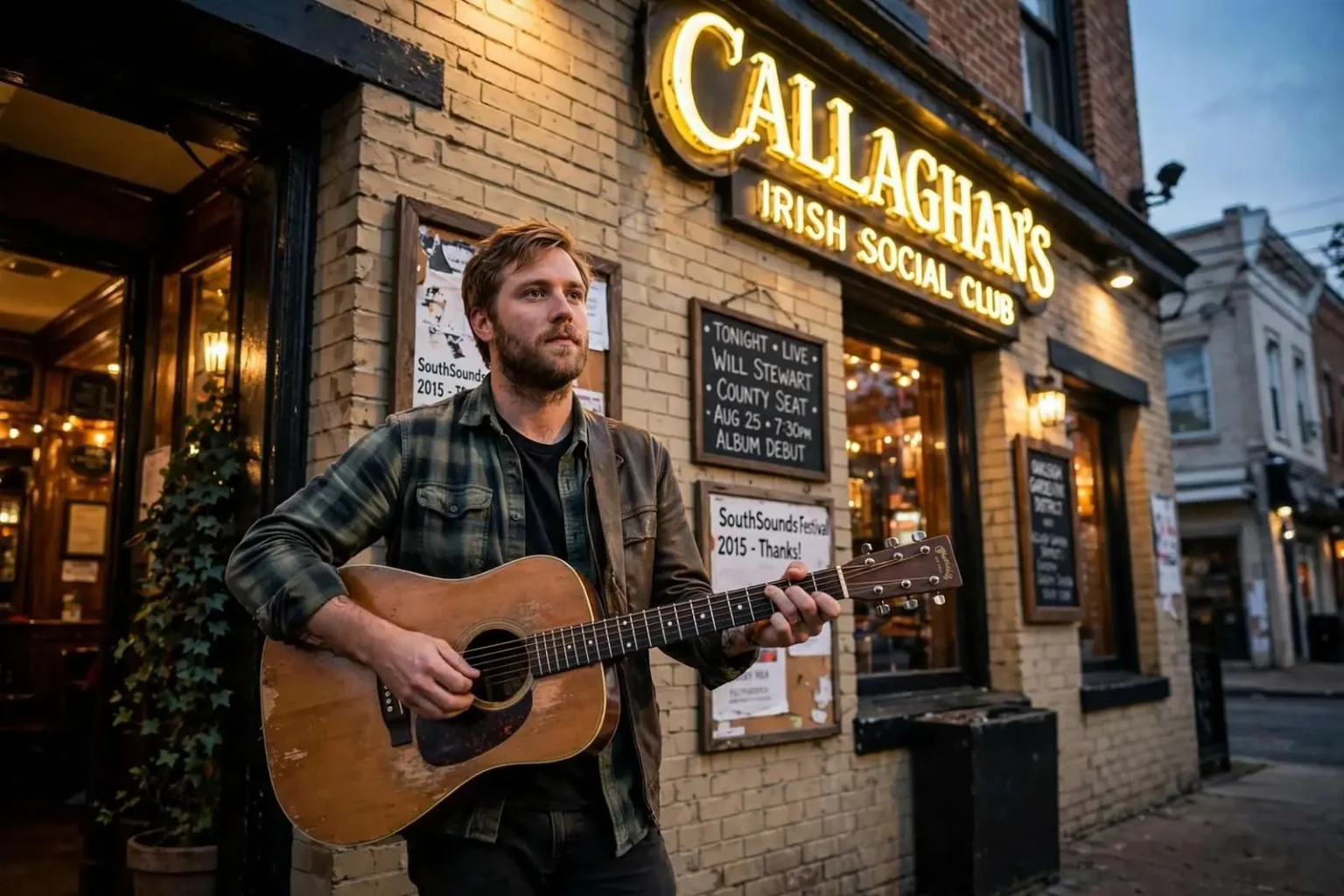
Birmingham singer-songwriter Will Stewart is set to bring his solo debut album, “County Seat,” to Callaghan’s Irish Social Club in Mobile on Saturday, Aug. 25, at 7:30 p.m. The date gives Mobile audiences their first chance to hear the record’s songs performed by the man who wrote them, in one of the city’s most intimate rooms.
Stewart isn’t new to Mobile audiences. Before launching his solo career, he played in several bands, including Willie & the Giant, which performed at the 2015 SouthSounds Music Festival. That festival, staged across downtown Mobile venues each year, has made a habit of booking rising acts from around the Southeast, and Stewart’s return as a solo artist traces a route many Alabama musicians have followed: build a name in bands, then step out alone.
But “County Seat” marks his first solo showing in the city, and it arrives as one of alt-country’s more talked-about recent debuts. The album has drawn attention for the way it balances two Southern musical identities that rarely share a record — the jangly, guitar-forward textures of early Southern rock and the smoother craftsmanship of contemporary Nashville country.
Alt-country, the genre tag most often attached to the record, has always been a loose banner — a corner of the music world where country instrumentation and songwriting meet the independence of rock and the storytelling weight of folk. Recent years have seen the category’s artists move from niche venues to festival main stages, and the audience for sincere, regionally rooted songwriting has never been larger. A debut arriving into that moment, from an Alabama writer with a specific place to write about, faces favorable odds.
The album blends early Southern rock textures reminiscent of Athens, Georgia, with the more polished country sound associated with Nashville — a combination shaped by Stewart’s own path from Birmingham to Music City and back again. The reference point matters: Athens built its reputation on bands that made rootsy music with an indie sensibility, and hearing that influence under Nashville songwriting discipline gives “County Seat” a sound that sits comfortably in neither camp.
Four years of apprenticeship in Nashville
Stewart moved to Nashville without a clear sense of what to expect, he said, but the city’s dense music community won him over quickly, even though he arrived largely unknown. Nashville can be an unforgiving market for newcomers — songwriters outnumber stages, and the industry’s gatekeeping is legendary — but the sheer concentration of musical talent makes it an education available nowhere else.
“Everyone you would meet was connected to the industry or was a musician in some way,” Stewart said. “I immediately felt like part of a community, even though nobody knew who the hell I was at the time.” That paradox — instant belonging, zero recognition — is one many transplants to Music City describe: the city embraces musicians as a tribe long before it embraces any individual’s work.
He spent four years in Nashville, surrounded by veteran songwriters he described as intimidating at times, but ultimately formative. The apprenticeship model of Nashville songwriting — learning by proximity to writers who have spent decades cutting lyrics to the bone — leaves a mark on the way a young writer constructs verses, and Stewart credits the experience with changing how he works.
By his own account, the experience built his confidence and sharpened his songwriting before he decided to return home to Birmingham, drawn in part by a lower cost of living and a scene he called more manageable than Nashville or Los Angeles. Birmingham’s music community has grown steadily more self-sustaining in recent years, offering working musicians venues, collaborators and audiences without the professional pressure cooker of the bigger markets.
After releasing two EPs, Stewart began writing the material that became “County Seat,” which he has described as a “love letter to the South.” The EPs served as his proving ground as a bandleader and songwriter, but the album is where his ambitions as a writer first got a full-length canvas.
Much of the album draws on what he calls a “weird dichotomy” he noticed growing up in Montgomery — affluent neighborhoods sitting alongside impoverished ones, coexisting uneasily alongside racial and economic tension. Montgomery’s history gives that observation particular weight: the city where the Confederacy took shape and where the civil rights movement found some of its defining moments remains a place where prosperity and hardship live within sight of each other.
Stewart said he hopes the songs contribute to a broader conversation about that divide, in the tradition of artists like Sturgill Simpson and Jason Isbell — writers who have made the contradictions of the modern South their central subject rather than a backdrop. Isbell, an Alabama native, built a career on unflinching songs about his home region, and Stewart’s ambition places him squarely in that lineage.
Writing about home from a distance — first in Nashville, then from Birmingham — gave Stewart the perspective “County Seat” runs on. The album’s title points straight at the subject: the county seat is where small-town Alabama concentrates its courthouses, diners, churches and divisions, the geography where the dichotomy he describes is hardest to avoid.
The right room for a debut
Callaghan’s Irish Social Club has built a national reputation disproportionate to its size. The neighborhood bar in Mobile’s Oakleigh Garden District has become a favored stop for touring singer-songwriters precisely because the room demands listening: the stage is close to the audience, the crowd comes for the music, and the intimacy rewards songs built on lyrics rather than spectacle.
For a debut album tour, that kind of room is ideal. A record like “County Seat” — built on storytelling and regional observation rather than radio-ready hooks — benefits from a crowd that will sit with the quieter numbers, and Callaghan’s audiences have a long record of embracing exactly that kind of writer. The venue’s booking history reads like a map of the Americana and alt-country circuit’s rising acts.
The Aug. 25 show also lands at a moment when Alabama’s own musical profile is rising nationally. The state has produced an outsized share of the songwriters defining modern Southern music — from Muscle Shoals’ legendary studios to the current generation of Auburn-area and North Alabama writers topping Americana charts — and Birmingham sits at the center of that ecosystem as both a home base and a stopping point for touring acts.
Stewart’s career arc offers a small case study in how that ecosystem works now. A musician can grow up in Montgomery, cut his teeth in Birmingham bands, spend formative years absorbing the Nashville scene, return home to write, and tour a network of small Southeastern rooms — the Azalea City included — that sustain a career without ever requiring a move to Los Angeles. The old model required relocation to an industry capital; the new one treats the whole region as the capital.
SouthSounds, where Willie & the Giant played in 2015, is part of that same infrastructure. The festival’s focus on emerging acts has made it an early marker for regional artists on the way up, and its multi-venue format across downtown Mobile gives bands exposure to new audiences in a single weekend. Returning to Mobile as a solo headliner closes a loop that began on those stages.
What to expect from the record live
Listeners who come to the show can expect the album’s central themes — affection and unease about the South in equal measure — delivered with the twin guitars and steady backbeat the record’s Athens-meets-Nashville sound suggests. Live, debut albums tend to be presented front to back by artists on their first tours, with the songs still close enough to their writing to carry the original charge.
The record’s Birmingham roots show in other ways too. The city’s scene has long mixed garage rock, soul and country without forcing artists to choose, and that hybridity — a guitarist comfortable in both a honky-tonk and an indie rock band — is audible throughout “County Seat.” The album sounds like a musician who grew up where the Southeast’s musical highways intersect rather than one who picked a single lane.
For Mobile audiences, the night is also a preview. Songwriters who debut at rooms like Callaghan’s frequently return on bigger circuits as their profiles grow, and Saturday’s show is the chance to hear “County Seat” the way albums are best heard first: in a small room, from the writer, before the songs belong to everyone else.
Showtime is 7:30 p.m. Saturday, Aug. 25, at Callaghan’s Irish Social Club in Mobile — an early start, an intimate room, and a Birmingham songwriter making his first solo statement in a city that has already been listening to him for years.