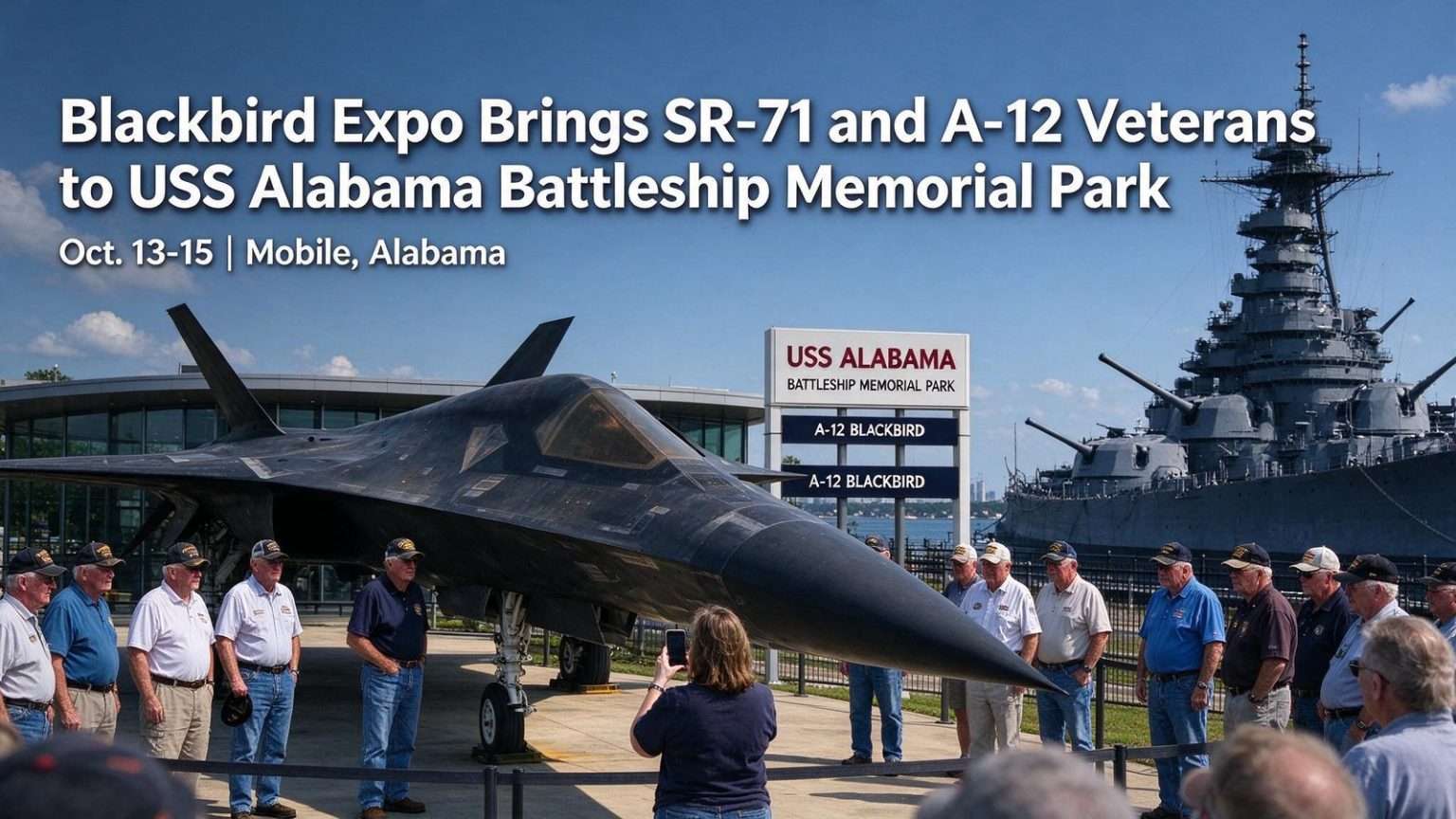
Aviation fans get a rare close-up look at one of the Cold War’s most legendary aircraft programs this month, as the Blackbird Expo lands Oct. 13-15 at USS ALABAMA Battleship Memorial Park in Mobile. The three-day expo covers both the A-12 and the SR-71 Blackbird, and former pilots, mechanics and reconnaissance systems officers who flew and maintained the jets will be on hand to meet visitors.
The gathering brings together, in one weekend, the aircraft, the veterans and the stories of a program that was classified for years after the planes retired. For the Mobile area, it also represents a homecoming of sorts: the park’s own A-12, displayed on the grounds, is one of the surviving examples of the family of aircraft the expo celebrates.
USS ALABAMA Battleship Memorial Park, on Mobile Bay just south of downtown, draws visitors year-round to the battleship, the submarine USS Drum and an aircraft pavilion filled with warbirds. The Blackbird Expo adds a weekend of programming aimed squarely at aviation enthusiasts, families and anyone curious about the heights Cold War engineering reached.
Attendees can sit in on a 360-degree cockpit presentation, view actual cockpits up close, and join discussion panels and breakout sessions with Blackbird Association members from across the country. The veterans in attendance — the pilots who flew the machines and the crews who kept them flying — are the expo’s central attraction, and their numbers grow smaller every year.
The planes that outran missiles
The A-12 began as a top-secret CIA spy plane developed during the Cold War, designed when U-2 shootdowns had taught American planners that altitude alone could no longer guarantee a spyplane’s safety. The answer Lockheed’s legendary Skunk Works built was radical: an aircraft of titanium, driven by enormous engines, that would simply fly above and beyond anything launched against it.
Cruising near 90,000 feet, its cameras could pick out objects as small as a foot across from the edge of space. From that height, crew members described the sky as deep indigo and the curvature of the earth as plainly visible, while the aircraft below swept across territory whose defenders could only watch the contrail streak past.
The Blackbirds got their name from the black paint that helped shed heat at speeds above Mach 3, and they were built to cross enemy territory unscathed simply by flying higher and faster than anything sent against them. At cruising speed the airframe’s skin ran hundreds of degrees hot — hot enough that the planes stretched measurably in flight and required special fuel, special fluids and ground crews trained for problems no other air force had.
No Blackbird was ever lost to enemy action. The aircraft’s standard response to a missile launch was to accelerate — and nothing launched at them could catch the planes once they reached cruising speed, a fact that turned every engagement into a testament to the design.
The A-12 and the SR-71 share a family resemblance but served different masters. The A-12 flew for the CIA in the early 1960s, a single-seat reconnaissance machine tested at the secret Groom Lake facility in Nevada. The SR-71 followed as a two-seat version operated by the Air Force, flying strategic reconnaissance missions for decades and setting speed and altitude records that still stand.
Together, the aircraft collected intelligence that shaped American policy through the tensest decades of the Cold War, photographing military installations, verifying arms agreements and filling gaps that satellites of the era could not. The program’s secrecy meant the public knew little of the planes’ work until long after the missions were flown, adding a layer of mythology that persists today.
The crews who will gather in Mobile belong to the Blackbird Association, the veterans’ organization of pilots, backseaters, mechanics and support personnel. Their stories — of refueling rendezvous at the edge of the envelope, of navigation at speeds no human had sustained, of landing a titanium aircraft whose panels had shrunk in the cool air — form the living history the expo preserves.
Reconnaissance systems officers and camera technicians bring their own perspective, explaining how the aircraft’s instruments turned nine miles of altitude into photographs sharp enough to read a license plate. That blend of technical depth and personal narrative is what draws Blackbird enthusiasts to events like this from across the country.
What visitors will find at the park
The expo’s 360-degree cockpit presentation gives visitors a sense of the strange flying suit enclosure the pilots wore — essentially a pressurized space suit, required because the cabin at 90,000 feet was closer to a spacecraft’s environment than an airliner’s. Actual cockpits on display let guests sit where pilots sat and study the array of gauges that kept the fastest airplanes ever built within human control.
Discussion panels will range across the program’s history, from design and testing to operational missions and the aircraft’s eventual retirement as satellites took over the reconnaissance role. Breakout sessions give smaller groups time with individual veterans, where questions go deep and the answers are unscripted.
“Meeting these iconic heroes is a rare opportunity,” park officials said in announcing the event. The observation reflects the expo’s underlying urgency: each Blackbird gathering brings veterans whose ranks are thinning, and the park’s role is to connect the public with that history while the men who made it can still tell it themselves.
Admission to the expo is included with general park admission, and all event proceeds go toward restoring the A-12 displayed at the park. The restoration project gives every ticket a direct purpose, and officials have framed the weekend as both a celebration and an investment in one of the park’s most significant artifacts.
The A-12 on display at Battleship Memorial Park arrived in Mobile as a survivor of the program’s demanding career. Only a small number of the aircraft were built, several were lost in testing and operational accidents, and the handful that remain are distributed among museums around the country. Mobile’s example gives the Gulf Coast a genuine artifact of one of aviation history’s most audacious programs.
Restoration work on such an aircraft is specialized labor. The Blackbird family’s titanium skin and exotic systems do not respond to ordinary museum maintenance practices, and preserving the airframe against the Gulf Coast’s humidity and salt air is a continuing effort. The funds raised during the expo will support that work directly.
The park itself is one of Alabama’s most visited attractions, drawing school groups, veterans and tourists to the battleship that gives it its name. USS Alabama earned nine battle stars in World War II, and the park’s collection has grown over the decades into a sprawling memorial campus that the Blackbird A-12 now anchors on the aviation side.
Hosting the Blackbird Expo fits the park’s mission of honoring service and preserving the machines in which it was rendered. The A-12’s story is also a story of the people behind it — the designers, the test pilots who flew an aircraft that sometimes outran its own knowledge base, the crews who turned maintenance of an impossible machine into routine — and the expo gives those people the floor.
A three-day program for enthusiasts and families
The Oct. 13-15 schedule spreads programming across three days, giving visitors flexibility and giving the veterans time for the extended conversations that make these gatherings memorable. Weekend attendees can plan around panel times and breakout sessions, while weekday visitors catch the presentation circuits on quieter grounds.
Families make up a significant share of the expo’s expected audience, and the material plays to all ages. Children can see a real spy plane and hear from the men who flew it; adults old enough to remember the Blackbird’s heyday get answers to questions the classified program never allowed them to ask at the time.
The timing places the expo in Mobile’s pleasant autumn season, when the park’s bayfront setting is at its best. Visitors can move between the expo programming, the battleship’s decks and the submarine’s compartments in a single visit, making the event a full-day destination for out-of-town enthusiasts.
For Alabama’s aviation community — flight students, modelers, air show fans and retired Air Force personnel across the state — the expo is a rare regional gathering of Blackbird expertise without a cross-country trip. Organizers expect that audience to travel from across the Gulf Coast and beyond.
Three days of cockpits, panels and veterans’ stories at Battleship Memorial Park will close the loop on a program that was born in secrecy: the aircraft that once crossed enemy lines unseen now stands in the open on Mobile Bay, with the men who flew it signing autographs beside it and every dollar of the weekend going to keep it standing.