Blues Singer John Ford Brings Old-Time Sound to The Peoples Room of Mobile
Blues and country musician John Ford performs an intimate, old-time show at The Peoples Room of Mobile on Friday, blending pre-war blues and Southern gospel influences with original songs.
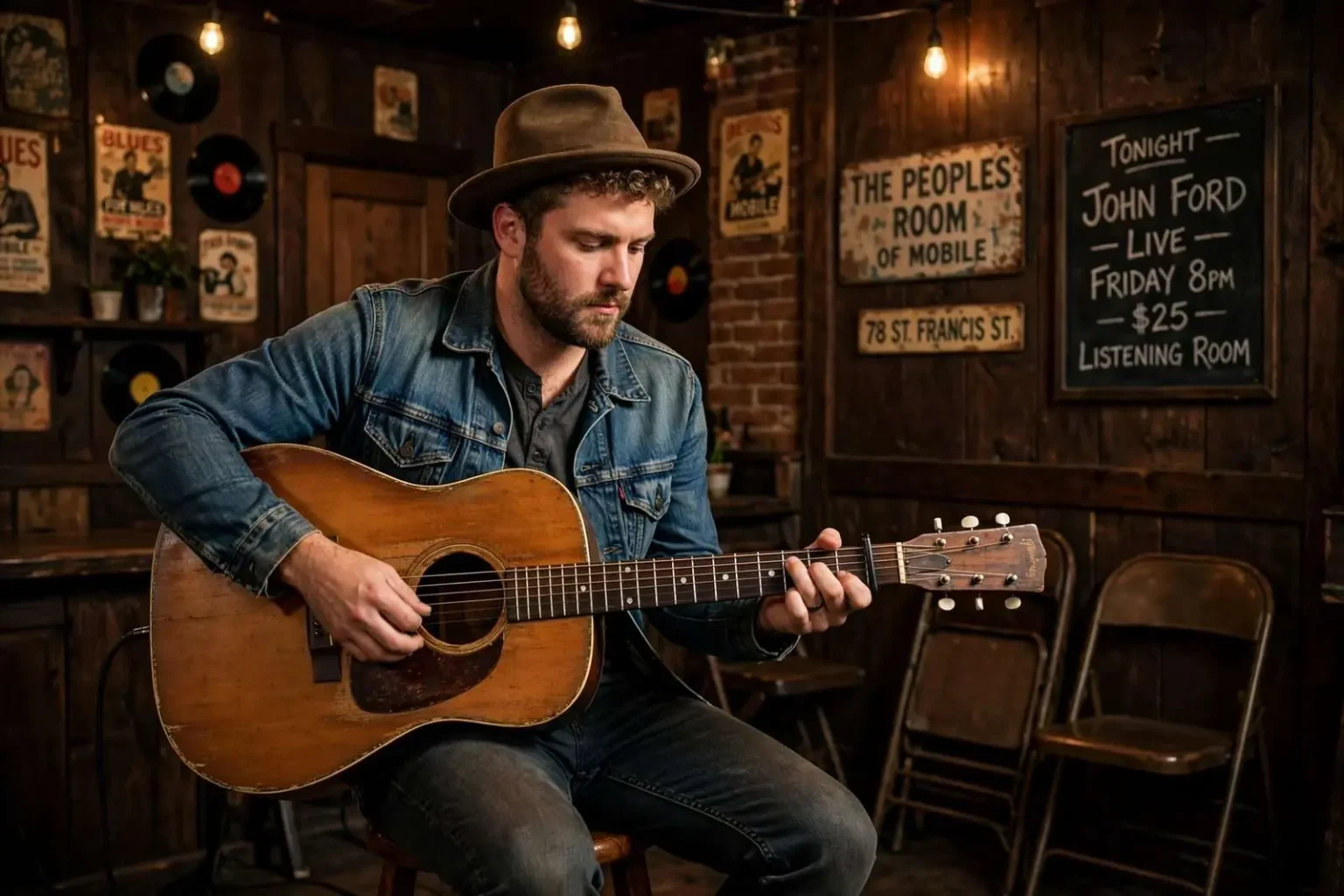
The Peoples Room of Mobile will take on the feel of an old-time juke joint this weekend when blues and country musician John Ford takes the stage for an intimate live performance. Ford is scheduled to play at the downtown Mobile venue, located at 78 St. Francis St., on Friday at 8 p.m. Tickets are $25 and are available through the venue’s website. For a room built around close listening, an artist whose entire repertoire is an argument for paying attention is a natural fit for the booking calendar.
Ford’s musical style draws heavily on the sounds of early-to-mid-20th century American roots music. He developed an interest in antiquarian blues and country as a teenager, a fascination that grew into a career built around performing and writing original songs in that same tradition. The path is an unusual one for a young player, whose peers more often arrive at older styles later in life, and it has made Ford’s relationship to the material that of a scholar-performer rather than a revivalist passing through.
He has described his artistic focus as centering on pre-war blues, old-school country and Southern gospel, along with an interest in the history behind the music itself. Those three streams converge in the acoustic traditions that shaped American popular music before the age of amplification, when regional styles developed in relative isolation and carried the accents of the communities that produced them. Ford’s devotion to the history as well as the sound separates his work from acts that borrow the surface of the style without its substance.
A juke joint on St. Francis Street
That deep knowledge of musical history is expected to shape Friday’s show, giving audience members both a performance and something of a living lesson in the roots of American blues and country traditions. Fans of the genre can expect a set that blends education with entertainment, delivered in the kind of small, close-quarters setting The Peoples Room of Mobile is known for. Between songs, Ford tends to place the music in its context, and the room’s size makes that storytelling part of the show rather than a interruption of it.
The juke joint comparison in the venue’s promotion reaches back to the informal roadhouses of the rural South, where traveling musicians played for tips, workers unwound at week’s end and the blues took practical shape as dance music. Recreating that feel in a downtown Mobile room is a matter of staging as much as repertoire: chairs close to the stage, lights low, and a performer working unamplified or nearly so, the way the music was originally heard.
The Peoples Room of Mobile has built its reputation as a listening room in a market where many stages function as background music for a crowded bar. The difference shapes both booking and audience behavior: the room tends toward songwriters, acoustic acts and players whose material rewards attention, and patrons who talk through the quiet numbers draw the kind of glances a listening room enforces. A Friday audience there arrives to hear the songs, not to converse over them.
Music with its history attached
Pre-war blues, the style at the center of Ford’s repertoire, refers to the recordings and performance traditions that predate the Second World War, when country blues traveled by word of mouth and the commercial record industry captured regional styles only fitfully. The music was built for solo performance, one voice and one guitar carrying rhythm and melody at once, and it remains one of the most demanding formats a player can attempt because nothing hides behind a band.
Old-school country, the second strand in Ford’s approach, draws on the same era’s rural songbook, when hillbilly records, radio broadcasts and traveling shows cross-pollinated with the blues that shared the same rural geography. The two genres were never as separate as their marketing became; the musicians of the era borrowed freely from one another, and a performer who studies both hears them as the single tradition they were.
Southern gospel completes the triangle. The church supplied the harmonies, the emotional intensity and a substantial share of the songs that blues and country performers reworked for secular stages, and its influence runs through American roots music like a watermark. A performer who can move credibly among all three traditions has done the kind of listening that cannot be faked, and audiences who know the material recognize it immediately.
A record from the road
Alongside the historical material, Ford will perform songs from his own catalog of original music. His latest release, “John Ford: Live at Morehead State University,” offers a preview of what audiences might hear during the Mobile show. A live album recorded in a university setting captures the storytelling side of his work as much as the songs, preserving the between-song context that has become part of what he offers an audience.
Among the tracks is “Ma Sibbi’s Chicken & Dumplings,” a song Ford wrote as a tribute to his grandmother. The track leans on sparse instrumentation, letting Ford’s voice and lyrics carry the emotional weight of the piece. Songs written for family members occupy a distinct place in roots music, where the personal and the traditional have always been intertwined, and audiences respond to the specificity of a song that could only have been written by someone who knew its subject.
Ford’s sound has been described as marked by an amiable, unhurried style of guitar playing paired with a voice that carries the texture of lived experience. The description fits the material: pre-war blues rewards patience, and the fingerstyle approach it demands leaves no room for rushing the tempo. A player who has absorbed the tradition knows where the beat truly lives, and audiences familiar with the old recordings will hear the difference in the first number.
For listeners drawn to acoustic blues, country and gospel traditions, the show offers a chance to hear those influences performed live in an intimate downtown setting. Those interested in attending Friday’s performance can find ticket information through The Peoples Room of Mobile’s website. In a market whose nightlife is dominated by amplified bands and cover sets, a Friday evening spent with a solo performer who knows the music’s history as well as its chords offers something the district rarely provides, and the room is sized for the people who want it.
St. Francis Street has become one of the quieter anchors of downtown Mobile’s entertainment corridor, a block removed from the loudest stretches of Dauphin Street and home to venues that trade on intimacy rather than volume. The address puts the club within walking distance of the district’s restaurants and hotels, close enough to fold a show into a full evening downtown but far enough from the busiest blocks that the street itself stays conversational before and after a performance.
Listening rooms occupy a specific niche in the music economy of Gulf Coast cities. Bars can pay bands out of bar sales and book whatever fills the room, but a listening room sells the music itself, through ticket prices, memberships and a clientele that plans its nights around what is being played. That model only works when the audience trusts the booking, which is why rooms like The Peoples Room cultivate a reputation for acts that deliver exactly what is promised.
The economics of a $25 ticket also say something about the show being offered. Cover charges at nightlife venues pay for the room; a ticketed show pays the artist, and a price in that range signals a seated, featured performance rather than a band working for the door split. For fans, it buys a night where the performer’s livelihood depends on the quality of the set, an incentive structure that tends to produce memorable evenings.
Antiquarian music, the term that describes Ford’s specialty, has sustained a devoted following across the country through record collectors, festivals and small rooms willing to book the style. The audiences skew toward people who care about where songs come from, and the best practitioners function as living archives, keeping performance styles alive that the recording industry largely abandoned decades ago. Every generation produces a handful of players who take that work seriously, and the small-venue circuit is how they find their listeners.
The storytelling element Ford brings between songs also connects his work to how the music was originally transmitted. Before recordings standardized performances, songs traveled with the stories of the people who sang them, and knowing who wrote a piece, where it circulated and what it meant to its first audiences was part of knowing the song. Audiences at his shows hear not only the music but the reason it was made, a combination that turns a concert into something closer to a conversation.
Friday’s date also gives Mobile audiences a mid-summer option outside the district’s louder weekend rhythm. A solo acoustic show at eight o’clock ends early enough to suit listeners who plan their evenings around the music itself, and the format suits the room’s strengths. Regulars at listening rooms know that the shows they remember most are often the quiet ones, where a performer and a few dozen listeners share a room and the performance adjusts to it.
For anyone newly curious about pre-war blues and its cousins, a show like this one doubles as a guided introduction. The performer selects the material, supplies the background and demonstrates the styles in sequence, an experience no playlist can replicate. Mobile audiences have responded to that kind of programming in the past, and Friday’s booking gives the city another chance to support a touring tradition that depends entirely on rooms willing to host it.