Bluesman ‘Ghost Man’ Ric McNaughton Brings Juke Joint Sounds to The Peoples Room
Gulf Coast bluesman 'Ghost Man' Ric McNaughton transforms The Peoples Room of Mobile into a juke joint for an evening of blues.
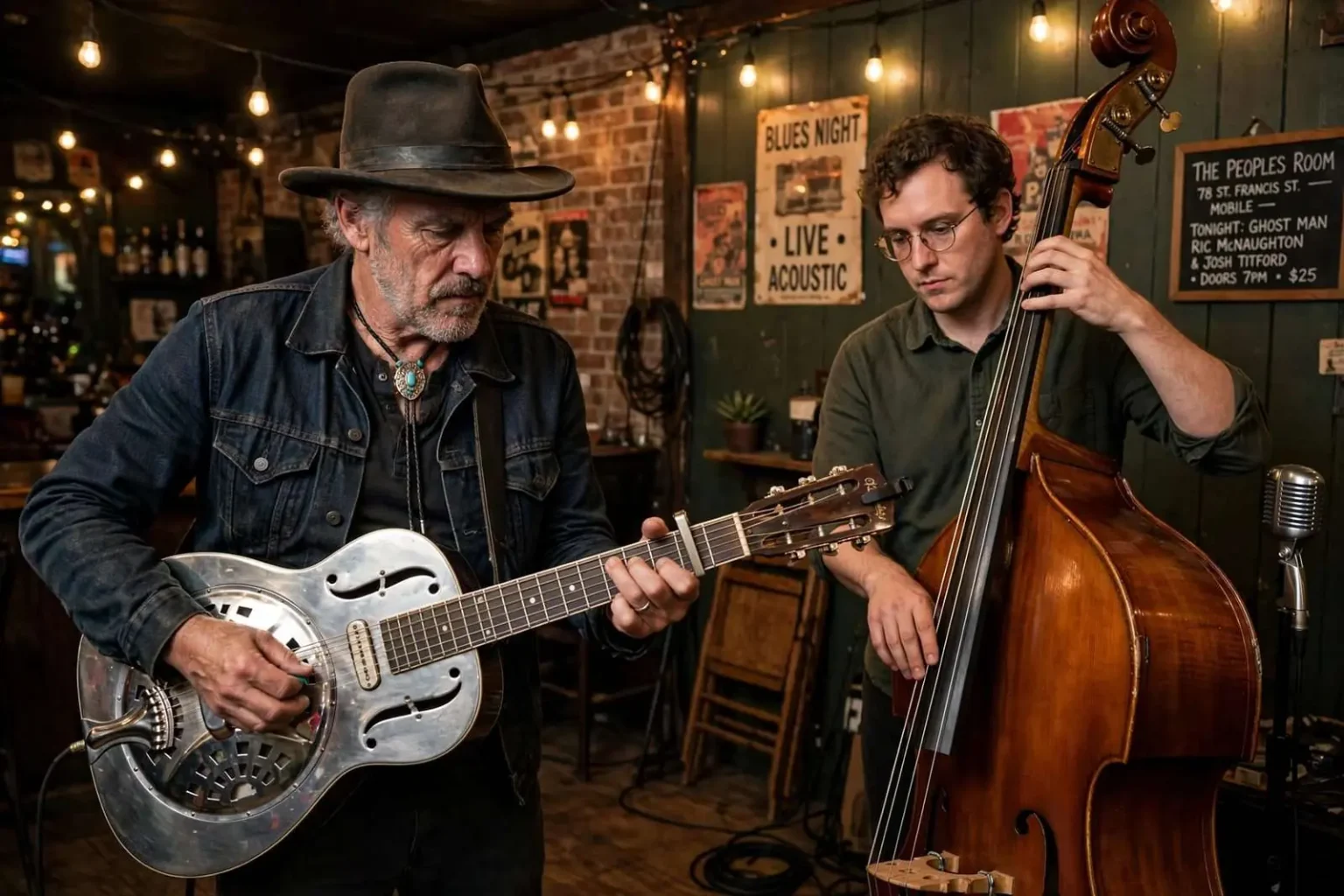
“Ghost Man” Ric McNaughton transforms The Peoples Room of Mobile into a juke joint for an evening of blues.
The Gulf Coast bluesman, known as a “blues shaman,” will be joined by Josh Titford on upright bass for a performance showcasing various blues styles. The pairing pairs McNaughton’s guitar work with the deep, woody pulse of the upright bass, an instrumentation that reaches back to the earliest days of the music — two players, no drums, and the songs carrying the room on their own.
McNaughton has spent years gracing stages at venues along the Gulf Coast, captivating audiences with his fretboard skills and deep knowledge of blues traditions. His upcoming show at The Peoples Room will feature an acoustic guitar and a resonator, offering a different sonic context from his typical performances.
The resonator, with its metal body and bright, cutting voice, was invented in the 1920s precisely to be heard in loud rooms — long before electric amplification — and it remains the signature instrument of prewar Delta blues. In McNaughton’s hands it serves as both a historical artifact and a working tool, a way of summoning the sound of the crossroads era without turning the evening into a museum piece.
The North Mississippi thread
The evening will highlight McNaughton’s love for North Mississippi Hill Country blues, along with styles ranging from Delta to Chicago blues.
Hill Country blues is the tradition most casual listeners know least and hear most. Built on hypnotic, repetitive riffs rather than the twelve-bar chord changes of the Delta style, it leans on rhythm — a fife-and-drum lineage, a one-chord sway, a groove designed for dancing all night. The tradition produced figures such as R.L. Burnside and Junior Kimbrough, whose juke-joint recordings in the 1990s brought the style to national attention, and its influence runs straight through modern blues-rock.
Setting Hill Country material alongside Delta and Chicago blues gives the audience a tour of the music’s geography: the acoustic country styles of the Mississippi Delta, the electrified urban sound that migrated north to Chicago’s South Side, and the drum-forward, trance-like grooves of the hills in between.
A juke joint for a night
The juke joint framing is more than a theme. In the rural South, juke joints were the informal roadhouses — often converted shacks or country stores — where working musicians played for dancing crowds on weekends, and where the blues was performed as dance music first and concert music second. Recreating that atmosphere means keeping the sets loose, the volume honest and the connection with the audience direct.
The phrase carries particular weight in the region’s musical memory. Photographs and field recordings from the juke-joint era — the work of documentarians who followed the music through Mississippi roadhouses in the 1930s, 1940s and beyond — preserved not just the songs but the setting: plank floors, string lights, a pool table pushed to the wall, and a crowd that treated the musician as one of their own. That image has shaped how blues performers think about their rooms ever since, and it is the model McNaughton brings to The Peoples Room.
For McNaughton, whose reputation on the Gulf Coast circuit rests on exactly that kind of intimate, tradition-steeped performance, the format plays to his strengths. The “Ghost Man” persona and the “blues shaman” label he has earned along the coast speak to the same idea: an evening built around presence and atmosphere as much as repertoire, where the audience is drawn into the music rather than merely presented with it.
The venue: The Peoples Room of Mobile
The Peoples Room of Mobile, at 78 St. Francis Street, has made its name as a listening room — a downtown venue built around the idea that audiences should hear the performance rather than talk over it. The room seats its crowds close to the stage, keeps the bar service unobtrusive during sets and books artists whose material rewards attention.
That design makes it a natural fit for a blues evening of this kind. An acoustic guitar and an upright bass carry easily in a room built for listening, and the subtle textures of resonator playing — the slide work, the percussive palm-muted figures, the sustain that a steel-bodied guitar coaxes out of a bottleneck — register at full effect in a space where the audience is quiet enough to hear them.
Downtown Mobile’s St. Francis Street corridor has become one of the city’s cultural anchors, with the venue contributing to a nightlife district that also draws crowds for theater, galleries and the city’s festival calendar. For ticket holders, the setting is part of the experience: a historic downtown block, a listening room that takes the music seriously, and an artist who treats the traditions behind his material with visible respect.
Josh Titford and the upright bass
Josh Titford’s role in the evening should not be undersold. The upright bass — the double bass of swing and early jazz and prewar blues ensembles — provides the bottom end without amplification-heavy support, and it demands a player with both rhythmic precision and restraint. With no drummer on stage, Titford’s pulse is the clock for the evening; when he leans into a hill country groove, the room moves with it.
The guitar-and-upright-bass duo format has deep roots in the music McNaughton will be drawing from. Prewar recordings from the Delta and the hill country frequently paired a guitar with a bass or a second percussion-minded player, and the arrangement remains one of the most demanding and rewarding configurations in roots music: no place to hide, and every nuance audible.
The stripped-down lineup also changes what listeners hear in familiar songs. Figures that would sit under a full band come to the front; the spaces between notes become part of the arrangement. Audiences who have seen larger blues ensembles in the same room will find the duo format a different experience entirely — closer in spirit to the way the music was first played than to its electrified descendants.
McNaughton and Titford have appeared together on Gulf Coast stages before, and their chemistry in the duo format is part of what the evening at The Peoples Room is built to showcase.
Tickets and details
“Ghost Man” Ric McNaughton and Josh Titford perform at The Peoples Room of Mobile, 78 St. Francis Street. Tickets are $25.
At that price point, the show sits in the accessible range for a two-set evening of live music in a downtown venue, and the room’s capacity means advance purchase is a practical safeguard — listening rooms of this size routinely fill for acts with a devoted regional following.
The Gulf Coast blues circuit
McNaughton’s career has unfolded largely on the Gulf Coast circuit — the bars, listening rooms and festivals that stretch from New Orleans through the Mississippi Coast to Mobile and Pensacola. It is a circuit with its own character: audiences who have heard the standards countless times and respond to players who bring something genuine to them, and venue owners who book musicians month after month and know exactly what holds a room.
Blues occupies a particular place in that landscape. The music’s history runs through the region — the Mississippi Delta is a short drive north, New Orleans sits at the western end of the coast, and the port cities along the way absorbed the music as it moved — and Gulf Coast audiences treat a blues night as a local tradition rather than a touring novelty.
Players like McNaughton sustain that tradition. By working the circuit year after year, studying the regional styles rather than flattening them into a single generic sound, and matching his material to rooms built for listening, he has built the kind of following that fills a room like The Peoples Room on a show night.
What the audience can expect
Attendees should expect an evening that moves. A program spanning Delta, Hill Country and Chicago styles does not sit still: the acoustic material runs intimate and spare, the resonator numbers cut sharper, and the hill country grooves build a rhythm that the room can settle into for long stretches. Between songs, the juke-joint framing promises storytelling — the blues has always been a narrative music, and McNaughton’s command of the tradition extends to its history and its characters.
The two-instrument format also leaves room for the improvisational stretch that defines the music. Without a drummer or a horn section to coordinate, a guitar-bass duo can drop to a whisper, hold a groove past its written length or stretch a slide line as long as the room will have it — the kind of flexibility that makes each night on a run of shows its own performance.
For Mobile audiences, it is a rare chance to hear the blues presented in its own vocabulary, in a room built for exactly that, a few blocks’ walk from downtown’s restaurants and bars. Doors and set times are handled through the venue, and ticket holders are advised to arrive early for the seating that best suits a listening-room show.