
Body of Missing Boater Found in Mobile River Four Days After Boat Accident Near Barry Steam Plant
The body of 32-year-old Robert Ellison was recovered from the Mobile River four days after his boat struck an object near the Barry Steam Plant.
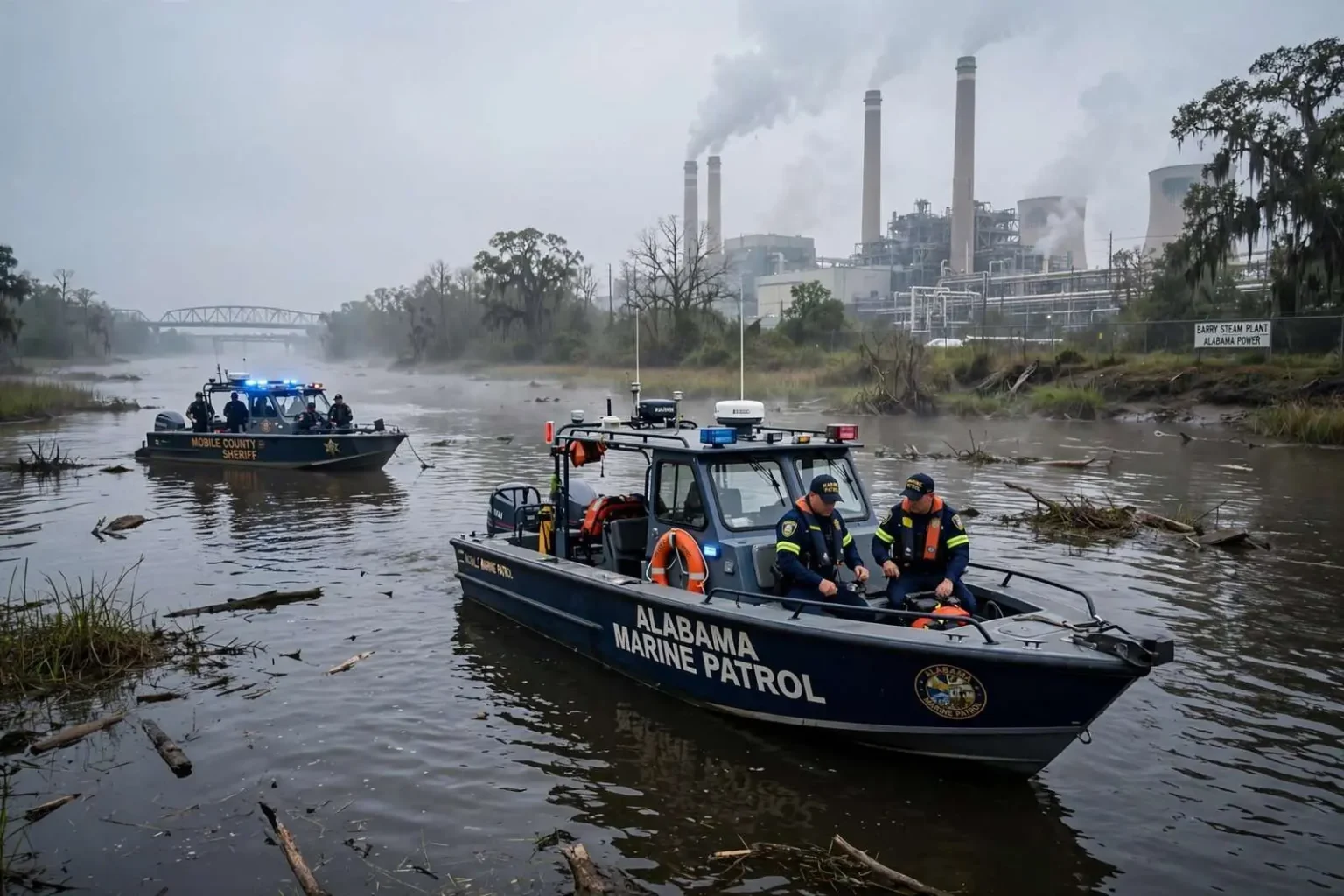
The body of 32-year-old Robert Ellison was recovered from the Mobile River on Sunday, four days after the 14-foot boat he was in struck an object in the water and sank near the Barry Steam Plant in northern Mobile County. The recovery brought to a close a search that stretched more than a dozen miles of river and drew together multiple law enforcement and rescue agencies, several of which battled poor weather and difficult conditions along the way.
According to the Mobile County Sheriff’s Office, flotilla units and state marine police located Ellison downstream near the River Delta Marina, roughly 14 miles from where his vessel went down in the early morning hours. Crews staged their recovery operation just south of the General Wilson Bridge, the crossing that carries U.S. Highway 43 over the river north of Mobile, and worked from that point as the search moved downstream.
How the Accident Unfolded
Sheriff’s officials said Ellison was on the river with his girlfriend and the couple’s dog at around 1 a.m. Thursday when the boat struck something in the water near the Barry Steam Plant, the large Alabama Power generating facility that sits on the banks of the Mobile River. The impact threw all three occupants into the current in a stretch of the river known for its commercial traffic, strong currents, and dark, unlit water after nightfall.
The Alabama Law Enforcement Agency’s Marine Patrol Division responded to reports of the sunken 14-foot vessel early that same morning. Troopers who worked the scene determined that neither Ellison nor his girlfriend was wearing a personal flotation device at the time of the crash, even though several flotation devices were aboard the boat. Under Alabama law, vessels are required to carry one Coast Guard-approved life jacket for every person on board, and children under a certain age must wear them while the vessel is underway, but adults are free to leave theirs stowed, a gap that safety officials say contributes to many of the state’s boating fatalities each year.
The girlfriend managed to swim to shore and pulled herself out on Alabama Power plant property, where employees found her and immediately called emergency responders. Her arrival on the plant grounds set the search in motion, as deputies and marine units began working the stretch of river between the steam plant and the surrounding delta with the information that at least one other person was unaccounted for in the water.
Rescuers also pulled the couple’s dog from the river during the first hours of the response. The animal was returned to family members as the search for Ellison continued, one of the few pieces of good news in an operation that grew more difficult as the days passed.
The Search Along the Riverbanks
Searchers used a drone operated by the sheriff’s office to scan both sides of the river, an approach that has become increasingly common in south Alabama water rescues because it allows teams to cover miles of marshy, hard-to-reach shoreline in a fraction of the time a boat-based sweep requires. The drone located the sunken boat about a quarter-mile downstream from the point of impact, giving crews a better picture of the current and the likely drift path of anything carried away from the wreck.
The section of the Mobile River where the accident occurred sits at the southern edge of the vast Mobile-Tensaw Delta, where the river widens and braids around islands, oxbows, and sloughs before eventually joining with the Alabama River to form the Mobile River’s main channel toward the bay. Recovery work in that environment is complicated by tidal movement, floating debris, and thick shoreline vegetation, all of which can move or conceal a victim in the days after an incident.
Poor weather forced crews to suspend the search at points over the four days, with officials pausing operations when visibility dropped and conditions on the water became unsafe. Each suspension extended the timeline for the family waiting on shore, but sheriff’s officials kept the effort active, rotating in marine units and continuing aerial surveys of the corridor between the crash site and the delta communities downstream.
The Recovery
On the fourth day, units recovered Ellison’s body near the River Delta Marina, a popular launch and dock facility serving boaters who use the upper reaches of the river and the delta. The location, about 14 miles downstream from the Barry Steam Plant, matched what investigators had come to expect given the current and the number of days that had passed since the boat went down.
Officials did not release additional details about the object the boat struck or about the mechanical condition of the vessel. The Alabama Law Enforcement Agency’s Marine Patrol Division typically leads the investigation of reportable boating accidents in the state, examining factors such as speed, lighting, navigation hazards, and impairment, and its findings are generally documented in a report completed after all evidence is gathered.
Sheriff’s officials thanked the assisting agencies and the plant employees whose quick call to emergency services brought the girlfriend to safety. In overnight accidents on dark stretches of river, responders say, the first alert is often the difference between a rescue that begins within minutes and one that begins after daybreak, when currents and conditions have already changed the picture considerably.
After the Recovery
A GoFundMe campaign was later set up to help Ellison’s family cover funeral expenses, a familiar step for south Alabama families facing the sudden cost of a burial after an accident. Campaigns of that kind circulate quickly through local social media groups in Mobile County’s smaller communities, where word of a river accident travels fast and neighbors often organize meals, donations, and assistance for the family left behind.
The death is the kind of accident that marine safety officials in the region warn about each year. The rivers north of Mobile carry a mix of recreational boaters and commercial traffic, and the water around industrial facilities can hide sandbars, partially submerged structures, and floating debris that are nearly invisible at night. Visibility, flotation devices, and travel at reduced speed after dark remain the recurring themes in the safety guidance that the state issues for boaters on the Mobile River and the delta.
For the small communities that line the river in northern Mobile County, the four-day search was a reminder of how quickly a routine night on the water can become a prolonged recovery operation. Crews from multiple agencies returned to their stations after the recovery, and the focus now shifts to the investigation and to the family planning services for a 32-year-old man whose last night on the river ended 14 miles from where it began.
The recovery operation highlighted the cooperative structure that governs water emergencies in Mobile County. The sheriff’s office maintains marine and flotilla units equipped for extended river operations, while the Alabama Law Enforcement Agency’s Marine Patrol Division brings statewide authority over accident investigations on navigable waters. Local fire departments along the corridor and volunteer rescue organizations frequently add boats and manpower, and industrial facilities along the river, like the steam plant where the girlfriend came ashore, often serve as unintentional first points of contact in overnight accidents.
Marine units responding that morning faced a stretch of river that is popular with anglers and recreational boaters but is far from any dense population center. The area near the General Wilson Bridge and the communities downstream toward the delta are served by volunteer and county rescue resources, which means a major search draws personnel from across the county rather than from a single station.
What Investigators Examine
In accidents like this one, marine investigators typically work through a standard series of questions: what the vessel struck, whether navigation lighting was functioning, how fast the boat was traveling, whether alcohol was a factor, and why the occupants were not wearing flotation devices. The answers shape not only the official report but also the safety messaging that agencies release afterward, particularly when a fatality involves a night accident on a commercial waterway.
The fact that several flotation devices were aboard the 14-foot boat but were not in use is a pattern that appears repeatedly in Alabama’s annual boating accident statistics. The state consistently records dozens of boating accidents each year, with a majority of fatalities involving victims who were not wearing a life jacket. Safety campaigns from the Marine Patrol and partner agencies stress that the few seconds required to put a jacket on before an accident is far less than the time a person has to find and don one after being thrown into dark water.
Low water temperatures and current add to the danger in the upper Mobile River. Even in warmer months, a person who falls overboard without a flotation device must swim against a current that can carry them downstream quickly, and the river’s width and shoreline vegetation make it difficult for anyone on shore to spot a swimmer. In this case, the girlfriend’s ability to reach the plant property likely depended on the stretch of bank she washed toward and her own strength in the water.
Community Response in Northern Mobile County
News of the accident spread through the river communities north of Mobile within hours, and residents followed the search’s progress through sheriff’s office updates over the four days. River communities along this corridor are closely tied to the water, and boating accidents involving neighbors resonate widely, prompting an outpouring of support that often continues through the funeral period and beyond.
The GoFundMe established for the Ellison family is the most visible part of that support, but it typically arrives alongside casseroles, help with childcare, and offers from local churches and civic groups. In communities the size of those near the crash site, a four-day search is something residents talk about for years, and the recovery brings a measure of closure even as it confirms the loss.
The girlfriend, who survived the accident and was treated after making it to shore, has not been named publicly in connection with the incident. Authorities have not indicated whether any charges or citations will result from the accident, which remains under investigation by the state’s Marine Patrol Division.
Boating Safety on the Mobile River
The upper Mobile River near the Barry Steam Plant is a working stretch of water. Barges and towboats move through the channel, and the discharge areas around industrial facilities can produce currents and turbulence that surprise recreational boaters. Navigation markers guide commercial traffic, but at night, with no moonlight and few shore lights between communities, the distinction between open water and a submerged hazard can disappear entirely.
State boating safety guidance for the region stresses several practices that are directly relevant to this accident: running at a safe night speed, keeping navigation lights on and working, filing a float plan with someone ashore, wearing flotation devices rather than merely carrying them, and avoiding alcohol on the water. Each of these measures appears in the after-action reviews of accidents like the one that took Ellison’s life, and each is aimed at the narrow window between striking a hazard and ending up in the river.
Four days after the boat went down near the steam plant, the search that began with a call from Alabama Power property ended at a marina 14 miles downstream. The investigation will document what the boat struck and why, but for the family and the communities that followed the search, the immediate fact is the recovery itself, which ends the uncertainty and allows the region to mourn one of its own.